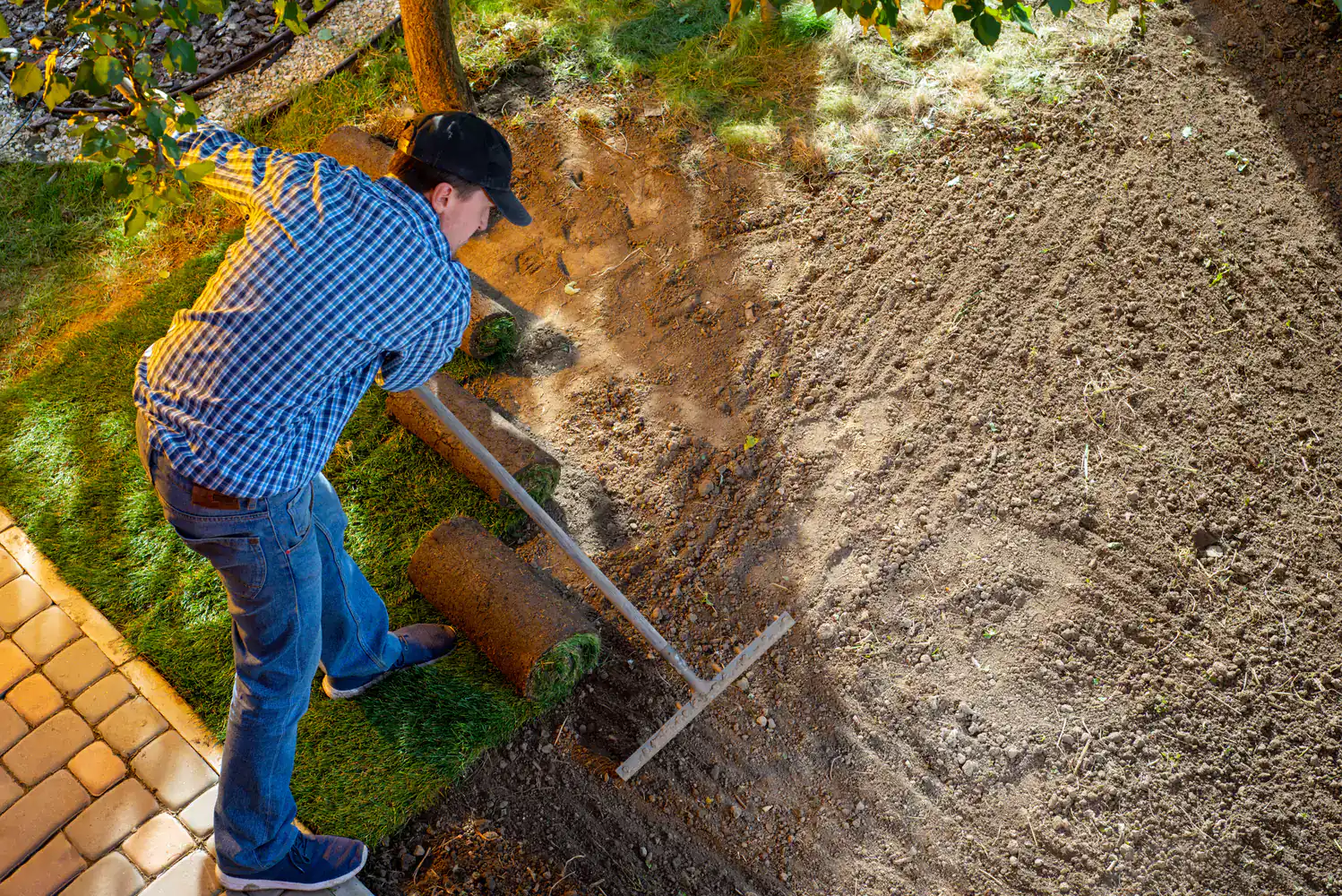
The organic vs synthetic debate misses the point. For most Suffolk County lawns, the real answer is knowing which approach — or combination — your specific soil actually needs.

If you’ve stood in the fertilizer aisle at a hardware store trying to figure out what your lawn actually needs, you’re not alone. The organic vs synthetic question sounds simple until you start reading labels, and then it gets confusing fast. Both options have real merits. Both have real drawbacks. And the generic advice you’ll find online rarely accounts for where you actually live — or what’s actually going on beneath your grass.
In Suffolk County, the soil composition, the climate, and the local regulations all shape what works and what doesn’t. Here’s what you need to know before you make a decision.
The core difference comes down to where the nutrients come from and how fast they reach your grass. Synthetic fertilizers are manufactured to deliver nitrogen, phosphorus, and potassium in water-soluble form — your lawn can absorb them almost immediately, and you’ll typically see greening within three to seven days. Organic fertilizers rely on soil microbes to break down natural materials before nutrients become available, which takes two to three weeks but feeds the lawn more steadily over time.
Neither approach is universally better. Synthetics give you speed and precision. Organics build soil health over time and reduce the risk of nutrient runoff. The right answer depends on what your lawn is starting from, what the soil is missing, and what you’re trying to accomplish this season versus next year.
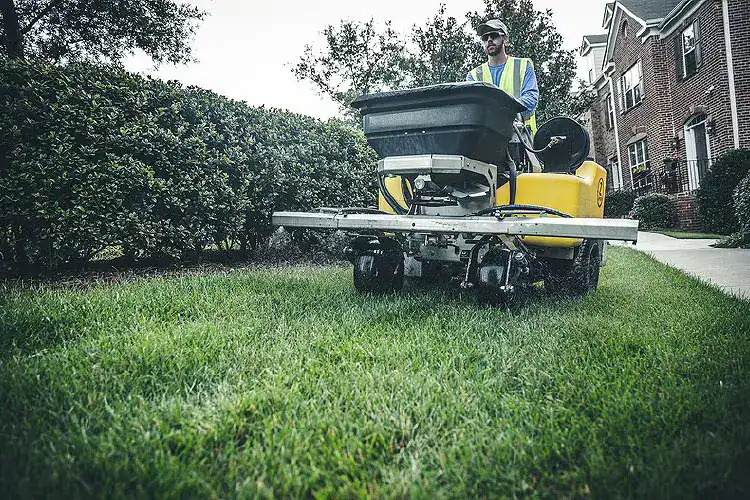
Organic fertilizers don’t just feed your grass — they feed the soil itself. As microbes break down the organic material, they improve soil structure, increase moisture retention, and gradually raise the level of organic matter in the ground. Over time, this creates a healthier root environment where grass can access nutrients more efficiently and withstand stress better.
The catch is that this process takes time. Transitioning a lawn to a fully organic program can take up to three full growing seasons before the soil biology is established enough to deliver consistent results. That’s not a reason to avoid organics — it’s a reason to be realistic about the timeline and to manage the transition strategically rather than just switching cold.
There’s also a temperature dependency that matters a lot in Suffolk County. Organic fertilizers require soil temperatures above 55°F to activate the microbial breakdown that releases nutrients. On Long Island, soil temperatures typically don’t reach that threshold until around mid-April. Apply an organic fertilizer in early spring before that point and it largely just sits there, doing very little. This is one of the reasons a professional approach to organic fertilization isn’t just about choosing the right product — it’s about timing the application to conditions that actually allow it to work.
One more thing worth understanding: organic fertilizers generally have a lower NPK analysis than synthetic options. That doesn’t mean they’re less effective over the long run, but it does mean the visible results come more slowly. If your lawn is patchy, thin, or struggling heading into spring, a purely organic program may not deliver the recovery you’re hoping for within a single season.
Synthetic fertilizers work fast, and that speed is genuinely useful in certain situations — early spring correction, addressing a specific deficiency quickly, or pushing recovery after summer stress. But they come with tradeoffs that are especially relevant for lawns in Suffolk County.
The biggest issue is leaching. Most of Suffolk County sits on sandy, fast-draining soil — Haven Loam is the most common type, and while it’s a solid base for growing grass, its sandy component means water moves through it quickly. Synthetic fertilizers are water-soluble, which is why they work so fast, but it also means they can wash through the root zone before the grass fully absorbs them. On a heavy clay soil, that’s less of a problem. On Long Island’s sandy profiles, it’s a real one. Nutrients that leach past the root zone don’t just go to waste — they eventually reach the groundwater.
That matters more here than it does almost anywhere else in the country. Long Island’s drinking water comes entirely from underground aquifers. There’s no river, no reservoir, no backup supply. Seventeen percent of Upper Glacial public water supply wells in Suffolk County now exceed 6 mg/L nitrogen — up from 9% in 1987. Residential fertilizer runoff is a documented contributor to that trend. Suffolk County passed Local Law 41-2007 specifically in response to it, which is why there’s a hard blackout on all fertilizer applications from November 1 through April 1, why phosphorus is prohibited in lawn fertilizer unless a soil test confirms a deficiency, and why a 20-foot buffer zone from any body of water is legally required.
Applying synthetic fertilizer without accounting for these conditions — the soil drainage, the timing, the proximity to water — isn’t just agronomically questionable. In some cases it’s a legal compliance issue. That’s the reality of doing lawn care responsibly in this county.
Want live answers?
Connect with a Lawn Master of Suffolk expert for fast, friendly support.
The organic vs synthetic debate is often framed as a binary choice, but the most effective approach for most Suffolk County lawns isn’t one or the other — it’s a program that uses both strategically. Fast-acting synthetic inputs can address immediate needs and deliver visible results while organic components work in the background to build soil biology and long-term fertility.
This is the thinking behind the custom blended fertilizer we use at Lawn Master. It’s not an off-the-shelf product. We formulated it specifically for our programs and the conditions we work with on Long Island — not for a national market, not for a warehouse shelf, but for the lawns we actually treat.
Before any fertilizer recommendation makes sense, you need to know what the soil is actually missing. A soil test reveals pH, nitrogen levels, phosphorus status, and organic matter content — the data that determines whether your lawn needs fast-acting correction, long-term organic building, or a combination of both at a specific ratio.
Suffolk County soils are generally slightly acidic, which affects how well grass can absorb nutrients regardless of what fertilizer you apply. If the pH is off, even a well-formulated fertilizer program will underperform. Lime applications often need to come first. Without a soil test, you’re guessing — and guessing with fertilizer on Long Island’s sandy soil often means spending money that washes into the groundwater before your grass ever sees it.
The grass type matters too. Tall fescue, Kentucky bluegrass, and perennial ryegrass are the dominant cool-season grasses in Suffolk County residential lawns. These varieties have different nitrogen needs and different stress tolerances than the warm-season grasses common in other parts of the country. They thrive in spring and fall, struggle in the heat and humidity of a Long Island summer, and have their single most important fertilization window in early September — before the November 1 blackout takes effect. A program that doesn’t account for this timing isn’t just suboptimal. It’s leaving the most valuable application of the year on the table.
When we assess your lawn before recommending a program, the conversation is grounded in actual data — what the soil contains, what it’s missing, what the grass type needs, and what the calendar allows. That’s a fundamentally different starting point than picking a bag off a shelf based on the label.
The cost comparison between organic and synthetic fertilizer is real — synthetic programs typically run $100 to $300 per application, while organic programs run $200 to $500. But that number only tells part of the story. The more relevant question is what it costs to get it wrong.
Fertilizer burn from over-applied synthetic nitrogen is one of the most common DIY lawn care mistakes. The lawn browns instead of greens, and recovery takes weeks. Applying the wrong NPK ratio to a soil that’s already deficient in one nutrient and over-supplied in another creates imbalances that compound over seasons. Applying fertilizer outside the legal window in Suffolk County isn’t just a waste — it’s a violation. And spending two or three years on a pure organic program without the soil biology to support it is a long, expensive way to eventually get results a properly designed hybrid program could have delivered in the first season.
We’ve been treating lawns in Suffolk County since 1987. That’s 37 years of working with Haven Loam, Plymouth loamy sand, the coastal properties near the Great South Bay, the North Shore lots in Smithtown and Port Jefferson, the heavier soils further east toward Riverhead. The pattern recognition that comes from that kind of long-term local experience isn’t something a training course can replicate. We know what works here because we’ve watched what happens when it doesn’t.
Our team consists of licensed pesticide professionals — not seasonal laborers supervised from a distance. NYS DEC certification requires a 30-hour training course, written examinations, and ongoing continuing education. The person treating your lawn carries legal accountability for their work and the knowledge to back it up. That distinction matters when the choice between organic, synthetic, or a custom blend isn’t obvious from the surface — and it rarely is.
Organic and synthetic fertilizers each have a real place in a well-designed lawn care program. Organics build long-term soil health. Synthetics deliver fast, targeted correction. The question isn’t which one is better in the abstract — it’s which approach, or which combination, is right for your specific lawn given your soil type, grass variety, the time of year, and the regulatory environment you’re operating in.
For most Suffolk County homeowners, the answer is a professionally designed program that uses both intelligently — not a generic package applied uniformly to every lawn on the route.
If your lawn hasn’t been responding the way you’d hoped, or you’ve never had it properly assessed, reach out to us at Lawn Master. We’ll take it from there.
Summary:
Article details:
Share: