Brown circles taking over your lawn? Here's what's actually causing them — and how to fix it the right way before fall closes the window.
You walk outside one morning and there it is — a brown circle in the middle of your lawn that wasn’t there last week. By the time you notice it, it’s already spread. That’s how brown patch works. It moves fast, it looks bad, and it has a frustrating habit of coming back every summer if the underlying problem isn’t addressed.
The good news is that Suffolk County lawns can fully recover from brown patch damage. The key is knowing what you’re actually dealing with, treating it correctly, and timing your overseeding to give new grass the best possible chance to root before winter. That’s what this page covers.
Not every brown patch in your lawn is a disease problem. Drought stress, grub damage, and dog spots can all look similar at first glance. But brown patch disease has some telling characteristics that set it apart — and across Suffolk County, it’s by far the most common culprit behind those spreading circular patches that show up in July and August.
The key is the shape and the border. Brown patch (*Rhizoctonia solani*) typically creates distinct, roughly circular patches with a darker, water-soaked ring around the outer edge — sometimes called a “smoke ring” — that’s most visible in the early morning when dew is still on the grass. You may also notice a white, cobweb-like mycelium across the blades at dawn. Grub damage, by contrast, pulls up like a loose carpet because the roots are severed. Drought stress tends to affect the whole lawn more uniformly rather than in tight circles.
Suffolk County’s geography creates near-ideal conditions for brown patch to develop every summer. The county sits between Long Island Sound to the north and the Atlantic Ocean to the south, which means summer humidity levels here are consistently elevated. Brown patch activates when nighttime temperatures stay above 70°F and leaf wetness persists for more than 10 hours — and that combination happens regularly across Suffolk County from late June through August.
The grass types most common on Long Island lawns — tall fescue, Kentucky bluegrass, and perennial ryegrass — are also the species most susceptible to this particular fungus. So the climate, the humidity, and the grass varieties all point in the same direction. If your lawn has had brown patch before, the fungus didn’t disappear when the weather cooled. It went dormant in the soil as microscopic resting bodies called sclerotia, which can survive in the ground for years and re-emerge when conditions are right again.
This is why homeowners in Patchogue, Port Jefferson, and communities across the North Shore and South Shore often deal with the same brown circle problem summer after summer without ever fully solving it. Treating the visible damage without addressing the fungal presence in the soil is like fixing the symptom and ignoring the cause. The lawn looks better for a while, then the same circles show up again the following July.
What makes this even more frustrating is how quickly the disease spreads. Once active, it can move across a lawn in a matter of days, especially during a stretch of hot, humid nights. By the time most homeowners realize what they’re looking at, the fungus has already been working for days beneath the surface.
This is where a lot of homeowners lose time and money. They head to the hardware store, pick up a granular fungicide product, apply it, and wait. Sometimes the spreading slows a little. Often it doesn’t. And the brown circles are still there.
Consumer fungicide products are real — they’re not snake oil — but they have meaningful limitations compared to what a licensed professional can apply. The active ingredients available in retail products tend to be weaker, have shorter residual periods, and typically rely on a single mode of action. That last point matters more than most people realize. Using the same fungicide chemistry repeatedly allows the fungus to develop resistance, making future applications even less effective.
In New York State, the commercial-grade fungicides that actually control brown patch effectively are restricted-use products. You can’t buy them at a hardware store. Purchasing and applying them legally requires a NYSDEC Commercial Pesticide Applicator certification — and any business applying these products for hire must be registered with the state. That’s not a technicality. It’s the difference between a product that provides real, lasting protection and one that barely scratches the surface.
When we treat a lawn for brown patch, we use commercial formulations with rotating active ingredients specifically to prevent resistance buildup. Timing matters too — the most effective approach starts with preventive applications in late May or early June, before disease pressure peaks, rather than trying to catch up once the lawn is already damaged. Properly timed preventive treatment typically runs $300 to $500 for the season. Reactive treatment after brown patch has established — plus the fall renovation work to repair the damage — routinely costs $800 to $1,500 or more, and the lawn often doesn’t fully recover until the following spring at the earliest.
Want live answers?
Connect with a Lawn Master of Suffolk expert for fast, friendly support.
Once brown patch has run its course, you’re left with bare or severely thinned areas where the grass simply didn’t survive. Those spots don’t fill in on their own quickly — and if you leave them alone, weeds move in fast. Overseeding is how you reclaim that ground, but the timing and the process matter enormously.
The first step is making sure the fungus is under control before any seed goes down. Overseeding into active disease — or into soil that still has high fungal pressure — leads to poor germination and thin, weak regrowth. Treat first, wait a few days, then seed. Skipping that step is one of the most common reasons DIY overseeding attempts fail.
Fall is the right window, and in Suffolk County that means late August through mid-October. Soil temperatures are still warm enough to support germination — typically in the mid-50s to low 60s — while air temperatures have dropped enough to reduce stress on new seedlings. Cool-season grasses like tall fescue and Kentucky bluegrass establish well under these conditions, and the increased rainfall that typically comes with September and October helps keep the seedbed consistently moist during the critical first few weeks.
There’s a practical deadline to keep in mind: aim to complete overseeding by October 15th on Long Island. New grass needs enough time to develop at least some root structure before the ground gets cold. Seed put down after that window may germinate slowly or not at all, leaving you in the same position come spring.
Spring overseeding is possible, but it’s a distant second choice for Long Island lawns. The window is narrow — you’re racing against warming temperatures, crabgrass competition, and the need to avoid pre-emergent herbicides, which prevent all seed germination, not just weeds. Fall gives new grass an entire season to establish before it faces its first summer of heat and disease pressure.
New York’s fertilizer blackout (November 1 through April 1) also creates a hard stop on fall programs. Once that date hits, fertilizer applications are prohibited under state law, with fines up to $1,000 for violations. That’s another reason timing your fall overseeding program correctly — and working with someone who knows these regulations — matters for Suffolk County homeowners.
Overseeding without preparing the soil first is one of the most common reasons homeowners get disappointing results. Seed scattered over compacted ground, heavy thatch, or hard, dry soil simply doesn’t germinate well. The seed needs contact with actual soil — not thatch, not surface debris — to absorb moisture and begin growing.
Core aeration solves this. The process pulls small plugs of soil from the ground, which relieves compaction, reduces thatch, and creates channels where seed can settle into direct contact with the soil below. Turf researchers consistently recognize aeration followed by overseeding as the most effective combination for filling bare spots and revitalizing thinning lawns. It’s not just about poking holes — it’s about fundamentally improving the environment the seed is going into.
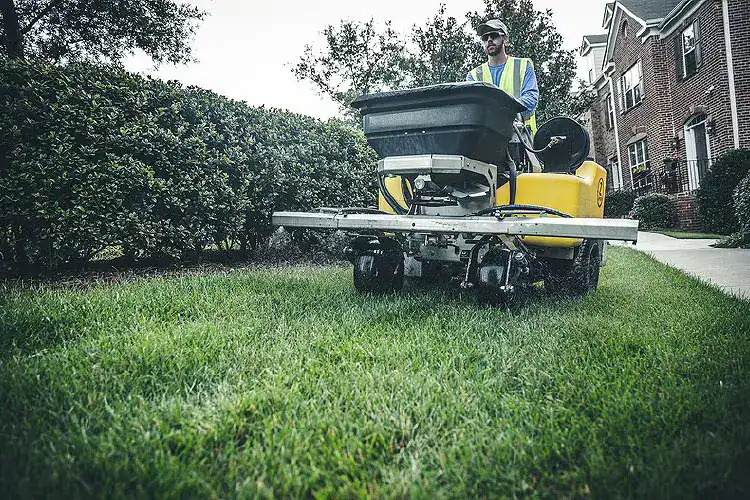
Equipment matters here more than most people expect. We use hydraulic seeders rather than standard broadcast spreaders, and the difference in results is real. Hydraulic seeders deliver seed more uniformly across the surface and achieve better seed-to-soil contact than broadcast equipment — which is especially important in damaged areas where the soil surface may be uneven after disease and thatch removal. Better contact means better germination, and better germination means a fuller, faster recovery.
Seed selection is the other piece that often gets overlooked. Not all grass seed performs the same in Suffolk County conditions. We match seed varieties to your existing lawn — the right species for your sun and shade conditions, with improved disease resistance ratings where available. Planting a variety with better resistance to *Rhizoctonia solani* doesn’t make your lawn immune to brown patch, but it does raise the threshold at which the disease gains a foothold. Combined with a preventive fungicide program the following summer, the right seed selection is part of a longer-term strategy, not just a one-time patch job.
After seeding, starter fertilizer goes down — formulated specifically to support root development in new grass rather than push rapid top growth. High-nitrogen fertilizer at this stage can actually increase brown patch risk in the following season, so the composition of what you apply matters. We use a custom-blended fertilizer made specifically for our programs, calibrated for the soil chemistry common across Suffolk County’s sandy loam soils. It’s not an off-the-shelf product, and that distinction shows in the results.
Brown patch is a fixable problem, but it rarely fixes itself — and the window to do it right is specific. Identify the disease accurately, stop the fungus before it spreads further, prepare the soil properly, seed at the right time with the right varieties, and follow up with a prevention program so you’re not starting over again next summer. That’s the full picture.
The homeowners who end up most frustrated are the ones who treated the visible damage without addressing what caused it, or who waited too long and missed the fall overseeding window entirely. Getting ahead of it — even mid-recovery — puts you in a much better position heading into spring.
We’ve been treating Suffolk County lawns since 1987, and brown patch recovery is something we handle from diagnosis through full restoration. If your lawn took a hit this summer and you want a straight assessment of where things stand and what it will take to bring it back, reach out to us. No guesswork, no generic programs — just an honest look at your specific lawn and a plan that actually fits it.
Summary:
Article details:
Share: