
Hear from Our Customers
Kyllinga doesn’t spread because you’ve been neglecting your lawn. It spreads because the conditions in your yard moisture, drainage, soil are exactly what this weed is built for. Lake Grove sits just north of Lake Ronkonkoma, and the glacially influenced soils in this area hold more moisture than the sandier parts of Suffolk County further east. If your yard has a low spot, a shaded corner, or an irrigation zone that runs a little heavy, kyllinga will find it before you do.
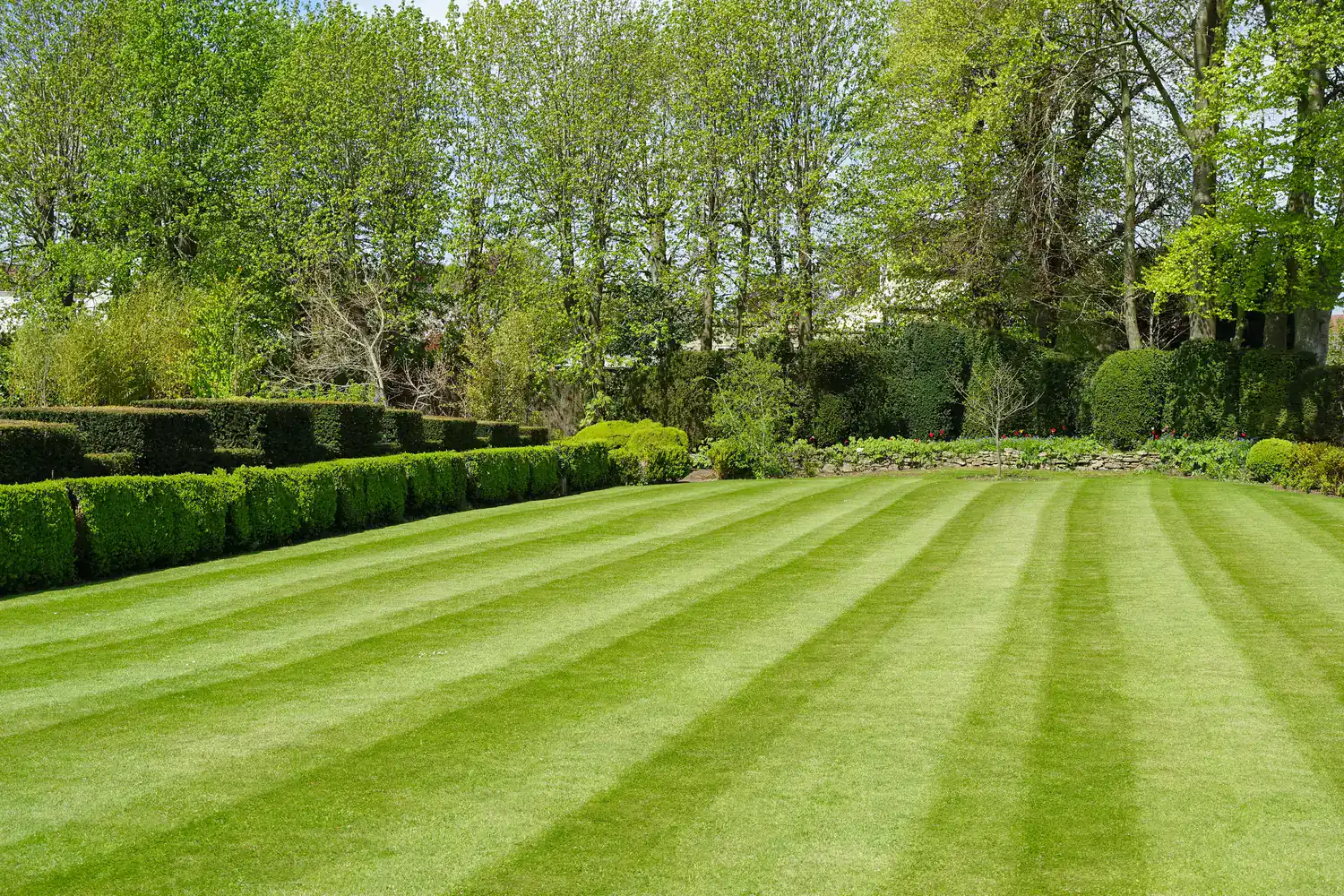
Once a proper sedge control program is underway, you stop chasing patches and start seeing your actual lawn come back. The dense, mat-forming growth that was crowding out your turf gives way to the grass that was always supposed to be there. Thin areas fill back in. The lawn looks consistent again instead of blotchy and uneven.
For Lake Grove homeowners with in-ground irrigation which is common at this price point the results also come with a clearer picture of what’s been feeding the problem. A lot of kyllinga infestations in this area trace back to irrigation zones that are running longer than they need to. Getting the weed under control is one part of the answer. Understanding what let it take hold in the first place is the other.
We’re a locally owned lawn care specialist based in Port Jefferson Station, serving homeowners throughout central Suffolk County including Lake Grove. This isn’t a franchise operation running generic programs out of a regional call center. We’re a company built specifically around lawn health, with the licensing and product access to back it up.
When it comes to kyllinga control in Lake Grove, that distinction matters more than it might seem. The herbicides that actually work on sedge professional-grade products like halosulfuron-methyl and sulfentrazone require a NYSDEC Commercial Pesticide Applicator License (Category 3a) to purchase and apply. We hold that license. Most general lawn companies don’t, which is why so many Lake Grove homeowners have already been through a treatment cycle that didn’t do much.
From the older bungalow-era neighborhoods off Middle Country Road to the planned developments near the Smith Haven Mall corridor, we work across the full range of Lake Grove properties and our approach is never one-size-fits-all. For pest protection, we provide Lake Grove flea and tick control.
It starts with identification. Kyllinga is frequently misidentified as nutsedge, and while they’re related, they’re not the same weed. Kyllinga grows lower and denser, forms a tighter mat, and has a distinct round seed head that nutsedge doesn’t. Treating one like the other produces incomplete results. Before anything gets applied to your lawn, the weed gets properly identified because the right diagnosis is what makes the rest of the program work.
From there, the treatment schedule is built around the plant’s actual growth cycle. In Lake Grove’s climate, kyllinga is actively growing from late May through late August. That’s the window when sedge-active chemistry works. Applications made outside that window or as a single one-and-done spray won’t eliminate an established infestation. A proper program means two to three targeted applications spaced four to six weeks apart, timed to when the plant is metabolically active and most vulnerable.
Every application in Lake Grove is also made in full compliance with Suffolk County Local Law 41-2007, which establishes pesticide-free buffer zones around public drinking water wells throughout the county. Given Lake Grove’s proximity to the Lake Ronkonkoma basin and the sensitivity of Long Island’s sole-source aquifer, that’s not a formality it’s something we check before every job. After treatment, the conversation shifts to what comes next: filling in the bare areas the kyllinga left behind and adjusting any irrigation or drainage conditions that helped it establish in the first place.
Ready to get started?
The program starts with a property walkthrough to identify all active kyllinga sites not just the obvious lawn patches, but also landscape beds, low-drainage areas, and transition zones where the weed commonly spreads from ornamental plantings into turf. In Lake Grove’s older neighborhoods, where smaller lots often have integrated bed-to-lawn layouts, that bed-to-lawn pathway is one of the most common reasons an infestation keeps coming back after partial treatment.
Treatment uses professional-grade sedge-active herbicides applied during the active growing window. The program is structured as a multi-application sequence not a single visit because kyllinga’s rhizome network survives a single application and regenerates. Two to three treatments spaced across the season is the standard, and the timing is adjusted based on what’s actually happening in your lawn, not a fixed calendar date.
Post-treatment, the focus shifts to restoration. Kyllinga crowds out desirable turf, and once it’s gone, those areas need to be overseeded and supported to close back in. Our background in lawn renovation means that step is part of the conversation from the beginning not an afterthought. For Lake Grove homeowners in Sachem district neighborhoods where lawn appearance reflects real community standards, that full-cycle approach is what separates a solved problem from a temporarily managed one.
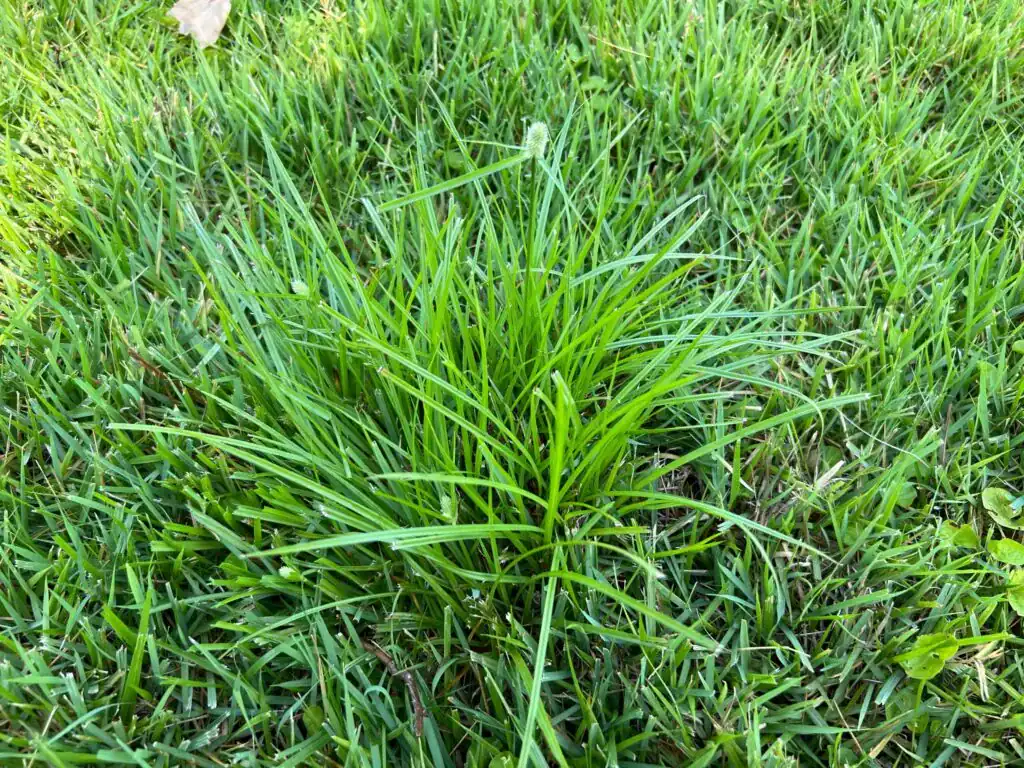
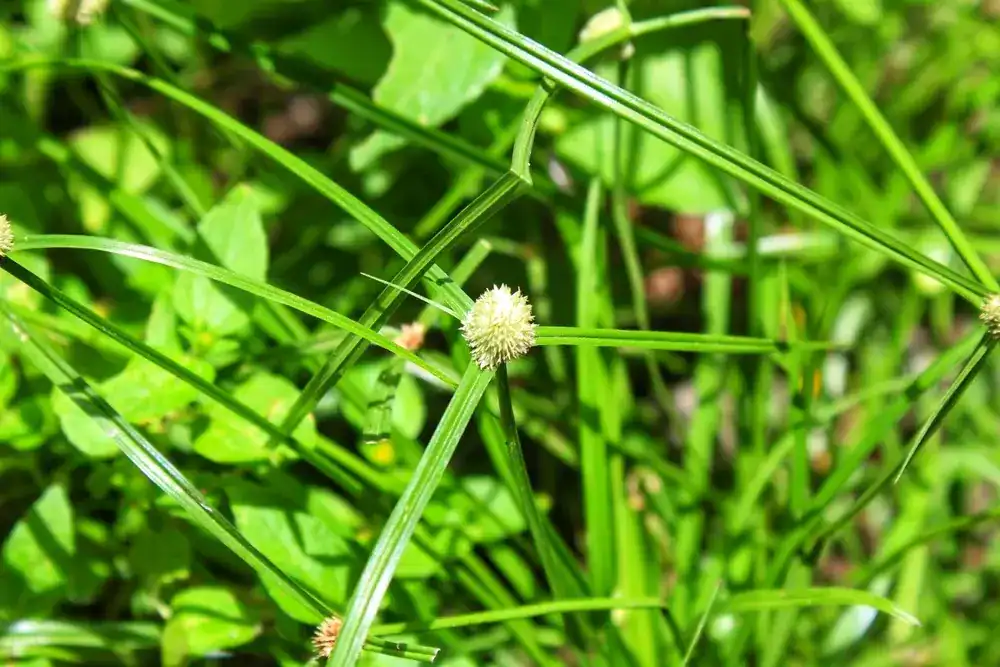
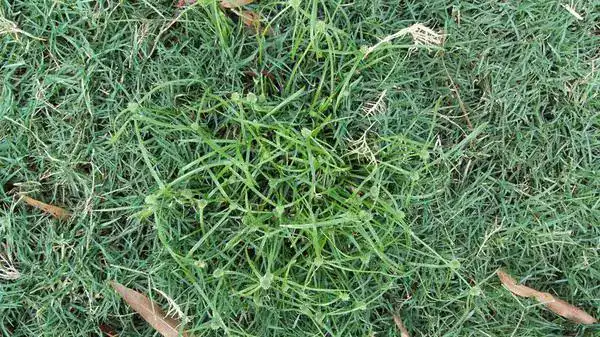
Kyllinga is one of the more commonly misidentified weeds in Suffolk County lawns, partly because it looks so much like grass at a glance. The clearest visual cues are the growth habit and the seed head. Kyllinga forms a dense, low-growing mat lower to the ground than nutsedge and stays a noticeably darker, shinier green than the surrounding turf. When it produces a seed head, it’s round and compact, usually white or pale green. Nutsedge, by comparison, grows taller and has a more elongated, brownish or yellowish seed cluster.
If you’re seeing a patch that stays green and keeps spreading even when the rest of your lawn slows down in summer heat, and nothing you’ve applied has made a dent in it, kyllinga is a strong candidate. The three-sided stem a classic sedge trait is another giveaway. Roll the stem between your fingers; if it has distinct edges rather than being round, you’re looking at a sedge, not a grass. A proper diagnosis before any treatment is applied is the most important first step, and it’s where we start every Lake Grove job.
This is probably the most common frustration we hear from homeowners in Lake Grove who’ve already tried to handle kyllinga on their own. Standard broadleaf herbicides the products most widely available at home improvement stores have no meaningful activity against sedges. Kyllinga is not a broadleaf weed. It’s a sedge in the Cyperaceae family, and it requires a completely different class of chemistry to control.
The products that actually work halosulfuron-methyl (sold commercially as Sedgehammer) and sulfentrazone (sold as Dismiss) are professional-grade formulations that require a NYSDEC Commercial Pesticide Applicator License to purchase and apply. The retail versions of these products, where they exist at all, are significantly diluted and don’t perform the same way. This isn’t a gap in how hard you tried it’s a product access issue that only a licensed commercial applicator can bridge. That’s one of the core reasons professional kyllinga control in Lake Grove produces results that DIY attempts consistently don’t.
For an established kyllinga infestation, a single application is not enough and any company that tells you otherwise is either oversimplifying or underselling the biology of the problem. Kyllinga spreads through an underground rhizome network, and that network survives a single herbicide application even when the visible plant tissue is damaged. The rhizomes regenerate new growth, which is why so many homeowners see the weed come back weeks after a one-time treatment.
A properly structured program requires a minimum of two to three targeted applications spaced four to six weeks apart during the active growing season. In Lake Grove’s climate, that window runs from late May through late August. Applications made outside that range when the plant isn’t actively growing are significantly less effective because the plant isn’t metabolizing the herbicide the way it needs to for the chemistry to work. The number of treatments also depends on the severity and spread of the infestation. A small, recently established patch may respond well to two applications. A larger infestation that’s been spreading for a season or two typically needs three, followed by overseeding to restore the areas the kyllinga was occupying.
Yes and this is one of the most underappreciated drivers of kyllinga in Lake Grove specifically. Kyllinga thrives in moist, poorly drained, or chronically overwatered soil. It doesn’t need standing water; it just needs soil that stays consistently damp. In-ground irrigation systems are common in Lake Grove’s homeownership market, and when they’re running longer or more frequently than the lawn actually needs, they create exactly the conditions kyllinga exploits.
This matters even more in Lake Grove because the area’s proximity to Lake Ronkonkoma means the underlying soils already tend to hold more moisture than the drier, sandier parts of eastern Suffolk County. Add an irrigation system that’s slightly over-scheduled, and you’ve created a very hospitable environment for sedge. The fix isn’t to stop watering it’s to calibrate the system to actual evapotranspiration needs and address any drainage issues that are keeping specific areas wet longer than they should be. A kyllinga control program that only treats the weed without addressing the moisture conditions that fed it is solving half the problem. We look at both.
It’s not just your yard. Kyllinga has been expanding its range northward into the Northeast over the past decade, and Long Island with its humid summers, irrigated suburban lawns, and the specific soil conditions found in communities like Lake Grove sits squarely in that expansion corridor. Penn State Extension and Rutgers NJAES have both documented this northward spread, and lawn care professionals throughout Suffolk County have been seeing more of it in recent years.
Part of what makes it feel sudden is that kyllinga can go unnoticed for a season or two, especially in early establishment when the patches are small and easy to dismiss as irregular grass growth. By the time most homeowners notice it clearly usually mid-to-late summer, when the kyllinga stays dark green and continues spreading while the surrounding cool-season turf slows down in the heat it’s already been building for a while. The weed can also produce up to 5,000 seeds per plant per year, so a moderate infestation left untreated for one season can cover significantly more ground the following year. Catching it early is always less work and less cost than dealing with it after it’s had time to spread.
This is an important question that doesn’t get asked enough. Once kyllinga is eliminated, it leaves behind thin or bare areas where it was crowding out the desirable turf. If those areas aren’t addressed, they become open ground and open ground in a Lake Grove lawn is an invitation for kyllinga to re-establish, or for other opportunistic weeds to move in before the grass does.
The right follow-through is overseeding those areas with appropriate turf varieties for Long Island’s climate, combined with any soil prep needed to give the seed a good environment to establish. For homeowners in Lake Grove’s Sachem district neighborhoods, where lawn appearance is tied to genuine community standards and property values in the $500,000–$700,000+ range, skipping this step means the job isn’t really finished. Our background in lawn renovation means restoration is built into the program from the start not something you have to separately schedule or request. The goal is a dense, healthy lawn that closes back in and resists reinfestation, not just a yard where the kyllinga used to be.
Useful Links
Other Services we provide in Lake Grove