
Hear from Our Customers
Most Lake Grove homeowners have been maintaining their lawns for years fertilizing, watering, overseeding bare patches and still end up with the same results every fall. The grass looks thin. Water pools near the driveway after rain. Nothing seems to stick. That’s not a fertilizer problem. That’s compaction.
The Ranch homes, Cape Cods, and Split-levels that make up most of Lake Grove’s housing stock were built between the 1950s and 1980s. That means the soil underneath your lawn has been walked on, mowed over, and compressed for decades without any real mechanical relief. When soil compacts, it forms a dense layer that blocks air, water, and nutrients from reaching the root zone. You can apply the best fertilizer on the market, and it still won’t perform the way it should because it can’t get through.
Core aeration removes that barrier. By pulling small plugs of soil out of the ground, we open direct channels that let everything your grass needs actually reach the roots. Fertilizer uptake improves significantly. Water absorbs instead of running off toward the street. Overseeded areas finally germinate at real rates because the seed has somewhere to go. For a Lake Grove lawn that’s been compacted for 40 or 50 years, this isn’t a luxury service it’s the reset the soil has needed for a long time.
Lawn Master is a Suffolk County lawn care company not a franchise, not a national chain routing your call to whoever’s available. The crews serving Lake Grove are the same crews working across the Route 347 corridor through Smithtown, Nesconset, Stony Brook, and Port Jefferson. This is our backyard. We know the soil. We know the timing. We know what works on Long Island lawns and what doesn’t.
Every applicator on a Lawn Master crew holds a New York State DEC pesticide applicator license. That’s a legal requirement for commercial lawn care in New York and one that a surprising number of informal operators in the Lake Grove and central Suffolk County market either don’t hold or can’t prove. When you hire Lawn Master, you’re working with licensed professionals who are accountable under state law, not just someone who showed up with a machine.
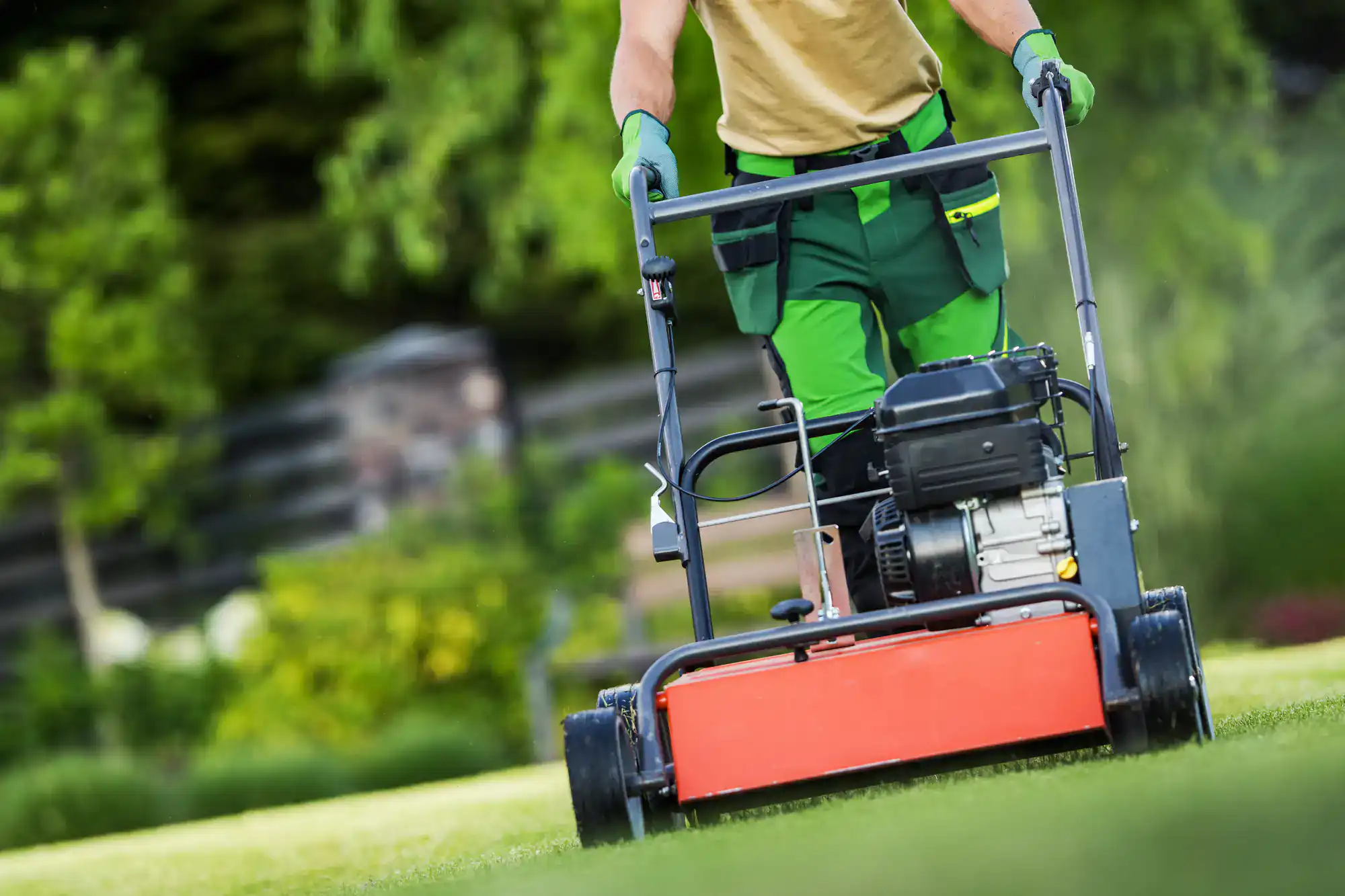
The equipment matters too. We use a commercial hydraulic aerator not the drum-style rental unit sitting at the Lowe’s on Middle Country Road. That distinction is explained in more detail below, but the short version is this: the machine we bring to your property does something a rental aerator physically cannot. We also offer flea and tick treatment in Lake Grove for active families.

Before anything touches your lawn, the timing matters. For the tall fescue, Kentucky bluegrass, and perennial ryegrass that grow on most Lake Grove lawns, the fall window late August through October is when aeration and overseeding produce the best results. Soil temperatures are still warm enough for germination, the heat stress of summer is fading, and the grass has a full cool-season stretch ahead to establish and thicken before winter. Miss that window, and you’re waiting another year.
On the day of service, we run a commercial hydraulic aerator across your lawn. Unlike a drum aerator with fixed tines, the hydraulic machine adjusts pressure dynamically driving cores 3 to 4 inches into the soil rather than the 1.5 to 2 inches a standard machine can manage on compacted Suffolk County ground. That depth difference is what separates a service that works from one that doesn’t. On the dense, decades-compacted soils common throughout Lake Grove’s postwar neighborhoods, the actual compaction layer sits deeper than a rental machine ever reaches.
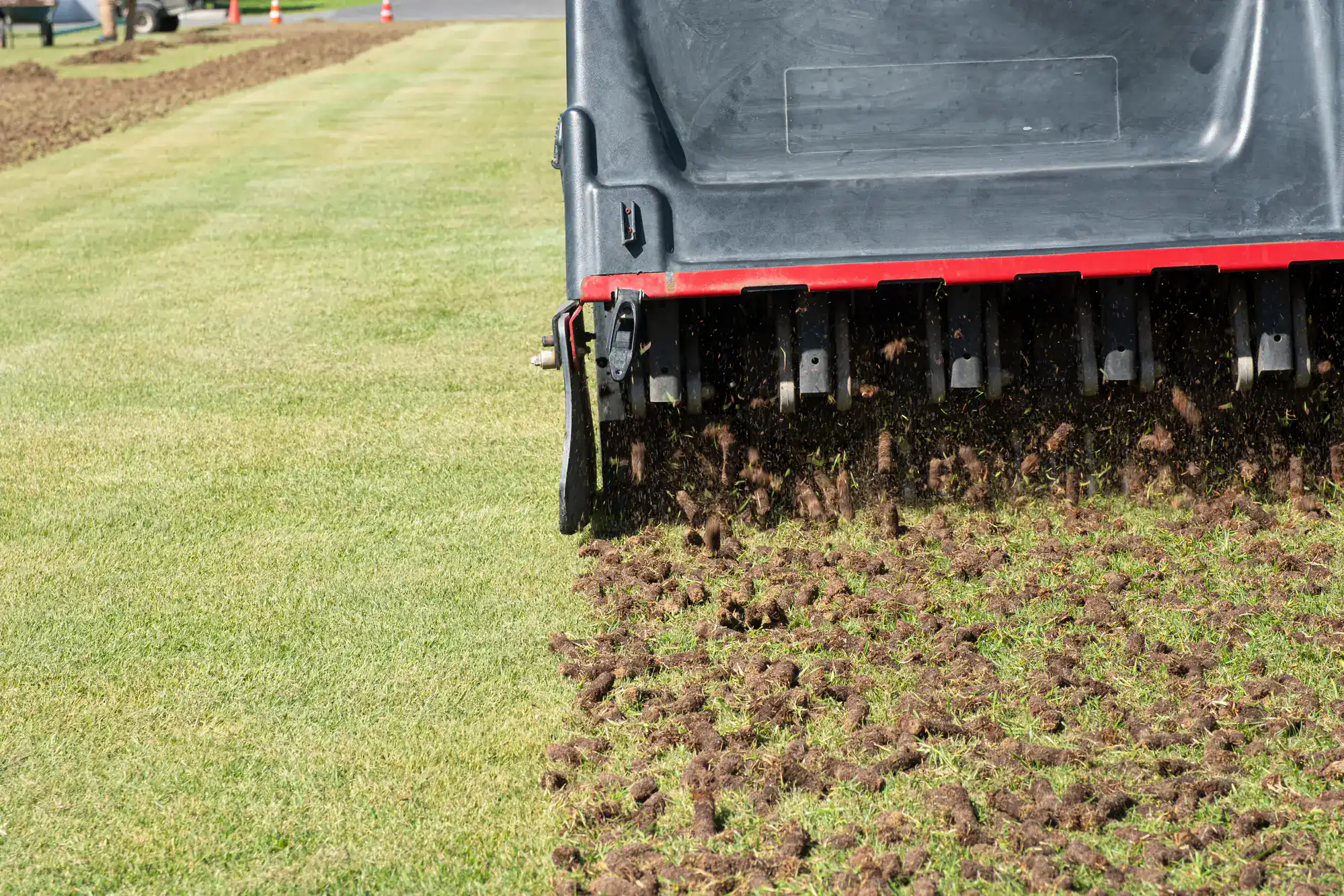
After the pass, your lawn will have soil cores scattered across the surface. Leave them there. Those plugs break down over 2 to 4 weeks, returning organic matter and soil microbes back into the turf while helping to decompose the thatch layer that’s been blocking water and nutrients. If overseeding is part of the service, seed goes down immediately after aeration dropping directly into the open holes where it makes soil contact and germinates at a much higher rate than seed applied to un-aerated ground. The lawn will look rough for a few weeks. Then it won’t.
Ready to get started?
The single biggest difference between Lawn Master and most other aeration providers in the Lake Grove area comes down to the equipment. A hydraulic aerator isn’t just a better version of the machine you can rent it operates on a fundamentally different level. It reads resistance as it moves and adjusts tine pressure to maintain consistent depth regardless of soil variation. On a Lake Grove lawn with uneven compaction denser near the driveway, looser in a shaded corner that adaptability matters. Every pass produces real decompression, not just surface disruption.
Core aeration pairs naturally with overseeding and fertilization, and we offer all three as part of a coordinated fall program. Aeration first, seed into the open holes, fertilizer applied where it can now actually reach the root zone. For homeowners already running a fertilization program that hasn’t been delivering results, this sequence is usually the explanation. The fertilizer was never the problem. The compacted soil blocking it was.
Our applicators are also fully compliant with New York State’s fertilizer laws, including phosphorus restrictions that apply across Suffolk County. For Lake Grove homeowners near water resources or environmentally sensitive areas, that compliance isn’t a footnote it’s part of what separates a licensed professional from an operator who just showed up with equipment. Every service is performed by NYS DEC licensed applicators who understand both the science and the regulations behind what we’re applying.
The optimal window for core aeration in Lake Grove is late August through October. This is when soil temperatures are still warm enough to support seed germination if you’re overseeding, but air temperatures have dropped enough to reduce heat stress on new grass. Cool-season grasses tall fescue, Kentucky bluegrass, and perennial ryegrass, which are the dominant species on most Long Island lawns respond best to aeration during this fall period because they enter their strongest growth phase as summer fades.
The catch is that this window fills up fast across central Suffolk County. We schedule fall aeration appointments early in the season, and availability closes before most homeowners realize the timing is right. If you’re thinking about it, the right move is to request an estimate now rather than wait until mid-October when the calendar is full and the germination window is nearly closed. A Lake Grove lawn that misses the fall window has to wait a full year for the next opportunity.
Core aeration removes a physical plug of soil from the ground creating a genuine open channel for air, water, and nutrients to reach the root zone. Spike aeration pushes a solid tine into the soil and displaces it sideways without removing anything. The problem with spike aeration is that the soil around each spike hole actually becomes more compacted as it gets pushed aside, not less. You end up with a lawn that looks like it was treated but hasn’t actually been decompressed.
On the type of compacted suburban soils common throughout Lake Grove where decades of foot traffic, mowing equipment, and wet/dry cycles have built up dense layers beneath the surface spike aeration doesn’t solve the problem. It can make it slightly worse. Core aeration is the only method that physically removes material and creates real space for the root zone to expand. If a company is offering spike aeration as a cost-saving alternative, that’s worth asking about before you book.
This is one of the most common frustrations among homeowners in Lake Grove, and the answer is almost always the same: compacted soil. When the surface layer of your lawn is dense and compacted, fertilizer applied on top of it has nowhere to go. It sits on the surface, gets washed off by the next rain, and never reaches the root zone where it would actually do something. You can apply premium fertilizer on a schedule all season long and see minimal results if the soil underneath is blocking it.
Core aeration solves this directly. By opening channels through the compacted layer, it gives fertilizer, water, and oxygen a direct path to the roots. Studies consistently show that fertilizer uptake efficiency improves substantially after proper core aeration some estimates put it at 30 to 40 percent. For homeowners who have been running fertilization programs and wondering why their Lake Grove lawn still looks the same year after year, aeration is almost always the missing piece. It’s not that the fertilizer is wrong. It’s that the soil isn’t letting it work.
You can but the results on compacted Long Island soil are usually disappointing, and a lot of homeowners who try it end up concluding that aeration doesn’t work. What actually happened is that the rental equipment didn’t penetrate deep enough to matter. The drum-style aerators available at the Lowe’s on Middle Country Road typically drive tines 1.5 to 2 inches into the soil under good conditions. On compacted Haven Loam the dominant soil type across central Suffolk County that often means the tines are barely scratching the surface layer and never reaching the actual compaction zone, which can sit 3 inches or more below grade.
Our hydraulic aerator adjusts tine pressure dynamically and consistently reaches 3 to 4 inches of penetration, even on dense, compacted ground. That’s the depth where real decompression happens. Beyond the equipment gap, there’s also the labor factor: aerating a typical Lake Grove lawn properly takes time and multiple overlapping passes. Most homeowners who rent equipment do one pass and call it done. A professional service is thorough by design, not by accident.
Doing them together in the same fall service is the most effective approach and the timing is the reason why. When you aerate first and overseed immediately after, the grass seed falls directly into the open holes left by the aerator. That puts the seed in direct contact with soil, which is exactly the condition it needs to germinate. Seed dropped on un-aerated, thatch-covered ground has a much harder time establishing because it can’t make that soil contact. Germination rates are measurably higher when overseeding follows aeration in the same session.
For Lake Grove lawns with bare patches, thin turf, or areas that have struggled to fill in despite repeated overseeding attempts, this sequence is usually the explanation for why previous efforts didn’t work. The seed wasn’t the problem the surface it landed on was. Pairing aeration and overseeding in the fall window, when soil temperatures are still warm and cool-season grasses are entering their active growth phase, gives new seed the best possible start before winter arrives.
Leave them on the lawn. The cores pulled out during aeration are not waste they’re part of how the service works. Each plug contains soil, organic matter, and beneficial microbes from below the surface. As they break down over the next 2 to 4 weeks, they return that material to the top of the turf, which helps decompose the thatch layer that’s been acting as a barrier between your lawn’s surface and its root zone. Raking them up removes that benefit entirely.
The lawn will look rough for a few weeks after aeration holes visible, cores scattered across the surface. That’s normal and expected. Within a month, the holes close as the grass fills in and the plugs dissolve, and the lawn that looked temporarily disrupted will be noticeably healthier than it was before. For Lake Grove homeowners who haven’t had professional aeration before, this is the part of the process that surprises people most. The short-term appearance is the trade-off for a lawn that actually responds to fertilizer, holds water properly, and grows thicker going into the following season.
Useful Links
Other Services we provide in Lake Grove