
Hear from Our Customers
Most lawns in Dix Hills don’t struggle because the homeowner isn’t paying attention. They struggle because the program treating them wasn’t designed for them. The soil here is genuinely variable sandy in some areas, clay-heavy in others and a one-size-fits-all fertilizer schedule doesn’t account for that. Sandy soil leaches nutrients before roots can absorb them. Clay soil compacts, restricts drainage, and turns applications into runoff. When the program is built around your actual conditions, the results are measurably different.
The rolling terrain that gives Dix Hills its name also creates real microclimates within a single property. A north-facing slope behind your house holds moisture longer and runs a higher risk of fungal disease in summer. A south-facing section near the street dries out faster and shows heat stress earlier. Mature oaks and maples common on the wooded lots throughout the hamlet create dense shade that thins turf and changes what nutrients are needed and when. These aren’t details a national chain is going to account for when they schedule your next visit from whoever happens to be available.
What a properly managed fertilization program actually produces is a lawn that holds its color through summer, resists crabgrass and weed pressure in the spring, recovers quickly after the heat breaks in September, and looks like it belongs on a property that someone genuinely cares about. In a community like Dix Hills, that’s not vanity it’s maintenance of a real financial asset.
We’ve been serving Dix Hills and Suffolk County since 1987. That’s nearly four decades of Long Island soil, Long Island summers, and the specific timing requirements that come with operating under Suffolk County’s fertilizer regulations. We’re not figuring out Dix Hills we’ve been working here long enough that some of the current homeowners weren’t alive when our first truck rolled out.
Every job is handled by a licensed pesticide professional not a seasonal hire, not a rotating technician who doesn’t know your property. New York State requires that any company applying pesticides for hire employ certified commercial applicators, and we hold that standard on every visit. That matters legally, and it matters practically when something on your lawn needs to be diagnosed, not just treated on a schedule.
Our fleet is fully wrapped, our equipment is commercial-grade hydraulic, and our fertilizer is a custom-blended formula made specifically for Lawn Master not purchased off a distributor’s shelf. From the Half Hollow Hills neighborhoods to the wooded lots near the Hamlet Golf and Country Club, the properties in Dix Hills have real complexity. Our program reflects that.
It starts with understanding what you’re actually working with. Dix Hills properties vary more than most homeowners realize soil type, sun exposure, shade from mature tree canopy, slope, drainage, existing turf species, current weed and pest pressure. Before we build a program, those conditions are factored in. That’s what “custom-tailored” actually means here it’s not a marketing phrase, it’s the only approach that works on a property with real variability.
From there, applications are timed to what the lawn needs and what Suffolk County law allows. The fertilizer season runs April through October applications between November 1st and April 1st are prohibited under Suffolk County’s fertilizer ban, and we operate in full compliance with that. Spring applications focus on slow-release nitrogen and pre-emergent crabgrass control, timed to soil temperatures rather than a fixed date on a calendar. Summer applications are conservative and strategic, because pushing aggressive growth during July heat on Long Island creates more problems than it solves. Fall is the most important window early September through mid-October is when cool-season grasses build the root depth and carbohydrate reserves that carry them through winter and fuel a strong spring recovery.
Core aeration, where needed, is done with hydraulic equipment that pulls deeper plugs than the tow-behind units most operators use. Overseeding follows aeration in the fall window when soil temperatures still support germination. If the lawn needs more than a standard program grub damage, persistent thin spots under heavy tree canopy, or areas that have never established properly we address those issues directly rather than papering them over with fertilizer.
Ready to get started?
The fertilizer we use isn’t available at a hardware store or through a national distributor. It’s a custom-blended formula developed specifically for Lawn Master formulated to deliver nutrients in the right form and at the right release rate for Long Island’s soil chemistry. For Dix Hills properties with sandy soil, that means a formula that doesn’t leach through the profile before roots can absorb it. For clay-heavy areas, it means a product that works with the soil structure rather than sitting on top of it.
Every application is made by a NYSDEC-licensed pesticide professional. That’s not a differentiator we invented it’s a legal requirement in New York State that a significant number of operators quietly ignore. On application days, yellow warning flags are posted on the property as required. Neighbors within 150 feet receive advance notice for certain spray applications, per the Neighbor Notification Law that applies across Nassau and Suffolk Counties. For a community with Dix Hills’ documented environmental awareness the hamlet holds Long Island’s highest electric vehicle ownership rate by ZIP code these aren’t just legal boxes to check. They reflect how we actually do the work.
Beyond standard fertilization, we handle lawn restoration and full new lawn installs from seed, grub control, crabgrass and broadleaf weed management, core aeration with hydraulic equipment, and nutgrass and bentgrass control for the persistent problems that most generalist operators misidentify. If your lawn needs more than fertilizer, the full scope of what’s required is available through a single company that already knows your property.
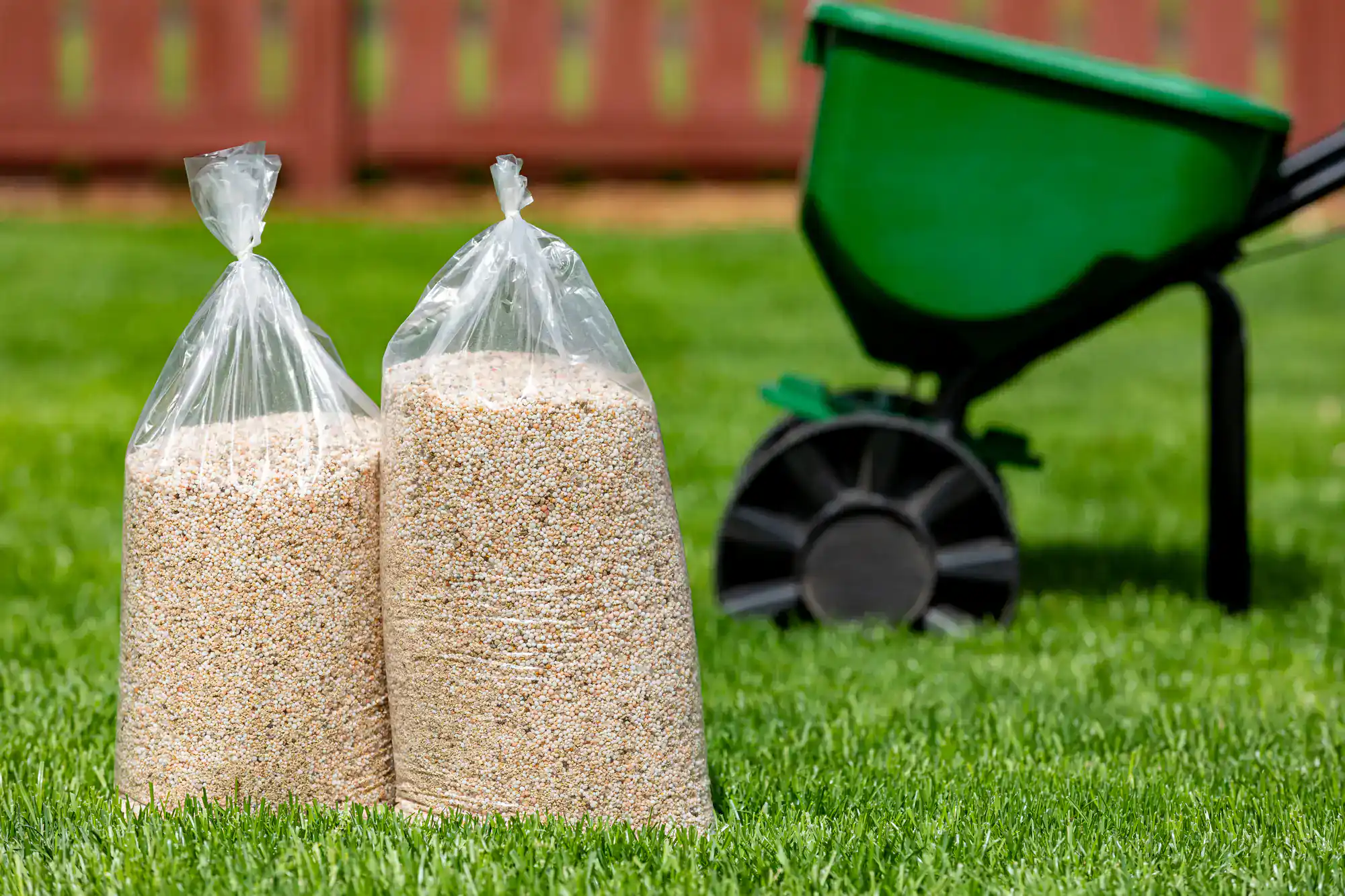
The two most important windows for lawn fertilization in Dix Hills are early spring and early fall. In spring, you’re looking at mid-April once soil temperatures consistently hold above 55°F that’s also the window for pre-emergent crabgrass control, which needs to go down before soil temps hit 55–60°F at the two-inch depth. Apply too early and it breaks down before crabgrass germinates. Apply too late and the seeds have already sprouted.
Fall is actually the more critical season for cool-season grasses like the Kentucky bluegrass and fescues common in Dix Hills. Early September through mid-October is when the grass is actively building root depth and storing the energy reserves it needs to survive winter and green up strong in spring. Summer applications exist but should be conservative pushing heavy nitrogen during July and August on Long Island creates heat stress and increases the risk of fungal disease like brown patch, which thrives in the humid conditions that come with a typical Long Island summer.
One hard rule in Suffolk County: no fertilizer applications between November 1st and April 1st. That’s county law, and violations carry a $1,000 fine. Any company offering fertilization during that window is operating illegally.
Patchy results after regular fertilization usually come down to one of a few things and most of them are soil or site issues that a standard program isn’t addressing. In Dix Hills specifically, the soil variability is a real factor. Sandy areas drain nutrients faster than roots can absorb them, so a section of your lawn may be getting fertilized on paper but starving in practice. Clay-heavy areas compact under foot traffic and equipment, which restricts water and air movement and limits how effectively any fertilizer can actually reach the root zone.
Dense shade from mature trees and Dix Hills has a lot of them creates another common cause of persistent patchiness. Turf growing under heavy oak or maple canopy is competing with shallow tree roots for water and nutrients, receiving significantly less light than the label on any fertilizer bag assumes, and often needs a different grass variety altogether to perform well. Fine fescues handle shade far better than Kentucky bluegrass, for example, but if the wrong grass is in the wrong spot, no fertilization program will fix that.
Grub damage is also frequently misread as a fertilization problem. If you have brown, spongy patches that lift easily from the soil in late summer or fall, that’s grub activity the root system has been severed, and fertilizer won’t restore turf that has no roots left to feed. That requires a separate diagnosis and treatment.
A professionally managed fertilization program isn’t just fertilizer applied on a schedule. It’s a sequence of applications timed to what your specific lawn needs at each point in the season pre-emergent weed control in spring, conservative slow-release nitrogen through summer, heavier root-building applications in fall, and adjustments based on what’s actually happening on your property rather than what a national calendar says should be happening.
The product itself matters too. We use a custom-blended fertilizer formulated specifically for Lawn Master not a bag from a commercial distributor. The nutrient ratios, release rates, and formulation are built around Long Island’s soil chemistry, which means it’s calibrated for the conditions your lawn is actually growing in rather than an average that doesn’t exist. That distinction shows up in the results over a full season.
As for whether it’s worth the cost for most Dix Hills homeowners, the math is straightforward. You’re maintaining a property worth well over a million dollars. The cost of a professional fertilization program is a fraction of what a season of neglect, a grub infestation, or a crabgrass takeover costs to correct. Restoration is always more expensive than maintenance.
Yes, and they’re specific enough that they catch a lot of homeowners and even some lawn care operators off guard. Suffolk County prohibits fertilizer applications between November 1st and April 1st this applies to both homeowners and commercial applicators, and the fine for violations is $1,000. The intent is to protect Long Island’s drinking water aquifer from nutrient runoff during the dormant season when grass isn’t actively absorbing what’s applied.
There’s also a phosphorus restriction on commercial fertilizers. Products containing more than 0.67% phosphorus can only be legally applied if you’re establishing a new lawn or a soil test confirms a deficiency. Suffolk County’s soil including the sandy profiles common in parts of Dix Hills typically doesn’t require high-phosphorus inputs, so compliant operators are already working within this framework by default.
If you’re hiring a company to apply pesticides which includes most weed control and grub control products that company must be registered with the NYSDEC and employ at least one certified commercial pesticide applicator. On application days, yellow warning flags must be posted on the property, and neighbors within 150 feet are entitled to 48-hour advance notice for certain spray applications. These aren’t optional courtesies they’re legal requirements under New York State and Suffolk County law.
The honest answer is that most lawns in Dix Hills benefit from both but for different reasons. Fertilization feeds the grass. Aeration fixes the conditions that prevent fertilizer from reaching the roots in the first place. If your soil is compacted which is common in clay-heavy areas of Dix Hills, on high-traffic sections of a lawn, or anywhere heavy equipment has operated nutrients, water, and air can’t penetrate the root zone effectively regardless of what product you apply or how often.
A simple test: push a screwdriver into your lawn. If it goes in easily, compaction probably isn’t the primary issue. If you have to force it, or if it barely penetrates, compaction is likely limiting your results. Core aeration done with hydraulic equipment that pulls deep, clean plugs relieves that compaction, improves infiltration, and creates the ideal conditions for fertilizer to actually do its job.
Fall is the best window for aeration and overseeding in Dix Hills. Mid-August through late September gives cool-season grass seed enough time to germinate and establish before soil temperatures drop below the germination threshold. Pairing fall aeration with overseeding and a proper fertilization application is the single most effective combination for improving a struggling lawn and the results from one good fall program are often more visible than an entire season of fertilization alone.
The most consistent complaint about national lawn care chains and it comes up constantly from homeowners in Dix Hills is the rotating technician problem. A different person shows up every visit. They don’t know the shaded corner that always struggles, the sandy patch near the driveway that dries out first, or the area where grubs hit two summers ago. They follow a standardized schedule, apply a standardized product, and move on to the next stop on the route. The program is built for an average lawn, not yours.
We’ve been operating in Suffolk County since 1987. The licensed professionals who treat your lawn know what was applied last visit, understand how your property’s soil and topography affect results, and can recognize when something needs to change rather than just continuing a program that isn’t working. Our fertilizer is a custom blend made specifically for Lawn Master not a product pulled from the same distributor supplying every other company in the region.
For Dix Hills homeowners who have been through a cycle with a national chain and ended up with a lawn that looked worse at the end of the season than the beginning, the difference isn’t subtle. It’s the difference between a company that services your lawn and one that actually knows it.
Useful Links
Other Services we provide in Dix Hills