Hear from Our Customers
Yaphank sits at the edge of the Long Island Pine Barrens, and the soil here is about as sandy and nutrient-poor as it gets on Long Island. That’s not an excuse it’s just the reality of what you’re working with. Fertilizer applied to this kind of ground doesn’t stay in the root zone the way it would on heavier soils further west. It leaches down fast, which is why a lot of Yaphank homeowners have put money into lawn programs and walked away wondering why nothing changed.
When the fertilizer is formulated for this specific soil chemistry and applied by someone who actually knows the seasonal timing for cool-season grasses on Long Island the results are different. You get color that holds through summer, density that fills in the thin spots, and a lawn that doesn’t look exhausted by July. That’s not a promise about magic products. It’s just what happens when the approach matches the conditions.
There’s also something worth saying about where you live. Yaphank sits above the same sole-source aquifer that supplies drinking water to millions of Long Islanders. What gets applied to your lawn can move through that sandy soil quickly. Working with licensed professionals who follow Suffolk County’s fertilization regulations isn’t just a quality issue it’s the responsible call for this community.
We’ve been working in Suffolk County since 1987. That’s not a tagline it’s just a fact that matters when you’re hiring someone to treat your lawn. We were operating in this county before Country Pointe Meadows existed, before the Central Pine Barrens Protection Act was passed, and before most of the competitors showing up in your search results were in business.
Every job gets a licensed pesticide professional not a seasonal hire, not a supervised laborer. The fertilizer we use isn’t sourced from a commercial distributor. It’s a custom blend we’ve formulated specifically for Long Island’s soil conditions. Five fully wrapped trucks run routes throughout Suffolk County, and the level of expertise on each job reflects someone who has been doing this work for decades, not someone who started last spring.
If you’ve dealt with a national chain before and a lot of Yaphank homeowners have you already know what it feels like when a company promises results and sends someone who doesn’t know your property. That’s the gap we fill.
It starts with understanding what your lawn is actually dealing with. Yaphank properties vary more than people expect a shaded lot near the Carmans River has completely different needs than a sun-exposed courtyard in Country Pointe Meadows or a newer construction home on a cleared sandy lot near the William Floyd Parkway corridor. Before anything gets applied, the conditions of your specific lawn drive the program.
From there, the seasonal timing matters as much as the product. On Long Island, cool-season grasses like Kentucky bluegrass, perennial ryegrass, and fescue the dominant types in Yaphank grow hardest in spring and fall. The first fertilization window opens around mid-April once soil temperatures hit 55°F. Summer applications require a lighter touch to avoid burning heat-stressed grass. The most important window of the year is late August through late September, when aeration and overseeding paired with a fall fertilizer application can genuinely transform a lawn’s density before winter.
One thing that’s non-negotiable in Suffolk County: no fertilization between November 1st and April 1st. That’s county law, and violations carry a $1,000 fine. Every application we schedule and execute stays within the legal window, with licensed professionals who know the phosphorus restrictions, the neighbor notification requirements, and every other regulation that applies here. You don’t have to think about any of that that’s our job.
Ready to get started?
We don’t run a one-size-fits-all program. The fertilizer blend is custom-formulated for Long Island soil not a generic granule pulled from a wholesale supplier. The program we build for your lawn accounts for your grass type, your sun and shade exposure, your drainage pattern, and any existing problem areas like thin spots, weed pressure, or bare patches. That’s what custom-tailored actually means in practice.
Beyond fertilization, we bring hydraulic aerators and seeders to jobs that need them commercial-grade equipment that pulls deeper plugs than the tow-behind units most smaller operators use. In Yaphank’s fast-draining sandy soil, getting air, water, and nutrients down to the root zone is the whole challenge. Deeper aeration makes a real difference here. For lawns that are past the point of a tune-up, full lawn restoration and new lawn installation from seed are also available so you’re not stuck hiring a second company when the situation calls for a fresh start.
Nutsedge and bentgrass are two of the most persistent problems in Yaphank-area lawns, especially on properties near the Carmans River corridor where moisture levels stay higher. Standard broadleaf weed control doesn’t touch either of them. Our licensed professionals know the difference and have the right products and approach for both. If previous companies have told you the nutsedge will “take time” to go away, you’ve been dealing with the wrong program.
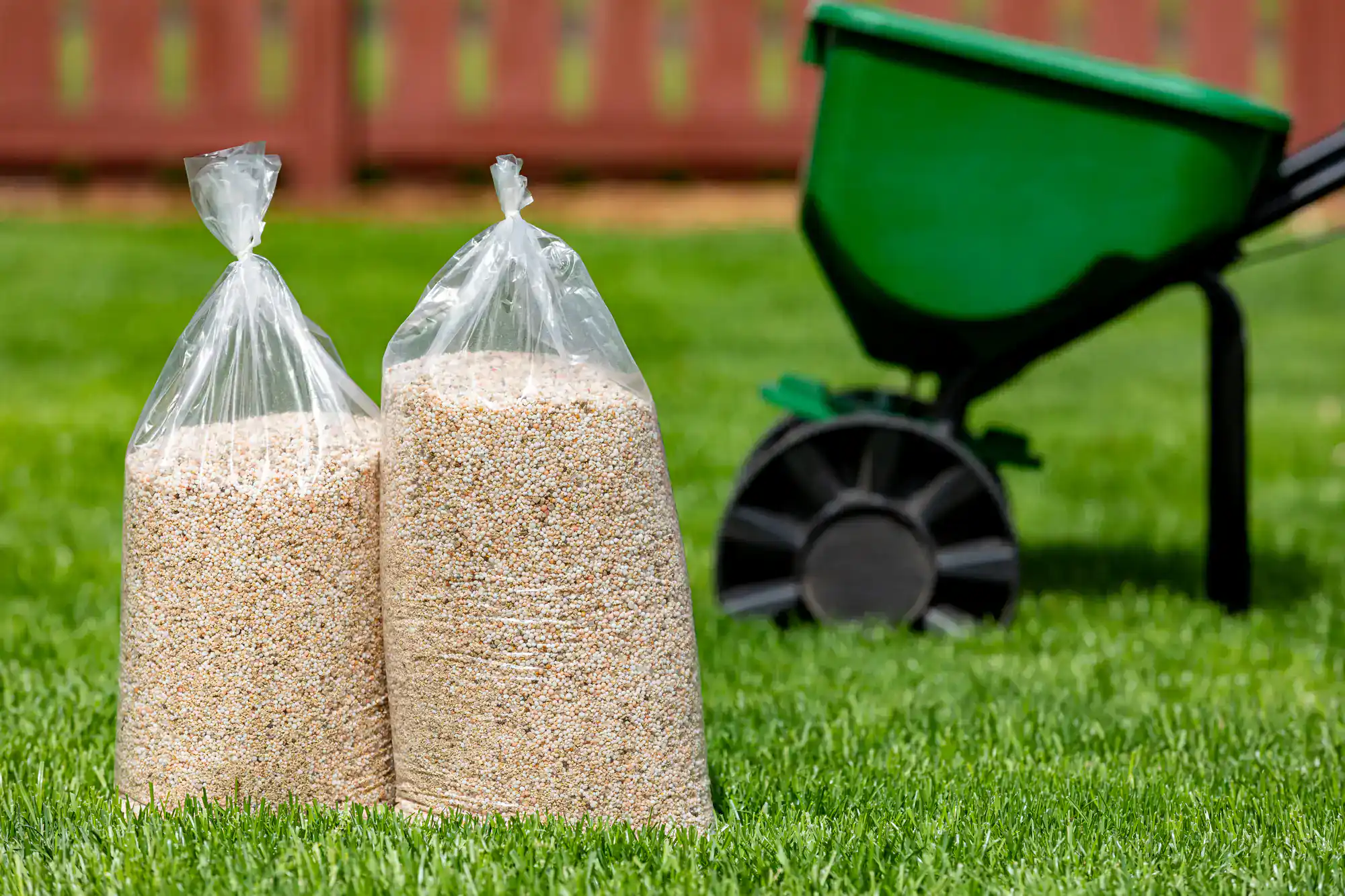
The best windows for lawn fertilization in Yaphank follow Long Island’s cool-season grass calendar. The first application typically happens in mid-April, once soil temperatures reach around 55°F and the grass is actively growing. Summer applications need to be handled carefully cool-season grasses like fescue and bluegrass slow down under heat stress, and over-fertilizing during that period can burn the lawn rather than help it.
The most impactful window of the year is early September through late October. Fall fertilization strengthens root systems before winter dormancy, and when it’s paired with core aeration and overseeding in late August through September, it’s the single best investment you can make in your lawn’s long-term density and health. One hard limit to know: Suffolk County law prohibits all lawn fertilization between November 1st and April 1st. That regulation exists specifically to protect groundwater quality which matters more in Yaphank than almost anywhere else in Suffolk County, given the hamlet’s location above the Pine Barrens aquifer recharge zone.
The most common reason is the soil itself. Yaphank’s ground is sandy, fast-draining, and low in organic matter typical of the Pine Barrens region it borders. When you apply a standard bag of fertilizer to this kind of soil, a significant portion of the nutrients leach below the root zone before the grass can absorb them. You’re essentially fertilizing the subsoil, not the lawn. You’re spending money and effort with very little visible payoff.
The other factor is timing. Most homeowners fertilize in spring because that’s when the lawn looks bad after winter. But for cool-season grasses, fall is actually the more critical window. A September fertilization in Yaphank, especially one paired with core aeration to open up channels in that compacted sandy soil, will do more for your lawn’s density and color than three spring applications combined. If you’ve been fertilizing and not seeing results, the issue is usually product calibration, timing, or both not the lawn itself.
Yes, and the fine is $1,000. Suffolk County’s fertilizer law prohibits lawn fertilization between November 1st and April 1st. The law was put in place to protect groundwater quality specifically to reduce nitrogen runoff into the aquifer and local waterways during the months when grass isn’t actively growing and can’t absorb nutrients. In Yaphank, that concern is especially relevant because the hamlet sits within the Central Pine Barrens region, which is a primary recharge area for Long Island’s sole-source aquifer.
The risk for homeowners isn’t just accidental DIY over-fertilization in late fall. It’s hiring a company that doesn’t follow the rules. Some operators particularly unlicensed or seasonal crews aren’t tracking application dates the way a licensed professional is required to. If a company applies fertilizer to your property outside the legal window, you could be on the receiving end of a complaint or fine even if you didn’t know it happened. Working with NYSDEC-licensed professionals who operate within the full regulatory framework is the straightforward way to avoid that entirely.
In New York State, any business applying pesticides which includes most weed control and some fertilizer products for hire is legally required to have at least one NYSDEC-certified commercial pesticide applicator on staff. Getting certified requires passing the Core General Standards exam plus a category-specific exam covering ornamental and turf applications. Recertification requires 24 continuing education hours every three years. That’s a meaningful bar, and not every company clears it.
A labor-only crew can mow, edge, and blow. What they can’t legally do is apply regulated pesticide products and in practice, many do it anyway, without the training to know correct rates, application buffers near water bodies, or the specific restrictions that apply in environmentally sensitive areas like Yaphank. The Carmans River runs directly through the hamlet, and properties near it are adjacent to wetland and wildlife habitat. Over-application or improper application near that corridor isn’t just a lawn quality issue it’s an environmental one. Licensed professionals understand those boundaries and are legally accountable for staying within them.
For most Yaphank lawns with cool-season grass Kentucky bluegrass, fescue, or perennial ryegrass a well-structured program typically includes four to five applications spread across the growing season. That means an early spring application once soil temps are right, a late spring application before summer heat sets in, a careful summer application if conditions call for it, and then the two most important ones: an early fall fertilization in September and a late fall application before the November 1st Suffolk County cutoff.
The exact number depends on your lawn’s condition, how quickly nutrients move through your specific soil, and whether you’re also doing aeration and overseeding in the fall. Sandy soils like those common in Yaphank release nutrients faster than clay-heavy soils, which means spacing and product selection matter more here than they would in other parts of Long Island. A program that works for a lawn in Smithtown isn’t automatically the right program for a property near Yaphank Lake or backing up to the Pine Barrens. That’s why a custom-tailored approach produces better results than a generic five-step template applied the same way across every property.
Fertilization alone won’t fix a lawn that’s significantly degraded but it’s a critical part of what does. If your Yaphank lawn has large bare areas, heavy weed or nutsedge pressure, or thin grass that’s been losing ground for years, the right starting point is usually a lawn restoration program rather than a standard maintenance plan. That means addressing the underlying issues first: aerating to break up compacted sandy soil, overseeding with a grass blend suited to Long Island’s cool-season climate, and then building a fertilization program around the new growth once it’s established.
For lawns that are beyond restoration, full new lawn installation from seed is also an option and we handle that directly, using hydraulic seeders and a program designed to give the new lawn a strong nutritional foundation from the start. The important timing note for Yaphank: the best window for seeding cool-season grasses on Long Island is mid-August through late September. That window gives new seed enough time to germinate and establish root depth before the first frost, which sets it up to come back strong the following spring. Missing that window and trying to seed in October or November significantly reduces your odds of a successful stand.
Useful Links
Other Services we provide in Yaphank