
Hear from Our Customers
Finding a tick on your kid after an afternoon in the backyard changes how you think about your property. It stops being just a lawn and starts feeling like a liability. That shift from enjoyment to anxiety is exactly what a well-timed, professionally applied flea and tick control program is designed to reverse.
Dix Hills properties sit in a genuinely high-risk environment. The wooded buffers, the proximity to the Half Hollow Hills and West Hills preserves, the established deer population moving through residential neighborhoods these aren’t generic risk factors. They’re the specific conditions that make tick pressure here more sustained and more structural than in denser, more built-out communities nearby. A program designed for this environment is not the same as a program designed for a standard suburban lot.
When the treatment is right and the timing is consistent, you get your yard back. Kids play outside without you mentally calculating exposure time. Dogs run the perimeter without a post-walk tick check turning into a twenty-minute inspection. That’s the actual outcome not a cleaner lawn, but a usable one.
We’ve been serving Suffolk County since 1987. That’s not a number we throw around lightly it means we’ve been treating properties in Dix Hills and surrounding communities through decades of Long Island tick seasons, shifting pest pressure, and changing regulations. We know how the Half Hollow Hills preserve affects adjacent residential lots. We know what a mature, half-acre wooded property looks like in May when nymphal tick populations peak. That kind of local knowledge doesn’t come from a training manual.
Every technician who steps onto your Dix Hills property is a licensed pesticide professional under New York State DEC requirements not a labor-only crew handed a spray tank. The owner brings expertise to every job, which means there’s real accountability behind the work, not just a name on a truck.
We also handle fertilization, aeration, seeding, and full lawn restoration so if your lawn’s health is part of the picture, we can address that too. Most of the companies competing for your pest control business in Dix Hills only do pest control. We do the whole lawn.
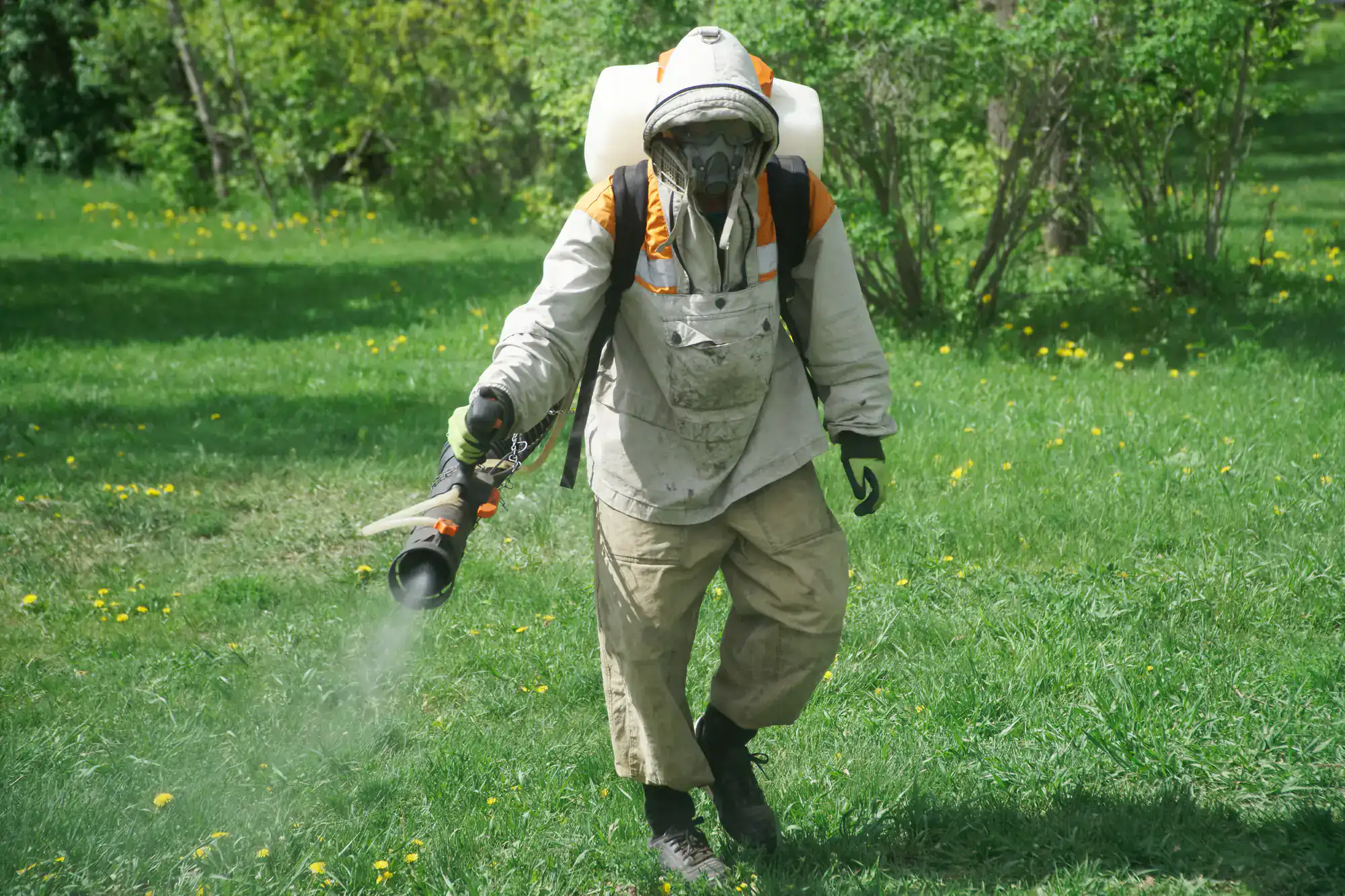
Tick activity on Long Island follows a predictable pattern and the program we build for your Dix Hills property is structured around it. We start in early spring, before nymphal deer tick populations peak in May and June. That window matters more than most homeowners realize. Nymphal ticks are the size of a poppy seed, they’re the primary transmitters of Lyme disease, and they’re nearly impossible to spot before they’ve already made contact. Getting ahead of that surge is the entire point of an early-season application.
From there, maintenance applications run every three to four weeks through the summer covering peak flea season and keeping the barrier active through the period when your yard sees the most use. In the fall, we come back for a second critical treatment targeting adult blacklegged ticks, which surge again in September through November as they seek a final host before winter. Most homeowners skip the fall treatment. That’s a mistake, especially on Dix Hills properties near preserved open space where deer movement continues well into the season.
Before any application, we assess your specific property the wooded edges, the mulch beds, the areas where your pets spend time, and the transition zones along the lot line where ticks actually concentrate. That assessment shapes where and how we treat, because a spray that only hits the lawn perimeter misses the zones that matter most.
Ready to get started?
Store-bought flea and tick sprays have lower active ingredient concentrations than professional-grade products and don’t include insect growth regulators the component that breaks the flea reproductive cycle and prevents re-infestation. Even if you apply a consumer product correctly, you’re likely missing the zones where ticks and fleas actually live: under deck edges, in deep mulch beds, along stone walls, and in the leaf litter at the wooded lot edge. Those are the harborage zones. That’s where the problem starts.
Our licensed applicators are trained to identify and treat those exact areas. On a Dix Hills property where mature landscaping, large lots, and wooded buffers create layered harborage zones that a smaller suburban lot simply doesn’t have that targeted approach makes a measurable difference. We’re applying professional-grade product in the right places, at the right concentrations, on the right schedule.
Because Long Island’s entire drinking water supply comes from underground aquifers, proper application practices matter here beyond just effectiveness. Our licensed professionals are trained to apply treatments in a targeted, properly-dosed way that protects both your family and the environment beneath your property. That’s not a marketing point it’s a legal and practical standard we hold ourselves to on every job in Suffolk County.
Dix Hills has some of the most sustained tick pressure in Suffolk County, and the geography explains why. The hamlet sits adjacent to the Half Hollow Hills and West Hills preserves both permanent deer corridors and tick reservoirs. Deer are the primary reproductive host for adult blacklegged ticks, and the deer population here moves freely between preserved open space and residential neighborhoods. That movement doesn’t stop at your property line.
Suffolk County consistently ranks among the highest-risk counties in New York State for Lyme disease. Columbia University researchers have found that roughly 56% of ticks on Long Island carry Lyme disease. New York State reported over 19,000 Lyme disease cases in 2023 a 146% spike in a single year. For a Dix Hills homeowner with a large wooded lot and an active family, those numbers aren’t abstract. They’re the risk profile of your specific backyard.
The honest answer is earlier than most people think. On Long Island, tick activity begins building in late March and early April sometimes earlier if we get a warm late-winter stretch. By the time May arrives, nymphal deer tick populations are peaking, and that’s the highest-risk window of the year. Nymphal ticks are the hardest to detect and the most likely to transmit Lyme disease. If you’re waiting until you see ticks to start treatment, you’ve already missed the most important application window.
For Dix Hills properties specifically with wooded lot edges and proximity to preserved land that keeps tick harborage zones active longer into spring starting in early April gives you meaningful protection before peak exposure arrives. The fall treatment window, September through November, is equally important and frequently skipped. Adult blacklegged ticks surge again in the fall, and properties near the Half Hollow Hills preserve see sustained deer movement through that entire period.
Yes when applied correctly by a licensed professional, the products we use in a professional tick control program are safe for children and pets once they’ve dried, which typically takes about 30 to 60 minutes depending on conditions. Our technician will walk you through the specific re-entry window before leaving, and it’s worth following that guidance rather than guessing.
The distinction between a licensed applicator and an unlicensed one matters here. New York State requires NYSDEC Commercial Pesticide Applicator certification for any company applying pesticides commercially a 30-hour training course and a state examination. That training covers proper dosing, targeted application, and safe practices around residential environments. We employ certified applicators on every job. The risk isn’t the product itself when it’s applied correctly it’s the product being applied incorrectly by someone without the training to know the difference. On a property in Dix Hills where children are playing in large backyards, that distinction is worth paying attention to.
You can, but the results tend to disappoint and there are a few specific reasons why. Consumer-grade products have lower concentrations of active ingredients than professional-grade formulations, and they don’t include insect growth regulators, which are what actually break the flea reproductive cycle. Without an IGR, you’re killing adult fleas but leaving eggs and larvae to hatch and restart the infestation within weeks.
The bigger issue on a Dix Hills property is application. A large lot with mature landscaping, deep mulch beds, stone walls, and wooded edges has far more harborage zones than a standard suburban yard. Ticks don’t live in the middle of your lawn they concentrate in the transition zones along wooded edges, under deck overhangs, and in leaf litter. Most homeowners applying DIY product miss these areas entirely. Professional applicators know where to look and what to treat. On a half-acre or larger Dix Hills lot, that knowledge gap between a consumer spray and a professionally applied program is where the real difference in results shows up.
A single treatment provides roughly four to six weeks of protection. If you’re only doing one application per season, you’re leaving significant gaps especially during the periods when your yard sees the most use. The professional standard for adequate control is a minimum of three applications, with six being the recommendation for season-long defense on a property with sustained tick pressure.
For a Dix Hills property near preserved open space, the math is straightforward. You need an early spring application before nymphal tick populations peak in May. You need maintenance treatments every three to four weeks through the summer to keep the barrier active during peak outdoor use. And you need a fall application in September or October to address the adult tick surge before winter. That’s not upselling that’s the actual biology of how ticks move through a season on Long Island. A company that sells you one treatment and calls it done isn’t being honest about what it takes to protect a property like yours.
Most pest control companies that market tick services in Dix Hills are pest specialists only they come out, spray, and leave. They’re not thinking about the relationship between your lawn’s health and its pest pressure. We do both, and that integration matters more than it might seem.
A well-maintained, properly-drained lawn with healthy turf is measurably less hospitable to tick and flea populations than neglected turf with heavy thatch and moisture retention. Thatch, overgrown edges, and compacted soil create the microhabitat that ticks and fleas need to survive. When we treat your Dix Hills property for pests, we’re also the company that can address the underlying lawn conditions contributing to the problem through aeration, fertilization, and proper turf management. You’re not just treating the symptom. You’re working on the environment that’s creating it. For a property in Dix Hills where large lots and mature landscaping create complex conditions, that whole-lawn perspective is something a pest-only company simply can’t offer.
Useful Links
Other Services we provide in Dix Hills