
Hear from Our Customers
Most people calling about new lawn installation in Shoreham aren’t dealing with a few bare patches. They’re standing on stripped ground post-construction, post-renovation, or post-equipment looking at a property that cost serious money and still doesn’t have a finished yard to show for it. That’s the gap we close.
What changes after a proper installation isn’t just the look. It’s the confidence that the lawn was built correctly for this specific environment. Shoreham’s soils along the North Shore are sandy, fast-draining, and low in organic matter the kind of ground that dries out fast in summer and doesn’t forgive a contractor who skips the prep work. When the soil is properly amended, graded, and seeded with varieties that actually perform near the Sound, you get a lawn that establishes fully and holds through the seasons.
For properties in Shoreham Village and East Shoreham, that also means accounting for salt spray, coastal wind, and the wooded, sloped terrain that defines this part of the North Shore. A lawn installed without considering those factors might look fine for a few weeks. One installed with them in mind lasts for years.
We’ve been installing lawns on Long Island since the mid-1980s. Not maintaining them installing them. From bare ground, stripped topsoil, and post-construction lots to complete tear-outs on properties that have been neglected for years. That’s the work we built this business on, and it’s still the work we do best.
Operating out of Port Jefferson Station, we’re 10 to 15 miles west of Shoreham along Route 25A the same road that runs past the Tesla Science Center and connects this village to the rest of the North Shore. We’re not dispatching crews from Nassau County or running a national franchise model. We’re a Long Island company that has been working in Shoreham’s specific soils, through these seasons, on North Shore properties like yours for nearly four decades.
When you call us, you’re talking to people who know the difference between a Shoreham lot near the Sound and an inland Suffolk property and who build the installation plan around that difference, not around a generic formula.

It starts with a site assessment. Before anything goes into the ground, we look at what we’re working with existing soil condition, grade, drainage, debris from construction, and any slope or drainage issues that need to be addressed before seeding. For Shoreham properties, that often means identifying how sandy the soil is, how close to the Sound the property sits, and whether the lot has significant grade change that requires correction. Skipping this step is how lawns fail.
From there, we handle soil preparation which typically includes topsoil amendment to improve water retention in Shoreham’s fast-draining coastal soils, pH testing and correction, and any grading needed to ensure proper drainage away from the structure. New York State law permits high-phosphorus starter fertilizer on new lawn installations specifically, and we apply it correctly as part of this phase. Once the ground is ready, we select seed varieties matched to your site conditions turf-type tall fescue performs well in Shoreham’s coastal environment, with the deep root system and drought tolerance these soils demand.
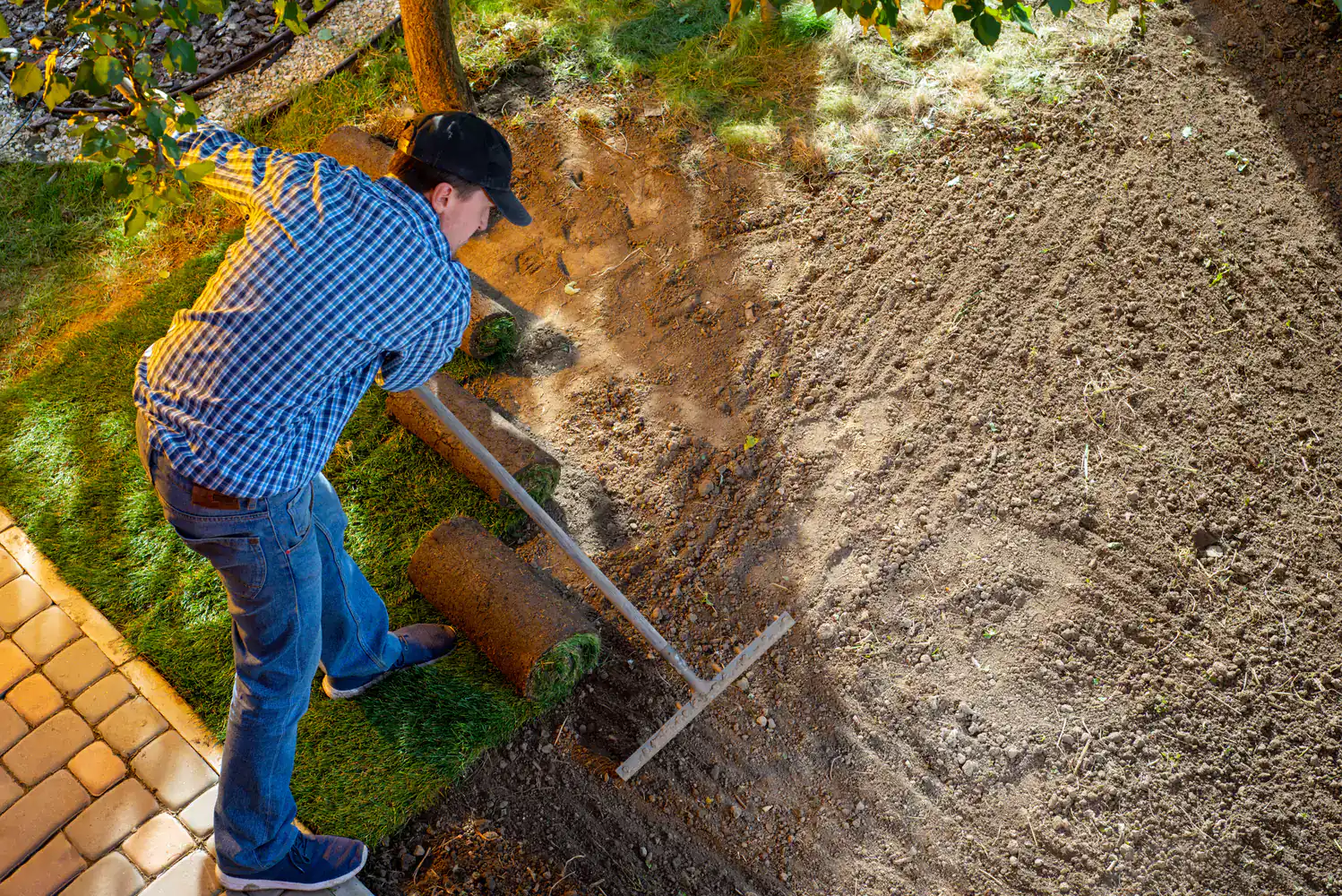
Installation follows whether that’s seeding for larger or sloped lots, or hand seeding for smaller areas and we close out with erosion control and a clear establishment timeline. You’ll know exactly what to expect at 30, 60, and 90 days, including a watering schedule built for Shoreham’s sandy, quick-draining ground.
Ready to get started?
Every new lawn installation in Shoreham starts with what the site actually needs not a fixed menu of services applied the same way to every property. Shoreham’s North Shore terrain varies meaningfully from lot to lot. A wooded, sloped property near the village beach has different requirements than a flat East Shoreham lot that was cleared for new construction. We account for that from the first visit.
What’s included in a Lawn Master installation: site assessment and soil testing, topsoil amendment and pH correction, grading and drainage planning where needed, debris removal from construction activity, seed selection matched to your exposure and soil type, installation by seeding or hand seeding depending on lot size and terrain, erosion control on sloped areas, and a full establishment guide covering watering schedules, first-mow timing, and first-year care. For properties near the Long Island Sound, we pay specific attention to salt-tolerant variety selection and wind exposure factors that matter in Shoreham Village and on elevated bluff positions that a generalist won’t think to ask about.
If your property falls within the Suffolk County drinking water protection buffer zone under Local Law 41-2007, we check that before any chemical applications go down. That’s not extra it’s standard practice for a company that’s been operating in Suffolk County for 38 years.
Shoreham sits on the North Shore of Long Island, directly on the Long Island Sound and that geography changes what a lawn installation actually requires. The soils here are sandy, acidic, and low in organic matter. They drain fast, which means they dry out fast, which means a new lawn seeded without proper soil amendment will struggle through its first summer before it ever gets established. Inland Suffolk towns like Hauppauge or Holbrook have heavier soils that hold moisture longer. Shoreham doesn’t work that way.
Add to that the salt spray from the Sound, the coastal wind exposure on properties near the bluff or beach, and the wooded, sloped terrain that defines the North Shore’s glacial moraine character and you have a site environment that requires specific grass variety selection, careful soil prep, and a contractor who has actually worked on North Shore properties before. That’s not a generic challenge. It’s a Shoreham-specific one, and it’s why the installation process here looks different than it does five miles inland.
For a seed-based installation which is typically the right call for Shoreham’s larger, more complex lots you can expect germination within 10 to 21 days depending on soil temperature and moisture. The lawn will look thin and uneven during this phase, which is normal. By 60 days, a well-installed lawn should have solid coverage. Full establishment, where the root system is deep enough to handle drought and foot traffic without stress, generally takes one full growing season.
The timing of your installation matters significantly here. The ideal window for new lawn installation in Shoreham is late August through early October. Fall seedings benefit from cooler air temperatures, reduced weed competition, and typically adequate rainfall and the lawn has the entire following spring to continue establishing before summer heat arrives. Spring installations are possible but require more intensive watering management, especially given how quickly Shoreham’s sandy soils lose moisture. We’ll tell you honestly which window applies to your project and what to expect either way.
For most Shoreham properties, seed either hand-seeded or hydraulically seeded is the better long-term choice. Here’s why: sod is grown off-site, often on soil conditions that don’t match what’s in your yard. When it’s transplanted, it has to re-root into your specific ground. On Shoreham’s sandy, fast-draining coastal soil, that transition can be stressful for the sod if irrigation isn’t managed carefully. Seed, by contrast, germinates and roots directly into your prepared soil it grows in place, which means stronger root development and better long-term adaptation to your site.
Sod makes sense when you need instant coverage before a family event, before a sale, or when erosion on a slope won’t wait for seed to germinate. For larger lots, wooded properties, or sloped terrain common in Shoreham Village and East Shoreham, seeding is often the most practical and cost-effective method. It covers irregular terrain evenly, includes a tackifier that holds seed in place on slopes, and produces results that are indistinguishable from hand seeding once established. We’ll give you a straight recommendation based on your specific lot not based on what’s easier for us.
Construction is rough on soil in ways that aren’t always visible from the surface. Heavy equipment compacts the subsoil, topsoil gets stripped or buried, and construction debris concrete chunks, fill material, lumber scraps often ends up mixed into the ground. If you seed over that without addressing it first, you’re not installing a lawn. You’re just scattering seed on damaged ground and hoping.
The prep work is where the installation actually happens. For a post-construction site in Shoreham, that typically means removing surface debris, breaking up compacted subsoil, bringing in quality topsoil to restore the seed bed, testing and correcting soil pH, and grading to ensure proper drainage. On North Shore properties with significant slope, grading also means making sure the finished grade directs water away from the foundation and doesn’t create erosion channels through the new lawn. None of this is optional it’s the foundation. A lawn installed on properly prepared ground will establish cleanly and hold for years. One installed on unaddressed construction damage will fail, and you’ll be starting over.
For most Shoreham properties especially those with direct or near-direct exposure to the Sound turf-type tall fescue is the workhorse variety. It has a deep root system that reaches moisture below the surface during dry stretches, which matters a lot on Shoreham’s fast-draining sandy soils. It handles drought stress better than Kentucky bluegrass, tolerates partial shade from the mature trees common on North Shore lots, and holds up reasonably well against the salt air exposure that comes with living near the water.
Kentucky bluegrass blends are a good choice for properties with less coastal exposure, better soil depth, and reliable irrigation they produce a dense, visually premium lawn when conditions support them. For shadier areas under tree canopy, fine fescue varieties are often blended in to handle reduced light. The right answer depends on your specific lot sun exposure, soil depth, irrigation availability, and proximity to the Sound all factor in. We assess all of that before recommending a seed blend, because putting the wrong variety in the ground is one of the most common reasons new lawns fail on Long Island.
For a seed-based installation in Shoreham, most projects fall somewhere between $5,000 and $15,000 depending on square footage, the condition of the existing ground, how much soil preparation is required, and whether grading or topsoil work is needed before seeding can begin. Properties that have been through heavy construction stripped topsoil, compacted subsoil, buried debris will sit toward the higher end because the prep work is more involved. Smaller, simpler lots with relatively intact soil will come in lower.
Shoreham properties tend to have more complex site conditions than typical suburban Suffolk County lots wooded terrain, slopes, older soil that may need significant amendment, and in some cases proximity to the Sound that affects variety selection and establishment care. That complexity is reflected in the quote, and it should be. A lower quote that skips proper soil prep, uses inferior seed, or ignores drainage isn’t saving you money it’s setting up a failed installation that you’ll pay to redo. We give you a detailed, itemized quote that explains exactly what’s included and why, so you can evaluate it on the merits rather than just the number at the bottom.
Useful Links
Other Services we provide in Shoreham