
Hear from Our Customers
If you’ve been putting money into a fertilization program and your lawn still looks thin, patchy, or just flat-out tired, compaction is almost certainly the reason. Compacted soil forms a barrier that blocks water, air, and nutrients from reaching the root zone. It doesn’t matter how good the fertilizer is if it can’t penetrate, it can’t perform. Research consistently shows that fertilizer uptake can improve by 30 to 40 percent after proper core aeration. That means every dollar you’ve already spent on lawn treatments starts working the way it was supposed to.
For Shoreham specifically, this problem runs deeper than it does in most of Suffolk County. The North Shore sits on the Harbor Hill Moraine a glacially deposited mix of sand, gravel, and clay-influenced till that compacts unevenly and forms a hard layer beneath the surface that most aeration equipment simply doesn’t reach. Add in the coastal wind exposure off the Long Island Sound, which accelerates moisture loss and thatch buildup, and you have a lawn that’s working against itself on two fronts. Core aeration addresses both: it relieves the compaction layer so water and nutrients actually infiltrate, and it reduces thatch buildup so your grass can breathe again.
Bluff-top and sloped properties near the Sound face an additional layer of urgency. When soil is compacted on a slope, water doesn’t soak in it runs off, taking topsoil and nutrients with it and contributing to the kind of surface erosion that’s a real concern on North Shore waterfront properties. Aeration restores infiltration on those slopes, keeping water where it belongs instead of watching it drain toward the bluff edge.
We’re a Suffolk County–based lawn care company, not a national franchise routing your call to whoever’s available. When you request an estimate in Shoreham, you’re talking to people who have worked across the North Shore from the bluff-top properties along the Sound to the heavier till soils further inland toward Rocky Point and Wading River. That geographic familiarity isn’t a talking point. It’s what makes the difference between a treatment plan that actually fits your lawn and one that’s just copied from a generic template.
Every applicator on our crew holds a New York State DEC Pesticide Applicator License a legal requirement for commercial lawn care that a surprising number of smaller operators in the area can’t verify. For Shoreham homeowners whose properties sit near the Long Island Sound, that licensing matters beyond credentials. It means the people treating your lawn understand and comply with New York’s fertilizer restrictions near coastal waterways. That’s not a small thing when you live this close to the Sound.
The process starts with a walkthrough of your property. Before anything runs, our crew assesses soil conditions, slope, thatch depth, and any areas of concentrated compaction the kind of evaluation that matters on a Shoreham lawn where you might have sandy surface soil near the bluff transitioning to heavier glacial till just a few feet away on the same property. That variability is exactly why equipment choice matters here.
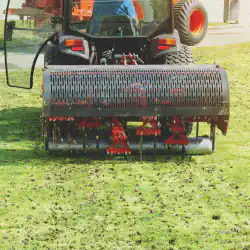
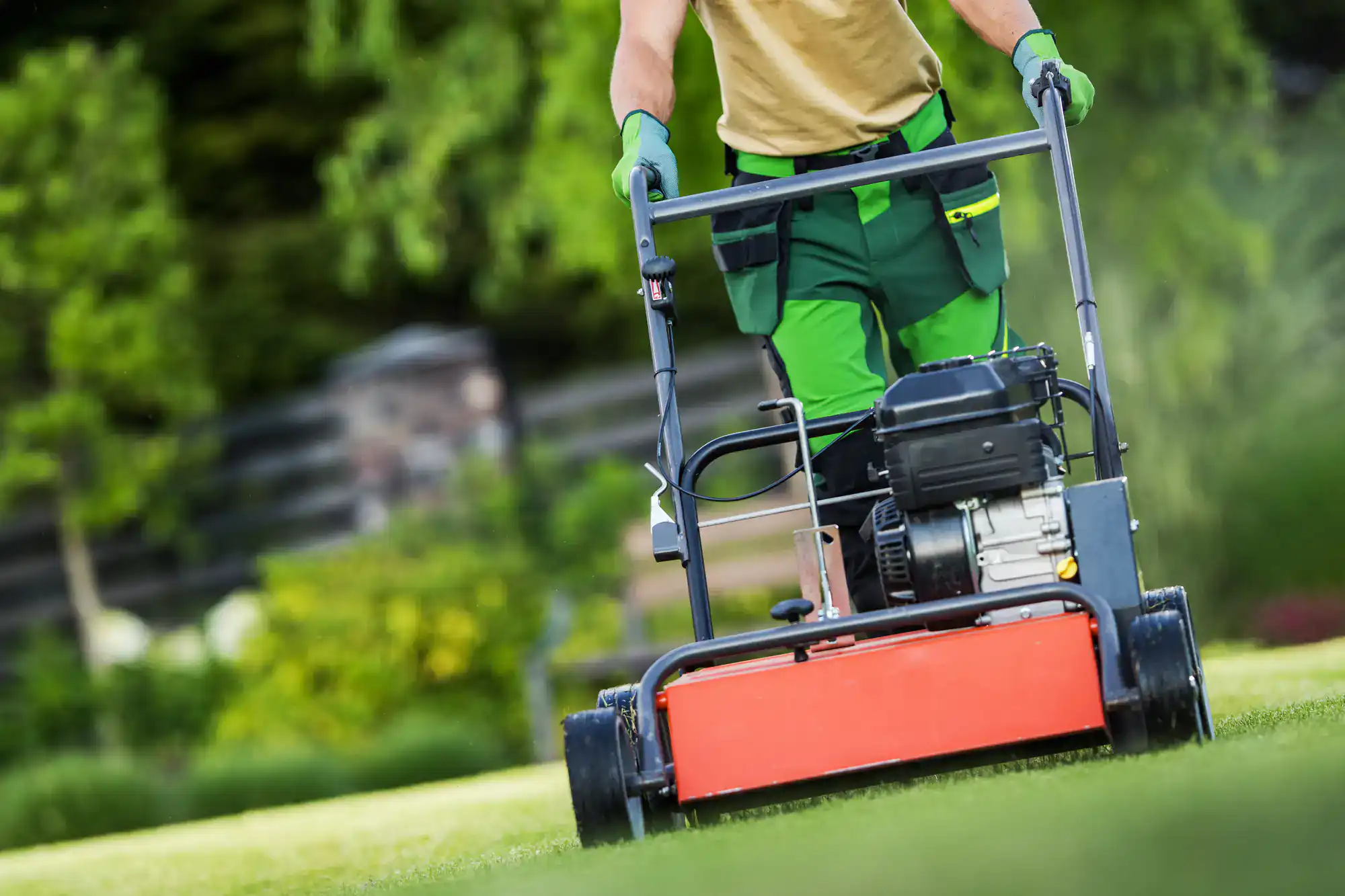
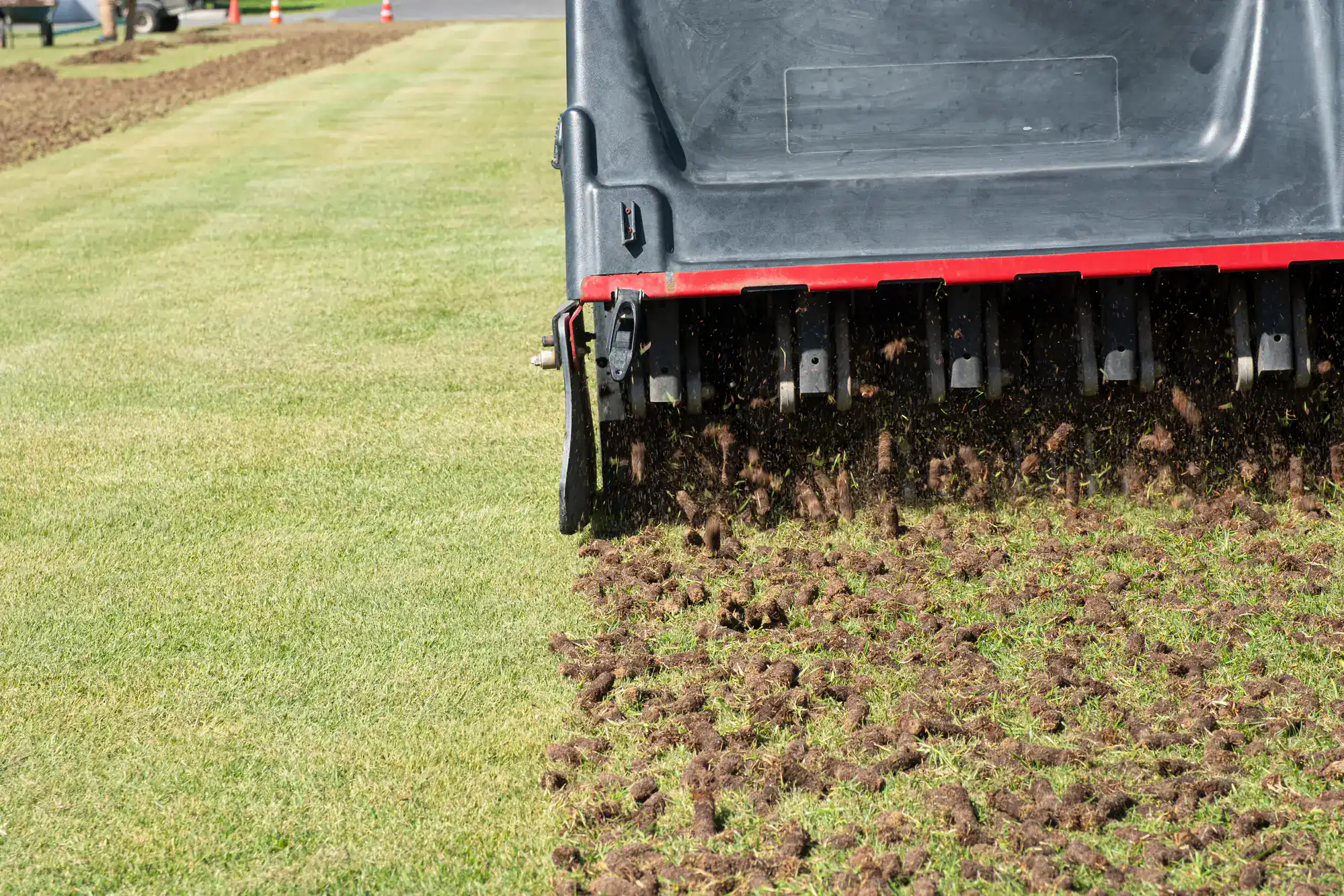
We use a commercial hydraulic aerator not the drum-style machines most companies use or the rental equipment you’d pick up at a hardware store. A drum aerator operates at a fixed tine depth, typically 1.5 to 2 inches under good conditions and far less on compacted North Shore soils. Our hydraulic aerator drives tines 3 to 4 inches deep and adjusts pressure dynamically based on what it’s encountering. On the dense, clay-influenced till common across Shoreham and the surrounding area, that depth difference is the difference between real compaction relief and surface-level treatment that looks like it worked but doesn’t hold.
After aeration, soil cores are left on the surface and that’s intentional. Those plugs break down within two to four weeks, returning organic matter and beneficial microbes to the soil and helping decompose the thatch layer from the top down. If overseeding is part of your program, it happens right after aeration, when the cores and open channels give seed direct access to soil. For Shoreham’s cool-season grasses, the fall window from late August through October is the optimal time to run this full program soil is still warm enough for germination, air temps have cooled, and the lawn has a full growing season ahead before summer stress returns.
Ready to get started?
Core aeration from us is not a standalone punch card service. It’s the foundation of a lawn program the step that makes everything else work. When it’s paired with overseeding, the open channels created by our hydraulic tines give seed direct soil contact, which is why germination rates after core aeration are consistently 30 to 50 percent higher than seed dropped on un-aerated ground. If you’ve been overseeding bare patches year after year with minimal results, the soil preparation not the seed is what’s been missing.
Aeration also pairs directly with fertilization. Our licensed applicators follow New York State’s fertilizer laws, including the phosphorus restrictions that apply near the Long Island Sound a regulation that’s directly relevant to Shoreham properties and one that not every local operator is even aware of. When fertilizer is applied to a properly aerated lawn, it reaches the root zone instead of sitting on the surface or washing off. That’s not a minor improvement it’s the difference between a fertilization program that builds a lawn over time and one that burns through your budget without visible progress.
Whether your Shoreham lawn needs a single fall aeration and overseeding, or you’re looking to build it into an ongoing program that includes fertilization and seasonal treatments, the starting point is the same: a free property estimate where our crew can assess what your specific soil conditions actually call for. No package upsell, no guesswork just a clear recommendation based on what’s in front of them.
For Shoreham and the broader North Shore, fall is the primary window typically late August through mid-October. This is when soil temperatures are still warm enough to support seed germination, but air temperatures have dropped enough that cool-season grasses like tall fescue, Kentucky bluegrass, and perennial ryegrass can establish without heat stress. The Long Island Sound moderates temperatures along the North Shore slightly compared to inland Suffolk County, which can extend the optimal window a few days into mid-October, but it still closes.
The reason fall matters so much here is that Shoreham lawns face coastal wind stress and occasional salt spray through winter that can thin turf significantly. Going into that season with a dense, well-rooted lawn makes a real difference in how your grass looks the following spring. Spring aeration typically April through May is a viable secondary option for heavily compacted areas or high-traffic zones, but it doesn’t pair as effectively with overseeding because summer heat arrives before new grass fully establishes. If you’re combining aeration with seeding, fall is the right call for this area.
Spike aeration pushes solid tines into the soil to create holes. Core aeration pulls a plug of soil out. That distinction matters a lot on the glacial till soils common across Shoreham and the North Shore. When you push a solid spike into already-compacted soil, you’re displacing that soil laterally compressing it further around each hole rather than removing it. You end up with holes that look like aeration but soil that’s actually more compacted around each puncture point than it was before.
Core aeration removes material. That’s what creates genuine decompression real channels for water, air, oxygen, and fertilizer to move through the soil profile. On Shoreham’s variable till soils, where you might have sandy surface layers sitting over a hard clay hardpan, that decompression needs to happen at depth, not just at the surface. The cores left on the lawn after the process also serve a purpose: they break down and return organic matter to the soil, improving its biological health over time. Spike aeration doesn’t offer any of that. On North Shore soils specifically, it’s a step backward.
This is one of the most common frustrations among homeowners on the North Shore, and the answer is almost always the same: the fertilizer isn’t getting where it needs to go. Compacted soil especially the clay-influenced glacial till beneath many Shoreham lawns acts as a barrier. Fertilizer applied to the surface either sits there, gets washed off by rain, or breaks down before it ever reaches the root zone. You’re spending money on a program that’s working against a physical obstacle it can’t overcome on its own.
Core aeration removes that obstacle. Once the compaction layer is broken up and open channels exist through the soil profile, fertilizer can actually move where it’s needed. Studies show fertilizer uptake efficiency improves by 30 to 40 percent after proper core aeration. For a lawn that’s been on a fertilization program for multiple seasons with minimal visible improvement, that’s a significant shift and it often produces noticeable results within a single growing season after the first proper aeration. The fertilizer program wasn’t wrong. The soil conditions just weren’t ready for it to work.
Yes and for bluff-top or sloped properties in Shoreham, this is one of the most important benefits aeration provides. When soil is compacted on a slope, water that hits the surface has nowhere to go but downhill. It runs off rather than infiltrating, carrying topsoil and nutrients with it. On properties near the Sound’s bluff edge, that runoff isn’t just a lawn problem it contributes to the surface erosion that’s an ongoing concern for North Shore waterfront homeowners.
Core aeration restores the soil’s ability to absorb water by breaking up the compaction layer and creating open channels through the soil profile. Once infiltration improves, water moves down into the root zone instead of across the surface. This doesn’t eliminate the need for good drainage planning on steep slopes, but it directly addresses the compaction-driven portion of the runoff problem which is often the primary driver on established North Shore lawns that haven’t been aerated in years. If your lawn slopes toward the bluff or toward a drainage area, aeration should be part of your annual program, not a one-time fix.
You can, but the results on Shoreham’s soil conditions are likely to disappoint you. Rental aerators are drum-style machines with fixed tine depth typically designed for average soil conditions, which Shoreham’s glacial till is not. On compacted North Shore soils, a rental drum aerator often penetrates only an inch or so, nowhere near the 3 to 4 inch depth needed to reach the actual compaction layer beneath the surface. You’ll end up with holes in the top inch of soil and a hard layer underneath that’s completely untouched.
This is one of the more common reasons homeowners conclude that aeration doesn’t work they tried it, saw minimal improvement, and moved on. The issue isn’t the concept; it’s the equipment. Our commercial hydraulic aerator adjusts pressure dynamically based on what it encounters in the soil, which is exactly what’s needed on the variable till soils common across Shoreham and the adjacent communities of Rocky Point, Wading River, and Sound Beach. The depth and consistency of penetration from professional equipment simply isn’t replicable with rental gear, particularly on the North Shore.
Yes. New York State’s fertilizer law restricts the use of phosphorus-containing fertilizers near waterways a regulation that applies directly to properties in Shoreham given the village’s position on the Long Island Sound. Every applicator on our team holds a New York State DEC Pesticide Applicator License, which is both a legal requirement for commercial lawn care and a meaningful indicator that the people treating your lawn understand these restrictions and follow them.
This matters more in Shoreham than in many other Suffolk County communities. The Sound is a designated coastal resource area, and the environmental awareness that’s part of this community’s identity shaped in part by decades of advocacy around local water quality and land use is well-founded. Hiring a licensed, compliant operator isn’t just about protecting your lawn; it’s about knowing the service is being done responsibly relative to the waterway your property sits beside. Many smaller local operators either don’t hold the required DEC license or aren’t fully aware of the phosphorus restrictions that apply in coastal zones. It’s worth asking any company you’re considering to confirm their licensing before they apply anything to your property.
Useful Links
Other Services we provide in Shoreham