Not all lawn care is created equal. Here's what average lawn care cost really means in Suffolk County — and why who's applying matters as much as what they're charging.
Most homeowners searching for lawn care cost information are really asking a different question: am I about to get ripped off? That’s fair. The price range for professional lawn care is wide enough to be genuinely confusing, and the difference between a $150/month quote and a $400/month quote isn’t always obvious until the season is over and your lawn looks exactly the same — or worse.
In Suffolk County, there’s another layer to this. Because of the county’s strict fertilizer and pesticide regulations, who is treating your lawn matters just as much as what they’re charging. Here’s what you actually need to know before you hire anyone.
Professional lawn care in Suffolk County typically runs between $100 and $500 per month, depending on your property size, what services are included, and how often a crew visits. Lot sizes vary significantly across the county, from dense suburban properties in Brentwood and Bay Shore to larger parcels on the North Shore in Smithtown and Huntington. Labor costs are higher here than in most of the country. And the regulatory environment — more on that shortly — adds real compliance overhead that any legitimate operator has to account for. When you see a quote that seems too low, it’s worth asking what’s actually behind it.
Lawn care pricing is driven by a handful of factors that most companies won’t walk you through unless you ask. Property size is the obvious one — more square footage means more product, more time, and more equipment wear. But beyond that, the type of service matters enormously. A basic mowing visit is a fundamentally different product than a licensed fertilization and weed control program. Treating them as comparable just because they both involve someone showing up with a truck is where a lot of homeowners go wrong.
In Suffolk County specifically, the soil adds another variable. Most of the county sits on sandy, slightly acidic loam that drains quickly. Nutrients leach out faster here than in heavier clay soils, which means fertilizer formulation, application timing, and release rates have to be calibrated for local conditions. A generic off-the-shelf product applied on a national chain’s standard schedule isn’t going to perform the same way a program built around Long Island soil will.
Then there’s the regulatory piece. Suffolk County has a fertilizer blackout period running from December 1 through April 1, during which nitrogen applications are prohibited by local law. The county also requires zero-phosphorus fertilizers for established lawns unless a soil test shows a deficiency — this is tied to protecting the sole-source aquifer that supplies drinking water to the entire county. There is no municipal reservoir system here. Every drop of drinking water in Suffolk County comes from the ground, which is why these rules exist and why licensed operators take them seriously.
Spring treatment timing is also more specific than most homeowners realize. Long Island soil temperatures typically reach 55°F around April 12 — that’s the threshold at which cool-season grasses like tall fescue, Kentucky bluegrass, and perennial ryegrass actually start growing and can absorb nutrients. A knowledgeable local operator plans around that date. A national algorithm doesn’t.
All of this is built into what a legitimate professional lawn care program costs in Suffolk County. When you see a quote that’s significantly below market, the question isn’t whether it’s a deal — it’s what’s been left out.
This is the part most lawn care cost guides skip entirely, and it’s probably the most important thing to understand before you hire anyone in New York State.
Under New York Environmental Conservation Law, any business applying pesticides or fertilizers for hire must be registered with the NYS Department of Environmental Conservation and must employ at least one certified commercial pesticide applicator. Getting that certification requires passing state examinations, completing 30 hours of approved training, and holding a minimum of three years of full-time experience in the applicable category. The license has to be renewed every three years with continuing education credits. This isn’t a box to check — it’s a meaningful credential that takes real time and expertise to earn.
A labor-only crew — someone hired through an app, a platform, or a word-of-mouth referral who shows up with a spreader and a bag of fertilizer from a big-box store — is not legally authorized to perform those applications for hire. If they’re doing it anyway, they’re breaking New York State law. And if something goes wrong on your property, you may bear more liability than you’d expect.
Beyond the legal question, there’s a practical one. A licensed applicator knows what they’re putting on your lawn, at what rate, and why. They know about the December 1 blackout period. They know about the zero-phosphorus requirement. They know they’re required to notify neighbors before applying pesticides. An unlicensed crew typically knows none of this — and your lawn, your family, and your neighbors absorb the consequences.
We’ve been licensed commercial pesticide applicators in Suffolk County since 1987. That’s not a marketing line. It’s a compliance standard we’ve maintained for nearly four decades, through multiple regulatory changes and every shift in what Long Island lawns have thrown at us — including nutgrass and bentgrass infestations that are particularly common here and require targeted, knowledgeable treatment to actually resolve.
Want live answers?
Connect with a Lawn Master of Suffolk expert for fast, friendly support.
Once you understand the licensed-versus-labor distinction, the evaluation process gets a lot more straightforward. You’re no longer comparing prices on an apples-to-apples basis — you’re comparing fundamentally different products. The question becomes: which licensed, insured, locally experienced provider is the right fit?
There are a few things worth looking at closely. How long have they been operating in this specific market? Do they use professional-grade equipment or consumer gear? Is the same knowledgeable person treating your lawn each visit, or does a different crew show up every time with no knowledge of your lawn’s history? And critically — what does their contract actually say?

The best lawn care service isn’t necessarily the most expensive one, but it does share a few consistent characteristics that are worth knowing.
First, the program should be built around your lawn, not a template. That means someone actually assesses your property — soil type, grass variety, existing problem areas, sun exposure, drainage — before deciding what to apply and when. Suffolk County’s soil varies meaningfully across the county. The sandy coastal soils in Patchogue behave differently than the heavier loam you find further inland near Hauppauge. A program that doesn’t account for that isn’t really a custom program, regardless of what the sales pitch says.
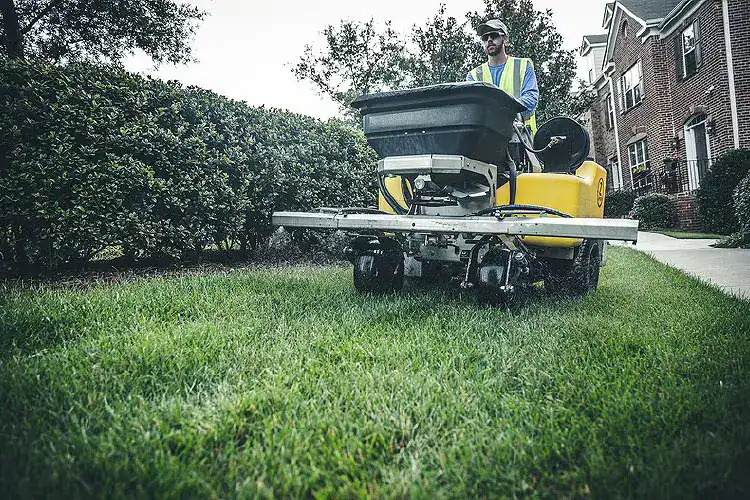
Second, the equipment matters more than most people realize. Hydraulic aerators, for example, pull deeper cores and produce more consistent results than the tow-behind units you can rent from a hardware store. The difference shows up in how well your soil recovers and how effectively overseeding takes hold afterward. Professional-grade equipment is a capital investment that signals a company is serious about outcomes, not just throughput.
Third, consistency and accountability are non-negotiable. You should know who is treating your lawn, what they applied, and when it’s safe for your kids and pets to be back on the grass. Licensed operators are required to document applications. If a company can’t or won’t tell you exactly what went on your lawn, that’s a problem.
We run a fleet of five fully wrapped trucks out of Port Jefferson Station, and we’ve been doing this long enough that our trucks are recognizable across Suffolk County. That visibility is intentional. It means you know exactly who’s on your property, and we’re accountable for every visit.
Lawn care contracts have a bad reputation, and honestly, some of it is deserved. The most common complaints about national lawn care companies in this category involve automatic renewal clauses that are easy to miss, cancellation penalties buried in the fine print, and charges that continue to appear on credit cards weeks after a customer has tried to end service. If you’ve been through that experience, it makes sense that you’d be hesitant to sign anything again.
But a well-written contract isn’t the problem — a vague or predatory one is. A good contract protects you as much as it protects us. It should spell out exactly which services are included, how many visits are scheduled per year, what triggers an additional charge, and what the cancellation process looks like. If any of those things are unclear before you sign, ask. A company that can’t answer those questions directly is telling you something.
A few specific things to watch for: automatic renewal clauses that lock you in for another full season without notice, vague language around “additional treatments” that become line items on your invoice, and any language that makes cancellation contingent on timing windows you weren’t told about upfront. These aren’t hypothetical concerns — they’re the most frequently cited complaints from homeowners who’ve had bad experiences with larger national providers.
The alternative isn’t to avoid contracts altogether. It’s to work with a company that’s transparent enough to walk you through the terms before you commit. We offer online invoice payment and a member account portal specifically because we want the billing relationship to be visible and straightforward. No surprises on the invoice, no mystery charges, no phone tag to figure out what you owe or why.
If you’re comparing providers in Suffolk County and one of them hesitates to explain their contract terms clearly, that hesitation is your answer.
The average lawn care cost question has a real answer, but it depends entirely on what you’re actually buying. A licensed, locally experienced professional program built around your specific lawn and Suffolk County’s regulatory environment is a different product than a labor-only crew applying generic fertilizer on a national schedule. The price difference between those two things reflects that.
Before you hire anyone, ask whether they’re NYS DEC certified, what their contract terms look like in plain language, and whether the same knowledgeable person will be treating your lawn each visit. Those three questions will tell you most of what you need to know.
We’ve been treating Suffolk County lawns since 1987, and we’re still doing it the same way — licensed professionals, custom-blended fertilizer formulated for Long Island soil, and owner-level expertise on every job. If you want to talk through what your lawn actually needs, reach out to us. We’re straightforward about what we do, what it costs, and what you can expect.
—
**Frequently Asked Questions**
**How much does professional lawn care cost in Suffolk County, NY?**
Most homeowners in Suffolk County pay between $100 and $500 per month for a professional lawn care program, depending on property size and what’s included. That range reflects real variation — a basic fertilization schedule for a quarter-acre lot looks very different from a full-season program that includes aeration, overseeding, weed control, and grub prevention for a larger North Shore property. The more useful question isn’t what the monthly number is, but what you’re actually getting for it and whether the company providing it is licensed to do the work legally in New York State.
**Do lawn care companies in New York need to be licensed to apply fertilizer and pesticides?**
Yes, and this is one of the most important things to understand before hiring anyone. New York State law requires that any business applying pesticides or fertilizers for hire be registered with the NYS DEC and employ at least one certified commercial pesticide applicator. That certification requires passing state exams, completing 30 hours of approved training, and holding relevant field experience. In Suffolk County specifically, licensed operators also have to follow the county’s fertilizer blackout period (December 1 through April 1) and zero-phosphorus requirements for established lawns — rules tied to protecting the county’s sole-source drinking water aquifer. An unlicensed crew applying chemicals for hire is breaking state law, and homeowners who unknowingly hire them may face liability exposure as a result.
**What’s the difference between a lawn care program and a mowing service?**
Mowing is maintenance — it keeps the grass at a manageable height. A lawn care program is about the health of the lawn itself: soil chemistry, nutrient levels, weed pressure, pest management, and long-term turf density. These are different disciplines, and they require different credentials. Mowing generally doesn’t require a special license. Applying fertilizers, herbicides, or pesticides for hire in New York State does. If a company offers both under the same umbrella, it’s worth asking specifically who handles the chemical applications and whether they’re licensed to do so.
**How do I avoid hidden fees and automatic renewals with lawn care contracts?**
Read the contract before you sign it, and ask direct questions about anything that isn’t clear. Specifically: does the contract auto-renew, and if so, what’s the notice window to cancel? What services are explicitly included, and what would trigger an additional charge? What does the cancellation process look like, and are there penalties? A company that’s reluctant to answer those questions plainly is worth walking away from. The goal is a written agreement that’s specific enough that there are no surprises when the invoice arrives.
**When is the right time to start a lawn care program in Suffolk County?**
For cool-season grasses — which is what most Suffolk County lawns are planted with, typically tall fescue, Kentucky bluegrass, or perennial ryegrass — the spring treatment window opens when soil temperatures reach 55°F. On Long Island, that’s usually around April 12. Starting too early means the grass isn’t actively growing and can’t absorb what you’re applying. Fall is actually the more critical treatment window for most lawns: aeration, overseeding, and fall fertilization in September and October set the foundation for the following spring. If you’re only treating your lawn in spring and summer, you’re missing the season that matters most.
Summary:
Article details:
Share: