Hiring the wrong lawn care company costs more than money. Here's what to look for before you sign anything in Suffolk County.

Most people don’t start looking for a new lawn care company because everything is going great. Usually, something went wrong — a company that stopped showing up, a program that didn’t work, a bill that didn’t match the estimate. If that sounds familiar, you’re not alone. It’s one of the most common frustrations we hear from homeowners across Suffolk County. The good news is that most of these problems are avoidable if you know what to look for before you hire. This page is going to help you figure that out.
When most homeowners search for “commercial lawn maintenance,” they’re not looking for a service that mows office parks. They’re looking for professional-grade lawn care — licensed, program-based, and handled by people who actually know what they’re doing. That distinction matters more in Suffolk County than almost anywhere else in New York.
Suffolk County has some of the strictest fertilizer and pesticide regulations in the state. Local Law 41-2007 prohibits fertilizer applications from November 1 through April 1 — a full month stricter than the state’s cutoff. There are also phosphorus restrictions designed to protect the county’s groundwater and coastal waterways, including the Great South Bay and the Peconic Estuary. A professional lawn service that operates here needs to know these rules cold — not learn about them after they’ve already made an illegal application on your property.

In New York State, anyone applying pesticides commercially — meaning for hire — is required to hold a valid Commercial Pesticide Applicator certification issued by the NYS Department of Environmental Conservation. Getting that certification isn’t quick or easy. It requires completing a 30-hour training course, passing two separate written exams (one core exam covering safety and state law, one category-specific exam for ornamental and turf), at least one year of verifiable field experience, and renewal every three years with continuing education. That’s a meaningful bar to clear.
The problem is that many lawn care operators advertise pesticide services without meeting it. A common workaround is to have one licensed person on staff — technically the “supervising applicator” — while sending unlicensed seasonal workers to do the actual applications. The license holder may never set foot on your property. That’s not just a legal gray area; it’s a practical one. An unlicensed worker applying a regulated product at the wrong rate or at the wrong time of year doesn’t have the training to know the difference. You won’t see the consequences until your lawn shows it — or until something ends up in the groundwater.
We’ve been operating in Suffolk County since 1987, and every application we make is handled by a licensed pesticide professional. Not supervised by one — handled by one. The person showing up to your property has passed the exams, knows the local regulations, and understands what they’re applying and why. That’s the baseline you should expect from any company you hire, and it’s worth asking about directly before you sign anything.
Suffolk County’s soil adds another layer of complexity. The dominant soil type here is Haven Loam — deep, well-drained, and formed over coarse sand and gravel — which means nutrients can leach through the root zone faster than in other markets. Coastal and eastern areas of the county often have even sandier conditions. A licensed professional who understands Long Island’s soil profile will build a program around those realities. Someone just following a generic checklist won’t.
Asking a company if they’re licensed is a reasonable first step, but it’s not enough on its own. Most companies will say yes regardless of what their actual credential situation looks like. The better move is to ask specifically: “Are the people who will be applying products on my property NYS DEC certified pesticide applicators?” That’s a more precise question, and the answer will tell you a lot.
You can also verify licensing through the NYS DEC’s pesticide business registry, which is publicly searchable. If a company is registered and their applicators are certified, that information is on record. If they can’t point you to it or get vague when you ask, that’s worth noting.
Beyond licensing, look at how long the company has been operating in your specific area. A business that has served Suffolk County for decades has navigated drought years, wet springs, grub cycles, and multiple rounds of regulatory change — including the implementation of the county’s fertilizer restrictions. That kind of local institutional knowledge doesn’t come from a training manual. It comes from actually working in this soil, in this climate, on these lawns, year after year.
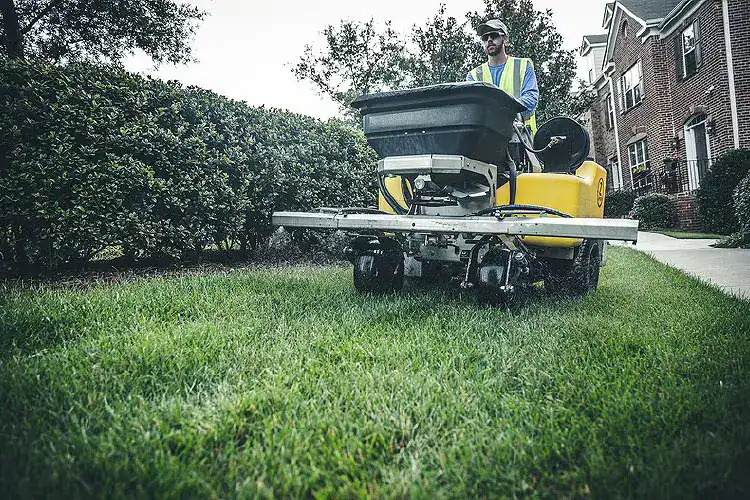
Equipment is another indicator that often gets overlooked. Hydraulic aerators, for example, deliver deeper and more consistent core removal than standard tow-behind equipment — which matters significantly for Suffolk County’s compacted or sandy soils. Hydraulic seeders provide better seed-to-soil contact than broadcast spreaders, which directly affects germination rates. When a company invests in professional-grade equipment, it usually signals they’re serious about the results, not just the invoice. Ask what equipment they use and whether they own it outright — it’s a fair question.
Cornell Cooperative Extension recommends two to three pounds of nitrogen per one thousand square feet per year for Long Island home lawns. A company that applies significantly more than that isn’t doing you a favor — they’re chasing a fast green-up at the expense of your lawn’s long-term health and the county’s water quality. A calibrated, research-backed program is what you’re looking for.
Want live answers?
Connect with a Lawn Master of Suffolk expert for fast, friendly support.
The contract conversation is where a lot of homeowners get burned. Not because they didn’t read the fine print, but because they didn’t know what questions to ask before they signed. A fair lawn care contract is straightforward — it tells you what services will be performed, when they’ll happen, what they cost, and what happens if you want to stop. If any of those things are unclear before you sign, ask until they are.
The most common contract problems in this industry aren’t complicated. They’re just not talked about upfront. Automatic renewal clauses that lock you in for another season without notice. Early termination fees that can run two to three months of service charges. Vague service descriptions that give the company flexibility to skip applications or substitute products without your knowledge. These aren’t hypothetical risks — they’re documented complaints from homeowners across Long Island.

The clearest red flag in any lawn care agreement is language that makes it easy for the company to get paid and hard for you to leave. Automatic renewal clauses are the most common version of this. Some contracts renew for a full season unless you cancel within a specific window — sometimes as short as 30 days — and that window may not be clearly communicated when you sign. If you miss it, you’re on the hook for another year.
Early termination fees are the second thing to look for. Some companies charge a flat fee to cancel mid-season; others charge a percentage of the remaining contract value. Either way, the effect is the same — you’re financially discouraged from leaving even if the service isn’t working. We don’t use cancellation penalties. Every service agreement we write is straightforward — you know what you’re getting, when you’re getting it, and what it costs. If something isn’t working for you, we’d rather have that conversation than trap you in a contract.
Vague service descriptions are subtler but just as important. If a contract says “lawn treatments as needed” without specifying what products, what rates, and on what schedule, the company has given themselves room to do less than you expect. A good contract names the services, the timing, and the products involved. It should also be clear about what happens if an application is missed due to weather or scheduling — does it get made up, or does it just not happen?
One more thing worth asking: does the same person show up every time? High crew turnover is one of the most consistent complaints in the lawn care industry. The person who assessed your lawn at the estimate has institutional knowledge about your property — your soil conditions, your problem areas, your history. When a different crew shows up every visit with no continuity, that knowledge disappears. It’s worth asking upfront how a company handles this.
Price is usually the first thing people compare when evaluating lawn care companies, and it’s also the comparison that leads to the most regret. The lowest bid in the market almost always reflects something — lower-grade products, unlicensed labor, less time spent per property, or some combination of all three. That’s not a knock on budget-conscious shoppers. It’s just the math of how these businesses work.
A licensed pesticide applicator costs more to employ than an unlicensed seasonal worker. Custom-blended fertilizer formulated for Long Island’s soil conditions costs more than a generic off-the-shelf product. Hydraulic aeration equipment costs more to own and operate than a basic tow-behind aerator. When a company charges significantly less than the market rate, something in that equation is being cut.
The real cost comparison isn’t quote A versus quote B. It’s what you spend over two or three seasons. A lawn that gets improper applications — wrong product, wrong rate, wrong time of year — often needs significant remediation before it can recover. Re-seeding, soil amendment, and addressing damage from over-applied nitrogen or incorrectly timed pre-emergent weed control adds up quickly. We’ve restored lawns in Huntington, Smithtown, and Brookhaven that had been through exactly this cycle — a few years of cheap service followed by an expensive fix.
In Suffolk County specifically, the cost of non-compliance is also real. Illegal pesticide applications — meaning applications made by unlicensed operators or in violation of local fertilizer restrictions — can expose the property owner to liability, not just the company. Hiring a licensed, compliant professional isn’t just about getting a better lawn. It’s about making sure the work being done on your property is legal.
What professional lawn service pricing should reflect is expertise, proper materials, and accountability. A company that has been operating in Suffolk County since 1987, owns a fleet of professional equipment, employs licensed applicators, and uses a custom fertilizer blend made for Long Island conditions isn’t going to be the cheapest option. But the cost of doing it right the first time is almost always lower than the cost of fixing what went wrong.
The short version of everything on this page is this: ask better questions before you hire. Ask whether the person applying products to your lawn is actually licensed by the NYS DEC — not just whether the company is. Ask what the contract says about renewals and cancellation. Ask what equipment we use and whether the program is designed for your specific lawn or just applied uniformly across every property on our route.
Most companies won’t expect those questions. A good one will welcome them.
We’ve been doing this work in Suffolk County since 1987, and the lawns we’re most proud of are the ones that took real diagnosis — the sandy coastal soils in Brookhaven, the shaded properties in Huntington, the lawns that other companies had already written off. If you’re at the point where you want a straight answer and a program that actually fits your property, reach out to us. We’re straightforward about what we do, what it costs, and what you can expect.
Summary:
Article details:
Share: