If your lawn looks rough despite regular care, compacted soil is likely the culprit. Here are 11 signs Suffolk County homeowners shouldn't ignore.
You’ve fertilized. You’ve watered. Maybe you’ve even hired a lawn service or two. And yet your lawn still looks thin, struggles through summer, and has patches that just won’t fill in no matter what you try. Before you blame the grass seed or switch fertilizer brands, consider this: the problem might not be what you’re putting on your lawn — it might be that your soil isn’t letting any of it in. Compacted soil is one of the most common and most overlooked lawn problems in Suffolk County, and once you know what to look for, the signs are hard to miss.
Healthy soil isn’t just dirt — it’s roughly half solid material and half open pore space. Those tiny air pockets are what allow water, oxygen, and nutrients to travel down to the root zone where your grass actually needs them. When soil gets compacted, those pores collapse. The ground gets dense and hard, and everything you apply to the surface — fertilizer, water, even air — has a much harder time getting through.
University of Massachusetts research confirms that compacted soil can reduce nutrient uptake by 10 to 30 percent. That means a significant portion of every fertilizer application you’ve made on a compacted lawn may have been wasted. Not because the product was bad, but because the soil wasn’t physically capable of delivering it to the roots.
Long Island’s glacial geology is part of the story. Suffolk County soils were shaped by glacial deposits, which means the soil composition can shift dramatically from one yard to the next — sandy loam near the South Shore coastline, heavier clay-influenced soil in inland areas like Brookhaven, Smithtown, and parts of Islip. Clay soils compact more easily and hold compaction longer, which is why so many homeowners in the middle of the county deal with chronic drainage and turf problems that never seem to fully resolve.
Then there’s the development history. A large portion of Suffolk County’s residential neighborhoods were built out during the postwar suburban boom of the 1950s through the 1970s. Construction crews graded those lots with heavy equipment, compressing the subsoil deeply — and in many cases, that compaction has never been properly addressed. If your home was built in that era, your lawn may be sitting on 50 or 60 years of accumulated compaction beneath a thin layer of topsoil.
Newer construction isn’t off the hook either. Modern home builds regularly strip topsoil during the construction process and leave behind compacted subsoil with only a shallow layer of new soil added back before the sod goes down. It looks fine at first, but roots hit that dense layer fast and the lawn starts struggling within a season or two.
Add in the everyday wear — kids, pets, foot traffic, mowing equipment — and it’s easy to see why compaction is so widespread throughout Suffolk County. It’s not a sign that you’ve done something wrong. It’s just what happens to soil over time, especially in a county where so many lawns have never had their soil structure properly restored.
Some of these signs are obvious. Others are easy to misread as a different problem entirely. Taken together, they paint a pretty clear picture.
Water pooling on your lawn after rain is one of the most visible signs. If you’re seeing puddles or soggy patches in areas that should drain, it’s often because the soil is too dense to absorb water at a normal rate. Homeowners near the South Shore or in low-lying parts of Babylon and Islip sometimes assume this is a grading issue — and sometimes it is — but compaction is frequently the underlying cause.
The ground feels hard underfoot. Try the screwdriver test: push a standard flathead screwdriver into the soil without hammering it. In healthy soil, it should slide in 3 to 4 inches without much resistance. In compacted Suffolk County clay, you’ll often hit resistance at 1 to 2 inches. That resistance is exactly what grass roots are fighting every time they try to grow deeper.
Your fertilizer doesn’t seem to be working. This is the one that frustrates homeowners the most. If you’ve been on a fertilizer program for a season or more and your lawn still looks pale, thin, or unresponsive, compaction is a serious suspect. Nutrient uptake is an active biological process that requires oxygen — and compacted soil cuts off that oxygen supply at the root zone.
Your grass looks thin and yellow despite regular watering. Chlorotic, sparse grass that doesn’t respond to water is a textbook compaction symptom. The water is sitting near the surface or running off rather than penetrating to where the roots need it.
Bare patches that won’t fill in. If you’ve overseeded bare spots and watched the seed fail to establish, compaction is likely why. Seeds need to make contact with loose, receptive soil to germinate and root. Dense, packed earth doesn’t give them that.
Your lawn looks great in April but deteriorates by July. This is one of the more telling patterns. Cool-season grasses — tall fescue, Kentucky bluegrass, perennial ryegrass, which are the dominant lawn types in Suffolk County — green up easily in spring when conditions are favorable. But when summer heat and dry spells arrive, a compacted lawn falls apart fast because shallow roots can’t access deeper soil moisture. The lawn isn’t weak. It just can’t reach the water it needs.
Weeds are taking over. Compaction-stressed grass thins out and loses density, which opens the door for opportunistic weeds. Goosegrass, knotweed, and annual bluegrass in particular thrive in compacted, hard-packed soil conditions.
You notice moss or algae in low-lying areas. Both indicate poor drainage and low oxygen levels in the soil — two conditions that go hand in hand with compaction.
Thatch is building up faster than usual. When soil is compacted and microbial activity drops off, organic matter doesn’t break down at a normal rate. Thatch accumulates. A thin layer of thatch is normal; a thick, spongy mat is a warning sign.
Your lawn recovers slowly after any stress. Whether it’s a dry stretch in August, heavy foot traffic from a summer gathering, or a late-season storm, a compacted lawn takes much longer to bounce back than a healthy one.
You’ve had multiple lawn services and the results are always the same. If you’ve cycled through treatments and programs and the lawn never really improves, the underlying soil structure hasn’t been addressed. Treatments applied to compacted soil are working against a structural problem, not with the biology of the lawn.
Want live answers?
Connect with a Lawn Master of Suffolk expert for fast, friendly support.
Understanding the problem is step one. Actually fixing it requires the right approach and the right equipment. Soil compaction repair isn’t complicated in concept, but the difference between a professional job and a DIY attempt — or a general landscaper with basic equipment — shows up clearly in the results.
The foundation of professional soil compaction repair is core aeration. A machine drives hollow tines into the soil and physically pulls out small plugs of earth, creating channels that allow air, water, and nutrients to penetrate the root zone. Those plugs get deposited on the surface and dissolve back into the lawn within two to four weeks, returning organic matter to the soil in the process.
Not all aeration equipment is the same, and the difference matters more than most homeowners realize — especially in Suffolk County’s heavier inland soils.
Spike aerators, which you’ll find at hardware stores and in the hands of many general landscapers, work by pushing a solid tine into the ground. The problem is that pushing soil sideways can actually compress the surrounding soil rather than relieve it. You end up with a hole, but potentially denser earth around that hole. For moderately compacted lawns, the results are marginal. For severely compacted clay-heavy soil, spike aeration can do more harm than good.
Core aeration removes soil rather than displacing it. The hollow tine pulls a plug out of the ground, leaving a genuine channel behind. This is the approach that actually reduces soil density and creates the open pathways that make everything else — fertilizer, water, overseeding — more effective.
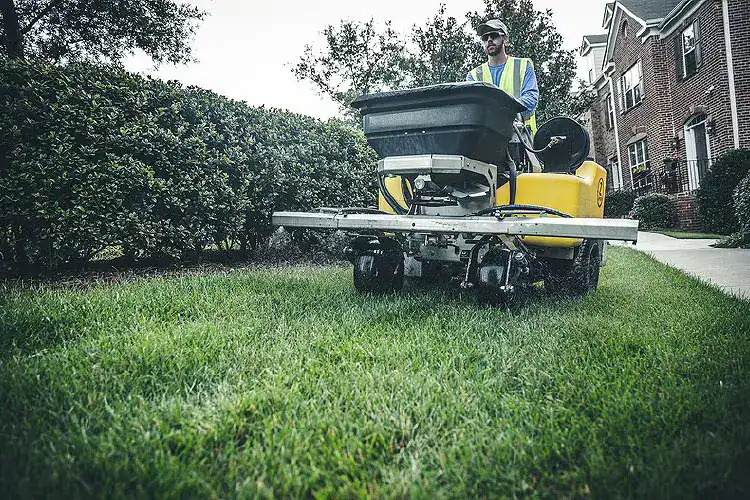
We use hydraulic aerators, which are a step above the walk-behind machines available at rental centers. Hydraulic equipment achieves greater tine depth and more consistent penetration across the full pass, even in hard, dry, or clay-heavy conditions. When you’re dealing with soil that’s been compacted for decades — which is the reality for a lot of homes in Babylon, Brookhaven, Smithtown, and Huntington — that extra depth and consistency is what separates a treatment that works from one that barely scratches the surface.
After aeration, the channels created in the soil become the most receptive the lawn has been in years. Overseeding at this point gives new grass seed direct access to loose soil and dramatically improves germination rates. Fertilizer applied post-aeration reaches the root zone efficiently rather than sitting at the surface or running off. The timing of that follow-up care matters, which is also why Suffolk County’s fertilizer ban — which runs from November 1 through April 1 — makes the fall aeration window so valuable. Getting aeration and fertilization done before that window closes means your lawn enters winter with the best possible foundation.
One of the most common reasons lawn treatments fail is that they’re applied without a real assessment of what’s actually going on in the soil. We don’t just show up and run equipment over your lawn. We look at the whole picture first.
A proper assessment starts with the basics: observing where water drains and where it pools, checking how the soil feels underfoot, and using a soil probe or the screwdriver test to gauge compaction depth. From there, it’s about reading the grass itself — the color, density, thatch depth, root length, and how different areas of the lawn are performing relative to each other. A lawn in Riverhead with sandy loam soil has different needs than a lawn in Smithtown sitting on clay. Both might show signs of compaction, but the severity, the approach, and the follow-up program won’t be identical.
This is where licensing matters beyond the legal requirement. New York State requires a DEC Pesticide Applicator License to apply herbicides and regulated lawn treatments — it’s not optional, and companies without licensed applicators are operating illegally. But more practically, the training and accountability that come with that license shape how a professional reads a lawn and makes decisions. It’s the difference between a technician following a route sheet and a knowledgeable professional who understands what they’re looking at.
We’ve been assessing Suffolk County lawns since 1987. That’s not a line we throw out casually — it means our team has seen virtually every soil condition, seasonal pattern, and turf problem this county produces across nearly four decades. We know how the soils in Huntington behave differently from the coastal lots near Bay Shore. We know what a lawn looks like when it’s been on a fertilizer program for three years on compacted soil and what it looks like after one proper aeration and seeding cycle. That accumulated local experience is what shapes every assessment we do, and it’s not something that can be replicated by a national franchise or a company that started operating last spring.
If several of those 11 signs sound familiar, the good news is that compacted soil is fixable. It’s not a permanent condition, and you don’t need to tear out your lawn and start over. In most cases, professional core aeration combined with a proper follow-up program is enough to turn things around within a season.
The key is addressing the soil structure before continuing to invest in fertilizer or treatments that can’t work the way they’re supposed to. Once the compaction is relieved, everything else becomes more effective — the fertilizer absorbs, the seed establishes, the roots go deeper, and the lawn holds up through summer instead of falling apart by July.
If your Suffolk County lawn has been frustrating you for more than a season, reach out to us. We’ll take a look at what’s actually going on and give you a straight answer about what your soil needs.
Summary:
Article details:
Share: