Suffolk County's fall overseeding window is narrow, specific, and unforgiving. Here's what you need to know before the season slips away.
If you looked at your lawn in late August and thought that you need to do something before winter, you’re already in the right headspace. The problem is that most homeowners assume they have all of fall to figure it out. In Suffolk County, that assumption costs people a full year.
The effective window for fall overseeding on Long Island is real, it’s narrow, and it’s shaped by factors most lawn care content doesn’t bother to explain. We’re going to walk you through exactly what you’re working with: the timing, the method, the local regulations, and the questions we hear most often from homeowners across Suffolk County.
The general guidance you’ll find almost anywhere is early fall. For Suffolk County, that translates to a specific window: roughly September 1 through October 15. That’s it. That’s your year.
Cool-season grasses, including tall fescue, Kentucky bluegrass, and perennial ryegrass, make up most Suffolk County lawns and need soil temperatures between 50 and 65°F to germinate reliably. In September, Long Island soils are still holding warmth from summer, typically above 55°F, while the air has cooled enough to reduce heat stress on new seedlings. That combination doesn’t last long.
By mid-October, soil temperatures are dropping toward the lower edge of the germination range. By November, you’re essentially done. Seeds that go into cold soil below 50°F don’t germinate well, and the ones that do germinate late are vulnerable to frost before they’ve had time to establish.
Here’s something most overseeding content and most lawn care providers don’t tell you: Suffolk County’s fertilizer blackout starts November 1. Under Local Law No. 41-2007, fertilizer applications are prohibited from November 1 through April 1. Violations carry fines of up to $1,000 per application. The law exists to protect Long Island’s sole-source aquifer and the surrounding waterways, including Great South Bay, Long Island Sound, and the coastal estuaries that define so much of this county’s character.
Why does this matter for overseeding? Because starter fertilizer is a critical part of establishment. When you seed a lawn, the new grass needs available nutrients in the soil to develop roots before winter. If you overseed in late October and try to apply starter fertilizer after November 1, you’re either breaking the law or skipping a step that meaningfully affects your results.
This is one of the most overlooked details in fall lawn care on Long Island, and it’s one of the main reasons we see homeowners frustrated with late-season overseeding attempts that don’t pan out. The practical takeaway is this: if you want to overseed and fertilize properly in Suffolk County using custom fertilizer blends that align with New York’s April 1 through October 31 fertilizer law, you need to be done with seed down and starter fertilizer applied before the end of October at the latest.
That gives you a window from early September through late October, roughly eight weeks, and less if summer heat lingers or if you’re waiting on a grub diagnosis.
Japanese beetle grubs are a real issue across Suffolk County, particularly in areas near wooded preserves and parks. They damage root systems in late summer, creating bare patches that look exactly like overseeding candidates. But seeding over grub-damaged soil without treating the underlying pest problem first is a waste of time and money.
The seed may germinate, but without healthy roots to anchor into, the new grass won’t survive. If your lawn has irregular bare patches that appeared in August, it’s worth having the soil assessed before you commit to overseeding. As licensed applicators, we can help determine whether you’re looking at grub damage, disease, or simple thinning, and what needs to happen next.
Want live answers?
Connect with a Lawn Master of Suffolk expert for fast, friendly support.
This is the detail that catches the most homeowners off guard. Pre-emergent herbicides, the products applied in spring to prevent crabgrass and other weeds from germinating, work by creating a chemical barrier in the soil that stops seeds from sprouting. The problem is that barrier doesn’t distinguish between weed seed and turf seed. It blocks both, equally, for roughly eight to twelve weeks after application.
If you or a lawn care provider applied a pre-emergent in April or May, that barrier may still be active when you’re trying to overseed in early September. Depending on the product and the application timing, you could be seeding into soil that’s chemically set up to prevent germination. The seed sits there, nothing happens, and you assume the overseeding failed when the real issue was a conflict that should have been caught before the first seed hit the ground.
This is one of the more technical factors that separates a knowledgeable lawn care provider from one who’s just going through the motions. A good overseeding program starts with understanding what’s already been applied to your lawn, not just showing up with seed and a spreader.
For most Suffolk County lawns where a spring pre-emergent was applied in April, the barrier has typically broken down enough by early September to allow overseeding, though it’s not something you should assume without checking. The Haven Loam soils that dominate most of Suffolk County, being sandy, fast-draining, and derived from the glacial outwash that formed Long Island, don’t hold pre-emergent compounds as long as clay-heavy soils do, which works in your favor here. But local soil, weather, and seasonal timing still matter, and getting it right requires knowing what went down and when.
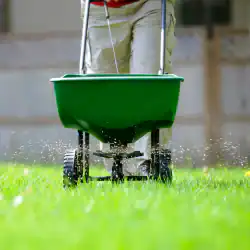
If you’ve tried overseeding before and been disappointed, the method is almost always the reason. Broadcast spreading, which means walking a spreader across the lawn and dropping seed onto the surface, is fine for very light touch-ups on already-healthy turf. For a lawn that’s genuinely thin or damaged, it rarely produces meaningful results.
The issue is seed-to-soil contact. Grass seed needs to be in direct contact with moist, loose soil to germinate. On a compacted Suffolk County lawn, broadcast seed lands on a hard surface, dries out between waterings, and either fails to germinate or washes away. It’s not that the seed is bad. It’s that the conditions for germination were never there.
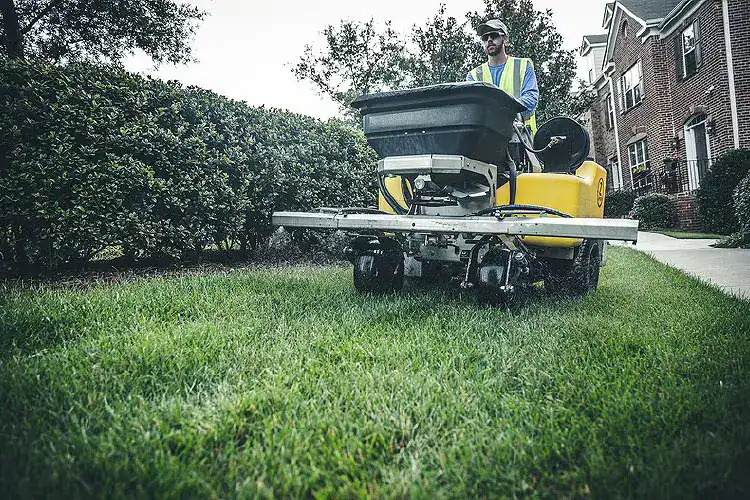
Professional power seeding, also called slit seeding or slice seeding, works differently at a mechanical level. The machine uses rotating blades to cut narrow grooves directly into the soil, then deposits seed into those grooves at a controlled depth using specialized hydraulic equipment. The seed is in the ground, surrounded by soil, with moisture available from below. That’s the environment grass seed needs to germinate reliably.
We pair power seeding with core aeration as a standard part of the process, not as an add-on. Our hydraulic aerators reach three to four inches into the soil, deep enough to make a real difference in the compacted areas that are typical in high-traffic Suffolk County lawns. The combination of aeration and power seeding is what produces the germination rates we see consistently: 75 to 85 percent, which is dramatically higher than what broadcast spreading achieves over compacted ground.
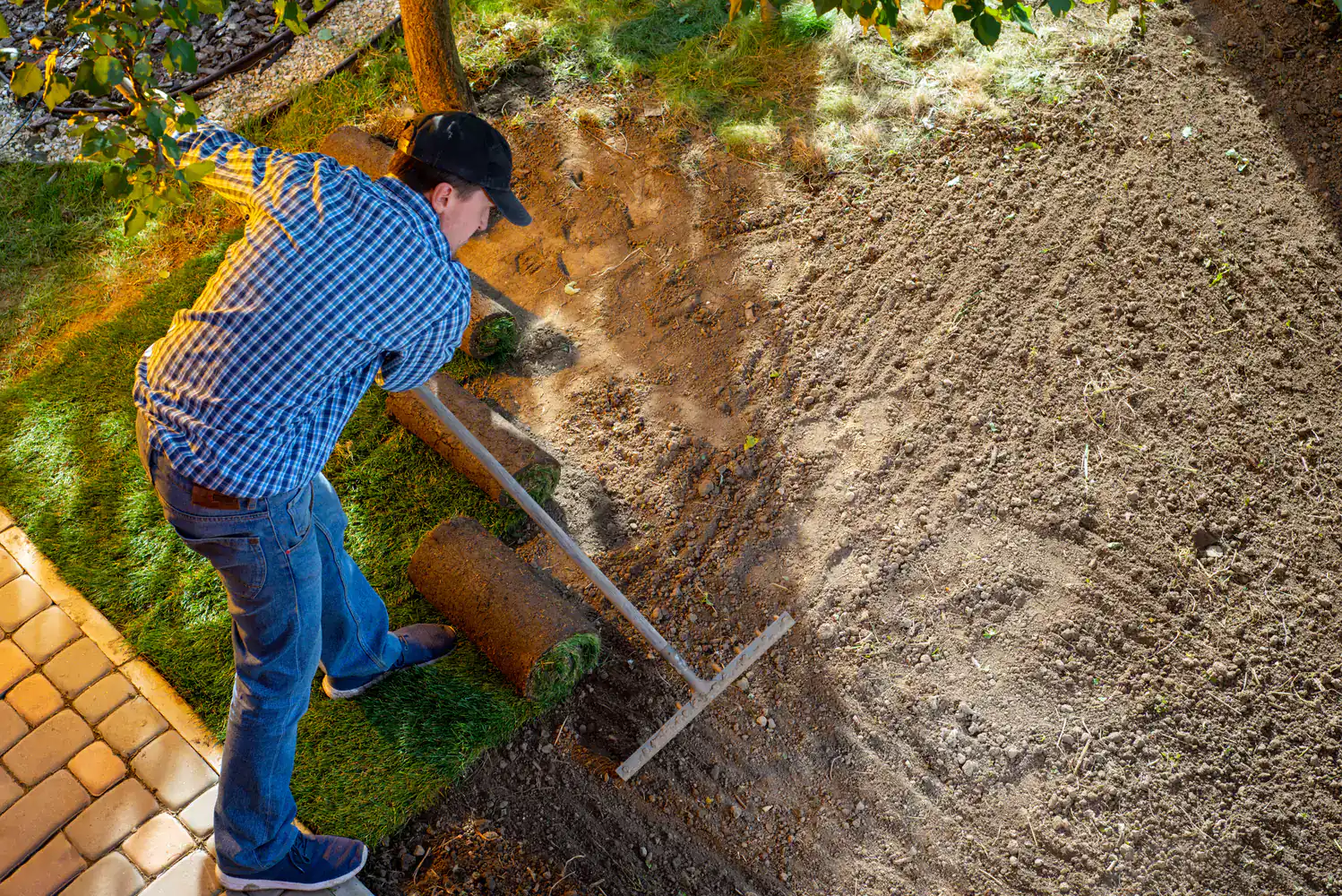
For context, a well-established lawn from sod is the gold standard most homeowners are comparing against. Professional power seeding, done correctly and at the right time of year, can get you to a result that’s comparable at a fraction of the cost.
The grass species we’re working with in most of Suffolk County, such as tall fescue, Kentucky bluegrass, and perennial ryegrass, all respond well to power seeding in the fall window. Tall fescue in particular is well-suited to Long Island’s sandy soils and the region’s summer stress patterns. Getting the right seed variety into the ground at the right depth, at the right time of year, is what makes fall overseeding work.
Can I overseed in October in Suffolk County?
Early October, yes, if you move quickly. The soil temperature window stays open through roughly mid-October on Long Island, and you’ll still have time to get starter fertilizer down before the November 1 blackout. But late October is pushing it, and anything after that is a gamble. If you’re reading this in October, the answer isn’t to skip it, but to call today.
Is fall or spring better for overseeding a Suffolk County lawn?
Fall is significantly better for cool-season grasses, which is what most Suffolk County lawns are made of. Spring overseeding runs into two problems: aggressive weed competition from crabgrass and other spring annuals, and the conflict with pre-emergent herbicides that most lawns receive in April. Trying to establish new turf in spring while also managing weeds is a losing battle in most cases. Fall gives you warm soil, cooling air, reduced weed pressure, and adequate moisture, which are the conditions cool-season grass needs.
Why didn’t my overseeding work last year?
The most common reasons we see include seed broadcast over un-aerated, compacted soil with poor seed-to-soil contact, seeding too late in the season after soil temperatures dropped, a pre-emergent herbicide conflict that wasn’t accounted for, grub damage in the root zone that wasn’t addressed before seeding, or inadequate watering in the first two to three weeks after seeding. In most cases it’s not one thing, but a combination. The fix isn’t trying harder with the same approach, but changing the approach.
Do I need aeration if I’m just overseeding?
On most Suffolk County lawns, yes. Haven Loam soils compact over time, especially in high-traffic areas, and compaction is one of the primary reasons broadcast seed fails to germinate. Aeration before seeding is what creates the conditions for seed-to-soil contact. Skipping it and just seeding is a common reason overseeding underperforms.
Summary:
Article details:
Share: