Timing your lawn fertilization wrong in Suffolk County can mean wasted product, burned grass, or even a $1,000 fine. Here's what you actually need to know.

Most homeowners think about fertilizing their lawn when it starts looking rough — thin patches, dull color, weeds filling in where grass used to be. The instinct is to grab a bag from the hardware store and get to work. But timing a fertilizer application correctly is more involved than it looks, especially in Suffolk County, where the soil, the seasons, and the local laws all shape what works and what doesn’t. Get it right and your lawn responds. Get it wrong and you’re dealing with burned turf, wasted product, or worse. This page walks through what good timing actually looks like — and where professional expertise changes the outcome.
The short answer is that fall is the most important window, and spring is secondary — but neither one is as simple as picking a date on the calendar. For the cool-season grasses that cover most Suffolk County lawns — tall fescue, Kentucky bluegrass, perennial ryegrass, fine fescue — the growth cycle determines when fertilizer actually does something useful.
Soil temperature is the real trigger. Grass roots can’t effectively absorb nutrients until the soil hits around 55°F. On Long Island, that typically happens around April 12th, based on Cornell Cooperative Extension data from Suffolk County soil temperature reports. Applying fertilizer before that point doesn’t feed your lawn — it just sits there and leaches into the ground.
There’s also a hard legal boundary here that a lot of homeowners don’t know about. Suffolk County prohibits fertilizer applications between November 1st and April 1st. Violating that window carries a fine of up to $1,000. So the spring window is narrow: after April 1st, but only once the soil has actually warmed enough to matter.
There’s a common assumption that spring is when you feed your lawn. It makes intuitive sense — the grass is greening up, everything is waking up, and you want to give it a boost. But for cool-season grasses, fall is where the real work happens.
In early September, soil temperatures are still warm enough for active root growth, but the air has cooled enough that the grass isn’t stressed. That combination creates ideal conditions for nutrient uptake. The fertilizer you apply in September and October isn’t just feeding what’s visible above ground — it’s building the root system that determines how your lawn handles next summer’s heat, drought, and foot traffic.
Suffolk County’s Healthy Lawns Clean Water program specifically recommends early September as the target window for fall fertilization. And the guidance from Cornell Cooperative Extension reinforces the same point: most of your annual nitrogen should go down in late summer and fall, not spring. Spring applications support green-up and recovery, but fall applications build the foundation.
The other reason fall timing matters here specifically is the soil. Most of Suffolk County sits on sandy to sandy loam glacial soils — a legacy of how Long Island was formed. Sandy soils drain fast, which means nutrients can leach through before the grass has a chance to use them. Slow-release fertilizer formulations are especially important in fall for this reason. They release nutrients steadily over six to eight weeks, matching the pace at which cool-season grass roots are actively growing before dormancy sets in.
Apply a quick-release product too late in the season and you get a surge of top growth the grass can’t sustain, followed by nothing — because the plant goes dormant before it can build any lasting root structure. Apply a slow-release product at the right time, in the right amount, and the lawn goes into winter stronger and comes back faster in spring.
The final fall application should happen in October, before the November 1st blackout begins. That last feeding, done correctly, carries the lawn through dormancy and sets the stage for a cleaner green-up the following April.
Spring fertilization feels like the safe bet — the lawn is waking up, you want to help it along, and it seems hard to go wrong. But mistimed spring applications are one of the most common causes of lawn damage we see across Suffolk County.
The most frequent mistake is applying too early. A stretch of warm air in late March can make it feel like spring has arrived, but soil temperatures on Long Island are still well below 55°F at that point. Fertilizer applied to dormant or semi-dormant grass doesn’t get absorbed — it sits on the surface, breaks down, and runs off. In Suffolk County, that runoff doesn’t just disappear. Long Island sits entirely over a sole-source aquifer, meaning all of the drinking water here comes from groundwater. Nitrogen that washes off an improperly timed lawn application goes directly into that system. It’s part of why 50% of nitrogen loads reaching Long Island groundwater are attributed to residential fertilizer use, and why the county passed strict laws to limit the damage.
The second common mistake is applying too much. The assumption that more product means faster results is understandable, but it’s wrong. Excess nitrogen causes fertilizer burn — the grass blades yellow, then brown, and in serious cases the turf dies outright. Recovering from fertilizer burn means reseeding, soil correction, and months of patchy regrowth. The cost of fixing that mistake almost always exceeds what a professional program would have cost in the first place.
The correct spring approach is to wait until the soil genuinely hits 55°F — around April 12th on Long Island on average — and apply at a conservative rate of 0.5 to 1 pound of actual nitrogen per 1,000 square feet. That’s enough to support active growth without pushing the plant faster than its root system can handle. It’s a narrow window, and getting it right consistently is harder than it sounds when you’re working with consumer-grade equipment and a bag of product from a big-box store.
Want live answers?
Connect with a Lawn Master of Suffolk expert for fast, friendly support.
Timing is the most important variable, but it’s not the only one. How a fertilizer application gets executed — the product, the equipment, the rate, the conditions — determines whether the timing even matters.
A proper application starts before anything goes on the lawn. The grass should be assessed for density, color, visible deficiencies, and existing weed pressure. The product selected should match the grass type, the season, and what the lawn actually needs — not just whatever’s on sale. Application rates need to be calibrated to the size of the area, not eyeballed. And the weather window matters: a light rain after granular fertilizer can help activate it, but heavy rain before the product has been absorbed washes it off the lawn entirely.
None of that is complicated in theory. In practice, it requires equipment that’s properly calibrated, products that are formulated correctly, and enough experience to read what a lawn is telling you before you start.

The difference between a professional application and a DIY one isn’t just the product — it’s the entire approach. When we apply fertilizer, we’re not working from a generic schedule. Every lawn we service in Suffolk County gets assessed individually before we touch it.
We use a custom-blended fertilizer made specifically for our programs. That’s not a marketing phrase — it means the product we apply is formulated for the soil conditions, grass types, and seasonal demands of Long Island lawns, not a mass-produced formula designed to sell in stores from Maine to Florida. The nutrient ratios are specific. The release rates are matched to the application window. It’s a meaningful difference in what the grass actually receives.
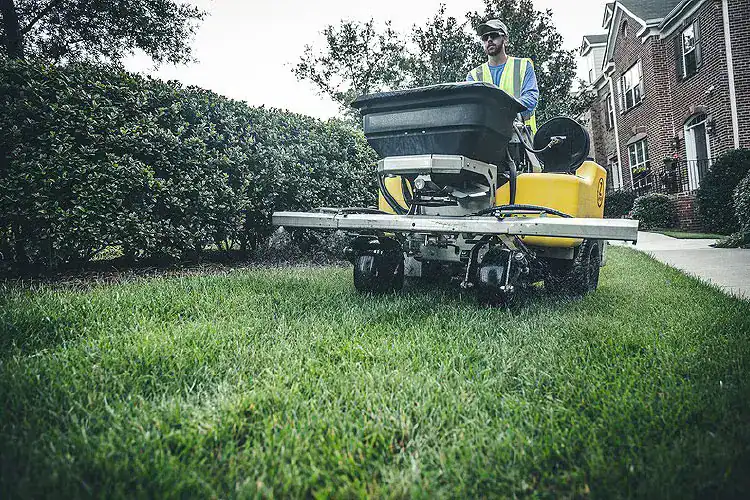
Equipment matters too. Consumer-grade spreaders — the kind you’d rent or buy at a home improvement store — are often poorly calibrated and produce uneven coverage. Overlapping too much in one area and leaving gaps in another means some sections of your lawn get too much nitrogen and others get too little. The result is inconsistent color, uneven growth, and sometimes burn in the over-applied areas. We use commercial equipment that delivers consistent, even coverage across the full application area, with the spread pattern and rate set precisely for the product being used.
Our staff are licensed pesticide professionals — not labor-only crews working under a distant supervisor’s license. New York State requires commercial pesticide applicators to complete a 30-hour training course and pass a NYSDEC exam before they can legally apply products. Those licenses renew every three years. The people doing the work on your lawn are trained, tested, and legally authorized to be there. That matters when you’re talking about what goes into the ground in a county where the groundwater is everyone’s drinking water.
After each application, we communicate what was applied, why, and what to expect. If you need to water it in, we tell you. If there’s a re-entry window, we tell you that too. The point is that you’re not left guessing what happened on your lawn.
Weather is the variable that catches most DIYers off guard. You can pick the right product, set the right rate, and still end up with poor results — or real damage — if the conditions on application day aren’t right.
Heat is the biggest risk in late spring and early summer. Cool-season grasses go semi-dormant when temperatures climb into the upper 80s and 90s, which is a regular feature of Suffolk County summers. Applying nitrogen to stressed, semi-dormant grass doesn’t stimulate growth — it pushes the plant when it’s already struggling, which can trigger fungal issues and further weaken the turf. This is why we avoid nitrogen applications during the hottest stretch of summer and focus that window on pest management, monitoring, and watering guidance instead.
Rain timing is the other major factor. A light rain in the day or two after a granular application is actually helpful — it moves the product off the grass blades and into the soil where the roots can reach it. But applying fertilizer ahead of a heavy rain is a problem. Runoff carries the nitrogen off your lawn and into storm drains, ditches, and eventually the groundwater. In Suffolk County, that’s not just a waste of money — it’s a direct contribution to the nitrogen contamination that’s already degraded wells beyond acceptable levels. The environmental stakes of poor timing are real and local.
Drought conditions create a different issue. Dry soil slows or prevents nutrient uptake, and applying fertilizer to a drought-stressed lawn can concentrate salts at the soil surface and cause burn. If the lawn is already struggling from lack of water, fertilizer isn’t the answer — irrigation is.
Knowing how to read these conditions and adjust accordingly is something that comes from experience. We’ve been servicing lawns in Suffolk County since 1987, which means we’ve seen every combination of spring cold snaps, summer heat waves, and fall drought stretches that this county produces. That pattern recognition shapes when we schedule applications, when we hold off, and when we recommend something other than fertilizer entirely.
The best time to fertilize your lawn isn’t a single date — it’s a window shaped by soil temperature, grass type, weather conditions, and the legal restrictions that apply specifically to Suffolk County. Fall is the most important window. Spring is secondary but still significant. Summer is mostly a hold. And the November 1st cutoff is non-negotiable.
Done correctly, a properly timed fertilization program builds a lawn that handles heat, drought, and foot traffic better than one that’s been fed on a guessed schedule with a generic product. Done incorrectly, it costs you time, money, and sometimes the lawn itself.
If you’d rather not manage all of that yourself, we’ve been doing exactly this work across Suffolk County since 1987. Reach out and we’ll take a look at what your lawn actually needs.
Summary:
Article details:
Share: