Not all fertilizer is created equal — especially on Long Island. Here's what Suffolk County homeowners need to know before buying another bag.
You’ve done everything the bag said. You bought fertilizer in the spring, spread it across the lawn, and waited. Maybe it greened up for a few weeks. Maybe it burned in spots. Maybe nothing changed at all. If that sounds familiar, you’re not doing it wrong — you’re just working with the wrong product for where you live.
Suffolk County lawns have specific soil conditions, specific grass types, and some of the strictest fertilizer regulations in New York State. What works for a lawn in Ohio doesn’t work here. This page explains why that is, what the better option looks like, and how to tell the difference between a fertilizer program that actually builds a lawn and one that just keeps it alive.
The fertilizer aisle at a big-box store is designed to look simple. Grab a bag, check the numbers on the front, spread it around. But those products are formulated for the broadest possible market — not for Suffolk County’s Haven Loam soil, not for the cool-season grass blends that dominate Long Island lawns, and certainly not with the county’s fertilizer blackout period in mind.
Suffolk County law prohibits fertilizer application from November 1 through April 1. That alone eliminates a significant window that many DIY homeowners unknowingly use — especially those eager to get a jump on spring. And even after April 1, timing still matters. Cool-season grasses don’t begin actively using fertilizer until soil temperatures reach 55°F, which in Suffolk County typically falls around mid-April. Apply before that threshold and you’re not feeding your lawn — you’re feeding the groundwater.
Most homeowners think of fertilization as a product decision. Pick the right bag, apply it correctly, done. But professional lawn fertilizer service is really a timing, formulation, and compliance decision — and the product is just one piece of it.
Here’s what a professional program accounts for that a bag from the store doesn’t: soil pH, existing nutrient levels, grass type, application rate by square footage, slow-release nitrogen ratios, pre-emergent timing, and Suffolk County’s specific regulatory requirements. That’s not a checklist you can work through in a Saturday afternoon with a broadcast spreader.
Take nitrogen as an example. Cornell Cooperative Extension recommends 2 to 3 pounds of nitrogen per 1,000 square feet per year for Long Island home lawns. Haven Loam — the dominant soil type across much of Suffolk County — has a cation exchange capacity below 3 meq/100g. In practical terms: nutrients move through this soil fast. Apply fast-release nitrogen and a significant portion of it leaches through the root zone before the grass can absorb it. You’ve spent money on a product that ended up in the groundwater instead of your lawn.
Slow-release nitrogen formulations solve this. They feed the turf steadily over six to eight weeks per application, matching the pace at which the grass can actually use the nutrients. Most retail products don’t offer this, or offer it in such low concentrations that the benefit is minimal. Professional-grade blends are built around it.
There’s also the compliance piece. Suffolk County’s fertilizer rules include phosphorus restrictions, nitrogen guidelines tied to the Peconic Estuary Program’s conservation goals, and the blackout period. We navigate all of this as part of our service. A homeowner doing it alone often doesn’t know these rules exist until something goes wrong.
The fertilizer we use isn’t something you can find on a shelf. It’s a custom blend formulated specifically for our programs and the conditions of Long Island lawns. That distinction matters more than it might seem.
Retail fertilizers are commodity products. The N-P-K numbers on the bag are accurate, but the formulation behind them — the release rate, the micronutrient content, the ratio of slow-release to fast-release nitrogen — is designed to be broadly acceptable, not precisely effective. A bag labeled 24-0-6 at Home Depot and our professional 24-0-6 blend can behave completely differently in the field, because the chemistry inside is not the same.
Our custom blend is built for Haven Loam. It accounts for the fast-draining sandy subsoil that characterizes much of Suffolk County, the cool-season grass blends — tall fescue, Kentucky bluegrass, perennial ryegrass — that make up the majority of local lawns, and the pH tendencies of Long Island soil, which often runs slightly acidic and needs lime correction before fertilizer can perform at its best. At the right pH range of 6.0 to 7.0, nutrients become available for uptake. Below that range, even a well-formulated fertilizer underperforms.
This isn’t something a homeowner can replicate by choosing a different product at the store. The blend itself is proprietary. The knowledge behind it comes from 37 years of working in Suffolk County, on these specific soils, with these specific grass types. There’s no shortcut to that kind of formulation.
We’ve been serving Suffolk County since 1987 — communities like Holbrook, Ronkonkoma, Patchogue, Sayville, Bohemia, and Port Jefferson Station. In that time, we’ve seen what works on Long Island lawns and what doesn’t. The custom blend we use today is the result of that accumulated experience, not a product decision made in a corporate office somewhere else.
Want live answers?
Connect with a Lawn Master of Suffolk expert for fast, friendly support.
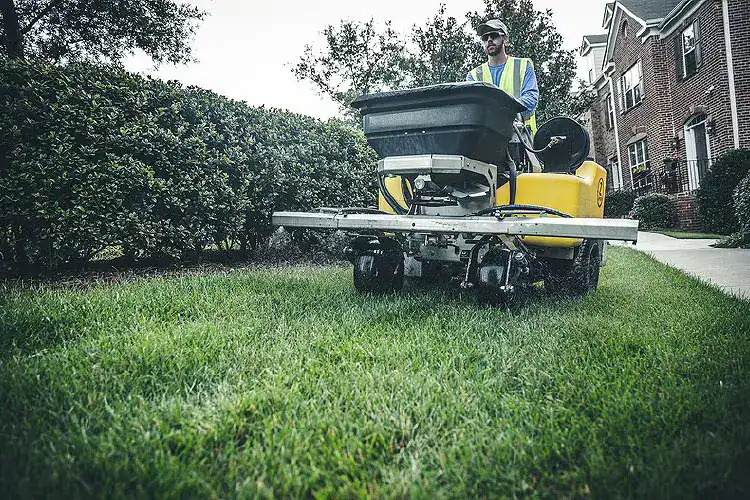
Liquid lawn fertilizer isn’t a new concept, but the way we apply it professionally is very different from anything available to a homeowner at the consumer level. The product matters, but so does the equipment, the calibration, and the technique — and on Long Island’s sandy, fast-draining soils, all three have to be right.
Professional liquid application delivers nutrients in a form that’s immediately available for uptake through both roots and leaf tissue. Coverage is uniform across the entire lawn, including edges, corners, and areas around obstacles where granular spreaders leave gaps. And because our equipment is calibrated for precise application rates, you’re not guessing at coverage — we’re applying exactly what the lawn needs, where it needs it.

Granular fertilizer depends on moisture to dissolve and carry nutrients into the soil. On Long Island’s sandy loam, that process is unpredictable. Water moves through quickly, and if rainfall or irrigation timing doesn’t line up with the application, granules can sit on the surface too long or flush through the root zone too fast. Either way, the lawn doesn’t get the full benefit.
Liquid fertilizer bypasses that uncertainty. The nutrients are already in solution, which means absorption begins immediately after application. On a soil type with a cation exchange capacity as low as Suffolk County’s, that faster uptake window is significant. You’re not waiting on soil chemistry to do the work — the product is already available.
There’s also the coverage question. Granular spreaders work well on flat, open turf, but most suburban lawns in Suffolk County aren’t perfectly flat or open. There are slopes, landscaping beds, tree roots, and tight areas near fences and foundations. Liquid application reaches all of it evenly. When we apply fertilizer to a lawn in Patchogue or Holbrook, we’re not leaving thin spots near the edges and hoping you won’t notice. The coverage is consistent across the entire property.
Professional liquid application also allows for more precise rate adjustments based on what the lawn actually needs at that moment in the season. In early spring, after soil temperatures cross 55°F, the rate and formulation look different than they do in late summer, when the goal is stress management rather than aggressive growth. That kind of adjustment isn’t something a bag from the store gives you — it requires a professional making a judgment call based on what they’re seeing in the turf.
This is a question worth asking carefully, because the answer has real consequences. In New York State, any business that applies pesticide-containing products for hire — including combination fertilizer and weed control products — must be registered with the NYS Department of Environmental Conservation and employ at least one certified commercial pesticide applicator. That certification requires a 30-hour training course, a state examination, and ongoing continuing education. It’s not a formality. It’s a legal requirement with enforcement behind it.
Hiring an unlicensed operator isn’t just a quality risk. It’s a liability risk for you as the homeowner. If something goes wrong — a lawn gets damaged, a product is misapplied, a neighbor complains — you want the company you hired to be operating legally and accountably.
Beyond licensing, there are practical things to look for. How long have they been operating in Suffolk County specifically? Do they explain what they applied after each visit, and why? Do they know about the November 1 through April 1 blackout period and schedule accordingly? Do they understand the phosphorus rules under New York State’s Nutrient Runoff Law? These aren’t trick questions — a qualified local operator should answer all of them without hesitation.
We’ve been a licensed, owner-operated lawn care business in Suffolk County since 1987. Every job gets the same level of attention — not a rotating crew of unfamiliar faces, but consistent, professional service from people who know Long Island lawns. Our trucks are on the road across Suffolk County every week, and every person on our team is a licensed pesticide professional, not a labor-only crew. That distinction matters when the product being applied is going into your soil, your groundwater, and ultimately the waterways — the Great South Bay, the Peconic Estuary — that make living out here worth it.
If you’re comparing lawn fertilizer service options in Suffolk County, ask the companies you’re considering whether they’re DEC registered, whether they complete the county’s turf management course requirements, and whether they can explain their fertilizer formulation. The answers will tell you a lot.
The best lawn fertilizer for your property isn’t the one with the most impressive label or the lowest price per bag. It’s the one formulated for your soil, applied at the right time, by someone who knows what they’re doing and is legally qualified to do it.
Long Island lawns have specific needs — Haven Loam soil that drains fast, cool-season grasses with precise feeding windows, and county regulations that most homeowners don’t know exist until they’ve already violated them. A store-bought product applied on a Saturday in March doesn’t account for any of that.
If you’re ready to stop guessing and start seeing real results, we’ve been helping Suffolk County homeowners do exactly that since 1987. Reach out and we’ll take a look at what your lawn actually needs.
Summary:
Article details:
Share: