Maintenance or renovation — the answer changes everything about what you'll spend. Here's how to read your lawn and budget accordingly in Suffolk County.
If you’ve been paying for lawn care and still cringing every time you pull into the driveway, you’re not alone. A lot of Suffolk County homeowners are stuck in the same loop — spending money each season, seeing modest results, and never quite figuring out whether the problem is the service, the program, or the lawn itself. The answer usually comes down to one question: does your lawn need maintenance, or does it need a renovation? They’re not the same thing, and they don’t cost the same thing. Here’s what you need to know before you make another call or sign another contract.
Lawn maintenance cost in Suffolk County typically runs between $100 and $500 per month, depending on property size, what’s included, and how often a crew is out. Mid-tier programs that combine mowing with four to six fertilization applications timed to Long Island’s growing season generally land in the $250 to $350 per month range. On the national scale, the average per-visit cost is around $123, but the Northeast consistently runs higher — expect $75 to $150 per visit for quality work in this market.
Annual plans from national chains run $558 to $890 per year for full-service coverage, though those programs are built around national averages, not the specific conditions in Centereach, Coram, Port Jefferson Station, or the rest of Suffolk County. What you pay matters less than what you get for it.
Breaking it down by service type gives you a clearer picture. Core aeration averages around $175 for a standard residential lot. Lawn fertilization runs $67 to $405 depending on property size and the number of applications in the program. Weed control treatments typically fall between $50 and $210 per visit. Overseeding costs vary widely based on how much ground needs to be covered and what method is used — standard overseeding is significantly less expensive than power seeding, though power seeding delivers far better results on lawns that are genuinely struggling.
Here’s something that doesn’t get talked about enough: the soil under your lawn changes what these services cost and how well they work. Suffolk County’s dominant soil type is Haven Loam — a sandy loam that drains quickly and leaches nutrients at roughly twice the rate of clay-heavy soils found in other parts of the country. That means a fertilizer schedule designed for a lawn in Ohio or the Carolinas is going to underperform here. You’ll likely need more frequent applications, and the product itself matters more than it would in a market with denser soil.
That’s one reason generic off-the-shelf fertilizers often disappoint Long Island homeowners. The chemistry isn’t calibrated for what’s actually under your grass. It’s also why programs built around a custom-blended fertilizer — formulated specifically for the conditions here — tend to produce noticeably better results than what you’d find in a national chain’s standard rotation. When the inputs are right for your soil, you stop throwing money at a lawn that never quite responds.
Coastal properties add another layer. If you’re near the Long Island Sound or close to a heavily salted road, salt exposure causes real damage that standard maintenance programs don’t address. Specialized treatments and salt-tolerant grass varieties become part of the equation, and that affects cost. It’s not an upsell — it’s just what the lawn actually needs.
The difference between a $200-per-month program and a $500-per-month program isn’t always obvious from the outside, but it’s usually significant on the inside. Lower-cost programs tend to cover the basics — mowing, maybe one or two fertilization visits, and reactive weed control when you call to complain. Higher-cost programs are typically built around a full seasonal calendar: timed fertilization, aeration, overseeding, weed and pest management, and proactive adjustments based on how the lawn is actually responding.
There’s also a licensing question that most homeowners don’t think to ask. In New York State, any company applying pesticides or certain fertilizers commercially is legally required to employ a NYSDEC-certified pesticide applicator. That’s not optional — it’s state law. A licensed applicator has passed a state exam, completed a 30-hour training course, and renews their certification every three years with continuing education. An unlicensed crew applying herbicides or fertilizer in Suffolk County is operating illegally, and more practically, they often don’t know enough to do it right.
When you’re comparing lawn care services prices, ask whether the company employs licensed pesticide professionals. It narrows the field quickly. It also explains part of the cost difference — licensed expertise isn’t free, but it’s the reason some programs actually work and others just run up a tab.
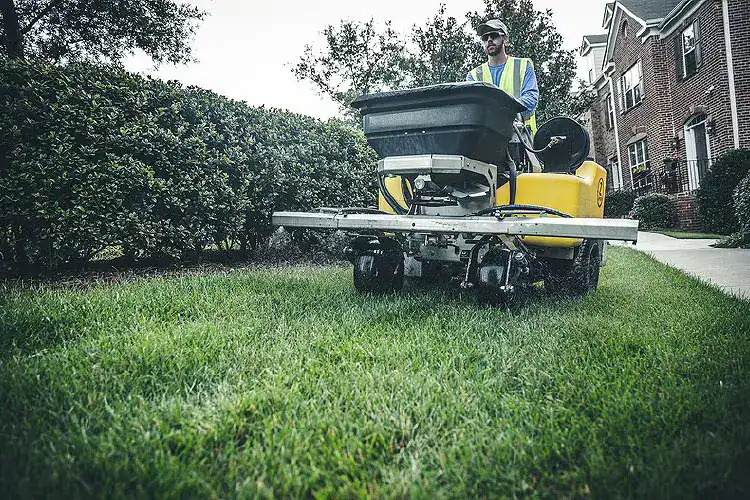
Equipment matters too. There’s a meaningful gap between the hydraulic aerators used by serious lawn care companies and the rental-grade machines that many operators bring to the job. Hydraulic aerators penetrate deeper, pull cleaner cores, and can make more passes efficiently. If aeration is part of your program — and for most Suffolk County lawns it should be — the equipment doing the work directly affects the result.
Want live answers?
Connect with a Lawn Master of Suffolk expert for fast, friendly support.
This is the question most lawn care companies don’t want to answer honestly, because the answer sometimes means recommending a bigger upfront investment instead of locking you into a recurring maintenance plan. The industry standard is straightforward: if more than 50 to 60 percent of your lawn is weeds, bare patches, or the wrong grass entirely, basic maintenance isn’t going to fix it. You need a renovation.
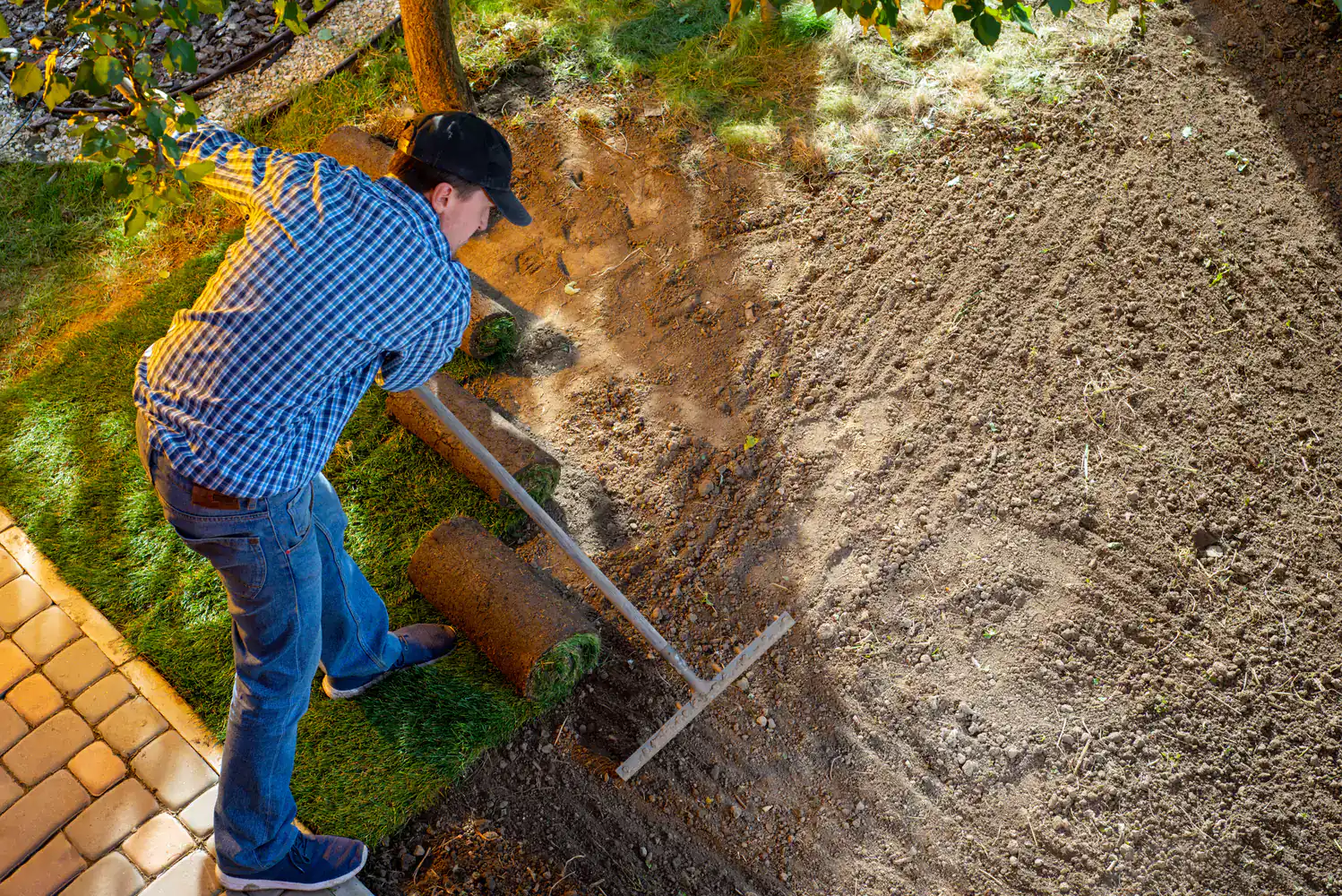
Lawn renovation cost nationally runs $2 to $5 per square foot, or roughly $2,000 to $7,000 for a standard residential yard. That sounds like a lot until you compare it to years of maintenance spending that produces marginal improvement — or to the cost of new sod, which runs 20 to 30 times more per square foot than aerating and seeding.
The math on renovation vs. repeat maintenance is something most homeowners only run after they’ve already spent more than they needed to. If you’re putting $300 to $400 per month into a lawn that’s fundamentally broken — compacted soil, invasive weeds like nutsedge taking over, bare spots that reseed themselves with the wrong grass — you can spend $3,600 to $4,800 in a year and end up with a lawn that looks nearly identical to where you started.
A well-executed renovation addresses the root cause instead of managing the symptoms. That might mean core aeration to break up compacted soil so fertilizer can actually reach the root zone. It might mean power seeding — which costs roughly twice as much as standard overseeding but delivers dramatically better results on severely degraded turf. For lawns with significant nutsedge or bentgrass problems (both are common and stubborn on Long Island), it means targeted specialty treatments that standard weed control programs simply don’t cover.
The timeline matters too. A renovation done right in early fall — which is the single most important lawn care window for cool-season grasses in Suffolk County — sets the lawn up to fill in through October, store energy over winter, and emerge in spring in genuinely better shape. Fall is when tall fescue, Kentucky bluegrass, and perennial ryegrass (the grasses most Suffolk County homeowners have) grow most vigorously. Skipping fall treatment or doing it wrong means starting the next year behind.
Nearly half of the lawns we assess in this region could benefit from intensive power seeding rather than standard overseeding. That’s not a sales pitch — it’s a reflection of how many lawns have been under-treated or treated with the wrong approach for too long. The good news is that most of those lawns don’t need to be torn out and sodded. They need the right program, the right timing, and the right hands doing the work.
Renovation cost in Suffolk County is shaped by a few factors that don’t apply the same way in other markets. The first is soil. Haven Loam’s sandy, fast-draining profile means that without proper aeration, even the best seed and fertilizer won’t perform the way it should. Renovation programs that skip aeration or use lightweight equipment are cutting corners that show up in the results — and in the follow-up costs when the lawn doesn’t recover the way it should.
The second factor is legal. Suffolk County falls under New York’s Nutrient Runoff Law, which restricts nitrogen fertilizer applications during specific blackout periods — typically November 1 through April 1. The reason is straightforward: Long Island sits on a sole-source aquifer that supplies drinking water to most of the island’s three million residents. Improper fertilizer application here doesn’t just hurt a lawn; it can contaminate the water supply. A licensed professional knows these windows and builds programs around them. An unlicensed operator often doesn’t, and homeowners can face liability as a result.
The third factor is what the renovation actually includes. A program that uses hydraulic seeders and aerators, custom-blended fertilizer calibrated for Long Island’s soil, and licensed applicators on every visit is going to cost more than a program that doesn’t. It’s also going to produce different results. When you’re getting quotes for lawn renovation in Setauket, Selden, Miller Place, or anywhere else in Suffolk County, those are the questions worth asking: What equipment are you using? Are your applicators licensed? Is the fertilizer formulated for this soil?
We’ve been treating lawns across Suffolk County since 1987. That’s long enough to have seen what works here and what doesn’t — and long enough to know that the lawns that come back strongest are the ones where the program was built around the actual lawn, not a national template.
Whether your lawn needs maintenance or a full renovation, the most expensive mistake is paying for the wrong one. Repeated basic treatments on a lawn that needs renovation will drain your budget without fixing the problem. And jumping straight to a full renovation when targeted maintenance would do the job costs more than it should.
The right starting point is an honest assessment — one that looks at your actual soil, your grass type, your weed pressure, and what the lawn has been through. From there, the program should be built around what your lawn needs, not what’s easiest to sell.
If you’re in Suffolk County and you’ve been going in circles with your lawn, we’ve been doing this work here since 1987. Reach out and let’s take a look at what’s actually going on before you spend another dollar guessing.
—
**Frequently Asked Questions**
**What factors affect lawn maintenance costs in Suffolk County?** Property size is the most obvious one, but it’s not the only one. Suffolk County’s sandy loam soils require more frequent fertilization than national programs account for, which affects the number of visits and the products used. Coastal salt exposure, the presence of invasive weeds like nutsedge or bentgrass, and whether your lawn needs aeration alongside fertilization all influence the total cost. New York’s fertilizer blackout periods also shape the seasonal calendar — a licensed professional builds their program around these windows; an unlicensed one often doesn’t, which can create problems down the line.
**How much does lawn renovation cost compared to regular maintenance?** Nationally, lawn renovation runs $2 to $5 per square foot, or $2,000 to $7,000 for a standard residential yard. Regular maintenance in Suffolk County typically runs $100 to $500 per month depending on what’s included. The comparison that matters most is cumulative: if you spend $3,500 or more annually on maintenance that isn’t improving a fundamentally broken lawn, a one-time renovation often costs less in the long run and delivers results that maintenance alone never will.
**When do I need a renovation instead of just maintenance?** The industry benchmark is when more than 50 to 60 percent of your lawn is weeds, bare patches, or the wrong grass type. At that point, overseeding and fertilizing what’s there won’t produce a lawn you’re happy with. You need to reset the turf, address the soil, and give the right grass a real chance to establish — which is what a proper renovation does.
**Is professional lawn care worth it compared to DIY in Suffolk County?** For most Suffolk County homeowners, yes. DIY equipment startup costs $500 to $2,500, annual supplies run $200 to $600, and the time commitment is roughly 50 to 60 hours per year for a quarter-acre property. Add in the cost of fixing mistakes — wrong fertilizer, poor timing, missed applications during blackout periods — and the gap between DIY and professional narrows quickly. A well-maintained lawn also adds 15 to 20 percent to property value, which puts the cost of professional care in a different frame entirely.
**What’s the difference between a custom lawn program and a generic package?** A generic package applies the same treatment schedule to every lawn regardless of what that lawn actually needs. A custom program starts with an assessment — your soil type, your grass variety, your weed pressure, your history — and builds a schedule around those specifics. On Long Island, where Haven Loam soils leach nutrients faster than most and where cool-season grasses have a very specific seasonal rhythm, that difference shows up clearly in the results by the end of the first full season.
Summary:
Article details:
Share: