Hear from Our Customers
If you’ve reseeded the same dead patch two or three times and it keeps dying in the same spot, the problem isn’t your seed. It’s an active fungal disease that was never properly identified and new grass simply cannot establish in soil where a pathogen is still present. That cycle ends when you treat the actual disease first.
Holbrook’s soil is part of Long Island’s post-glacial outwash plain, which means most lawns here sit on sandy loam fast-draining, low in organic matter, and prone to drought stress during July and August. That’s exactly when dollar spot thrives. Add in the humidity that builds up between the LIE corridor and Sunrise Highway, and you have near-perfect brown patch conditions from June through August. These aren’t abstract risks they’re what’s happening in Holbrook neighborhoods every summer.
Once the right fungicide is matched to the right disease and applied at the right time, your lawn stops declining and starts recovering. The brown circles stop spreading. The thin, straw-colored patches fill back in. And when fall comes and it’s time to overseed, your investment in new grass actually takes because the ground it’s going into is clean.
Lawn Master of Suffolk is a New York State DEC licensed commercial pesticide applicator. That license isn’t a background credential buried in fine print it’s what separates a professional fungicide treatment from someone showing up with a bag from the garden center on Veterans Memorial Highway. Under New York State law, applying pesticides for hire without that license is illegal. A lot of operators in the Holbrook market either don’t hold it or don’t mention it. We do both.
That license also means access to restricted-use fungicide chemistries professional-grade formulations with active ingredients like azoxystrobin and propiconazole that aren’t sold at any retail store. These are the same products used on golf courses and professional sports turf. When you hire us, that’s what’s going on your lawn.
We serve homeowners across Suffolk County, including throughout Holbrook from the neighborhoods near Sachem North’s side of town all the way through to the Timber Ridge area. We know this soil. We know this climate. And we document every application in writing, which New York State requires of licensed applicators and which most unlicensed operators simply cannot provide. When a lawn can’t be saved, our new lawn installation in Holbrook starts over the right way.
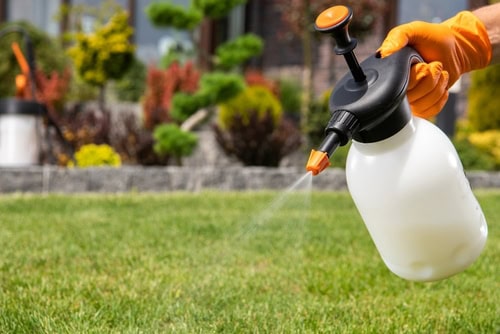
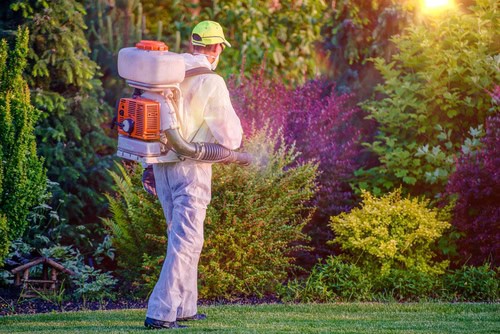
The first thing that happens isn’t a spray. It’s an assessment. A licensed applicator looks at your lawn the size of the affected areas, the pattern of spread, the color and texture of the damage and identifies which fungal pathogen is actually present. Brown patch, dollar spot, and red thread all look somewhat similar to an untrained eye, but they require different chemistries, respond to different timing, and thrive under different conditions. Treating the wrong one wastes your money and leaves the real problem untouched.
Once the disease is confirmed, the right fungicide is selected based on the specific pathogen, your grass type, and where we are in the season. For Holbrook lawns, timing matters a lot. Brown patch pressure typically builds in late June as nighttime temperatures climb past 70°F which happens consistently here, especially in lower-lying sections of the hamlet closer to Lake Ronkonkoma where humidity tends to linger. Preventative applications before visible symptoms appear are significantly more effective than waiting for active disease to spread across the lawn.
We also rotate fungicide modes of action across the season. This isn’t standard practice in the consumer DIY market, but it’s essential for long-term effectiveness using the same chemistry repeatedly creates resistance, which is why some Holbrook homeowners find that the same product stops working after a season or two. Professional rotation prevents that from happening.
Ready to get started?
The three fungal diseases most common on Long Island’s sandy, coastal soils are brown patch, dollar spot, and red thread and Holbrook lawns deal with all three at different points in the season.
Brown patch is the most destructive in terms of speed. It can take out large sections of a Holbrook lawn within days when nighttime temperatures stay above 70°F and humidity is elevated which describes most of July and August here. The damage shows up as circular brown areas with a darker outer ring, and it spreads fast. This is where professional-grade fungicide application in Holbrook, NY makes the biggest visible difference, because consumer-grade products typically can’t match the systemic action of restricted-use chemistries.
Dollar spot hits differently. It’s smaller silver-dollar-sized straw patches but it can spread across an entire lawn in drought conditions, which Holbrook’s fast-draining sandy soil makes more likely. It’s also one of the diseases most prone to fungicide resistance, which is why chemistry rotation is built into our program. Red thread is the cool-season problem: it shows up in April and May, and again in September and October, when nitrogen is low and temperatures drop back into the 60s. For Holbrook’s older lawns most of which were established during the 1960s and 1970s housing boom red thread is a recurring fall issue that gets worse without a targeted fungicide application before overseeding season begins. Every application comes with written documentation as required by the NYSDEC, so you always know exactly what was applied and when.
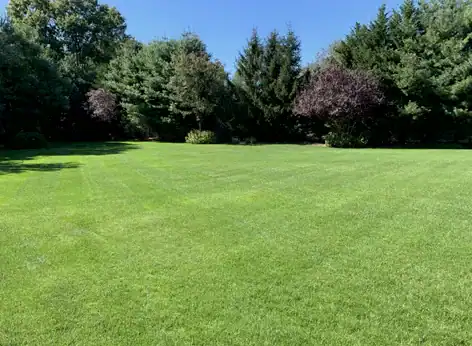
The most likely explanation is brown patch fungus specifically Rhizoctonia solani which thrives in the warm, humid conditions that central Suffolk County sees consistently from June through August. Holbrook’s position between the LIE and Sunrise Highway creates localized heat retention, and the proximity to Lake Ronkonkoma adds atmospheric moisture that lingers over nearby neighborhoods. That combination is nearly ideal for brown patch to develop and spread.
The reason it keeps coming back in the same spot is that the fungal pathogen overwinters in the soil and thatch layer. If the disease was never properly treated only masked by reseeding or a consumer-grade spray the pathogen is still there the following summer, waiting for the right temperature and humidity conditions to activate again. A professional fungicide treatment targets the pathogen directly with restricted-use chemistry that suppresses it at the soil level, which is what actually breaks the cycle.
This is one of the most common misdiagnoses on Long Island, and it’s costly because the fix for drought stress (water more) can actually make fungal disease worse. The key visual difference is pattern and texture. Drought stress typically causes uniform thinning and browning across open, sun-exposed areas of the lawn, and the grass blades will be dry and crisp but still attached at the crown. Fungal disease, by contrast, tends to appear in circular or irregular patches, often with distinct borders, and the grass may show discoloration, lesions, or a water-soaked appearance at the edges of the affected area.
In Holbrook specifically, the sandy loam soil drains fast enough that drought stress is a real possibility during dry stretches but that same drought stress weakens the turf and makes it more susceptible to dollar spot. It’s not always one or the other. A licensed applicator can read both conditions simultaneously and recommend the right course of action, which is why a professional assessment matters more than a visual guess from a product label.
Red thread is a cool-season fungal disease caused by Laetisaria fuciformis. It appears as pink or reddish thread-like strands extending from the grass blades which is how it gets its name and it spreads in patches that can reach 8 feet or more from a single infection point. The disease is most active when temperatures are between 60 and 75°F and nitrogen levels in the soil are low, which on Long Island typically means April through May and again in September and October.
For Holbrook homeowners, red thread is a particular concern in the fall because that’s also prime overseeding season. If you’re planning to overseed thin or bare areas of your lawn, active red thread needs to be treated first seeding into an infected lawn wastes both the seed and the labor. Holbrook’s mature housing stock, with lawns established in the 1960s and 1970s, often contains older cool-season grass varieties like tall fescue and perennial ryegrass that are more susceptible to red thread than newer disease-resistant cultivars. A targeted red thread fungicide application before overseeding protects that investment.
Yes. Under New York State law, any business applying pesticides including fungicides for hire must be registered with the NYSDEC and employ at least one certified commercial pesticide applicator. That certification requires passing both core and category-specific exams, meeting experience or education requirements, and renewing every three years with continuing education credits. Applying pesticides for hire without this license is a violation of New York State law.
This matters practically for Holbrook homeowners for two reasons. First, a licensed applicator has legal access to restricted-use pesticide formulations that are not available at retail professional-grade chemistries that significantly outperform what you can buy at any store on Veterans Memorial Highway or Sunrise Highway. Second, New York State requires licensed applicators to provide written documentation of every application and to notify neighbors before applying pesticides to a residential property. That accountability layer protects you, your family, and your neighbors and it’s something an unlicensed operator simply cannot offer.
Consumer-grade fungicides sold at retail stores are formulated at lower concentrations than the restricted-use products available to licensed applicators. They’re also typically broad-spectrum meaning they’re designed to address multiple diseases at a general level rather than target a specific pathogen with precision. If your lawn has brown patch, applying a product formulated for general disease suppression may reduce visible symptoms temporarily without actually suppressing the pathogen at the soil level.
There’s also a resistance issue. Many Holbrook homeowners apply the same consumer product season after season, and dollar spot in particular is highly prone to developing resistance to repeated applications of the same fungicide chemistry. When that happens, the product stops working not because your lawn is unusually difficult, but because the pathogen has adapted. Professional fungicide programs rotate chemistries across the season specifically to prevent this, which is why a lawn that hasn’t responded to store-bought products often responds quickly to a professionally calibrated fungicide program in Holbrook, NY.
Fall is actually one of the most important treatment windows for Holbrook lawns, and it’s the one most homeowners overlook. Red thread fungus peaks in September and October as temperatures cool back into the 60s and nitrogen levels in the soil drop heading into dormancy. If you’re planning to overseed which most Holbrook homeowners do in September to repair summer damage active fungal disease needs to be addressed before new seed goes down. Seeding into infected soil is one of the most common reasons fall overseeding fails.
Beyond red thread, fall is also when the fungal pathogens responsible for brown patch and dollar spot begin to overwinter in your thatch layer. Holbrook’s older lawns, many with 50 or more years of thatch accumulation since the 1970s housing boom, provide an especially hospitable environment for pathogens to survive the winter and reactivate the following June. A fall fungicide application timed correctly before temperatures drop below 50°F reduces the pathogen load going into winter and gives your lawn a cleaner starting point in the spring. It’s not a glamorous treatment, but it’s often the one that makes the biggest difference in how your lawn looks the following summer.
Useful Links
Other Services we provide in Holbrook