Hear from Our Customers
When your fertilization program is built around your actual soil not some average suburban lot somewhere else on the island the difference shows up fast. Thicker turf. Less crabgrass forcing its way through. Fewer bare patches that come back every spring no matter what you put on them.
Farmingville sits directly on the Ronkonkoma Moraine, and that geology matters more than most homeowners realize. The soils here are coarse and drain fast which means nutrients from a generic fertilizer can move right through the root zone before your grass ever gets to use them. A program calibrated to that drainage pattern holds nutrients where they need to be, longer.
The tree coverage in Farmingville is also higher than average for central Suffolk County. Shaded lawns compete with root systems for moisture and nutrients, and they need a different fertilization approach than a wide-open full-sun yard. When those conditions are factored in from the start, you stop chasing problems every season and start seeing a lawn that actually holds up.
We’ve been working in Suffolk County since 1987. That means we’ve been treating lawns in Farmingville and the surrounding communities Holbrook, Selden, Centereach, Ronkonkoma longer than most of our customers have lived here. We know this ground because we’ve spent decades on it.
Every job gets a licensed pesticide professional, not a seasonal crew member handed a spreader for the summer. The fertilizer we use isn’t pulled off a commercial shelf it’s a custom blend formulated specifically for our programs, built for Long Island turf. And we show up in one of five fully wrapped trucks, on schedule, doing the job the same way every time.
Farmingville homeowners invest seriously in their properties. With median home values pushing $635,000 and a community that takes visible pride in how things look, your lawn is worth treating like the asset it is.
It starts with understanding your specific property. Slope, shade coverage, soil condition, what’s been done before all of it shapes what your lawn actually needs. A south-facing yard near Bald Hill behaves differently than a flat, shaded lot a few streets over. That assessment drives the program, not the other way around.
From there, applications are timed around what cool-season turf in this part of Long Island actually responds to. Early fall is the most critical window mid-August through late September is when aeration and overseeding do the most work, and when a well-timed fertilizer application sets your lawn up for the following spring. Summer applications are managed carefully given how quickly Farmingville’s moraine soils dry out during heat stretches without coastal breezes to moderate the temperature.
One thing that’s non-negotiable in Suffolk County: no fertilizer goes down between November 1st and April 1st. That’s county law, and it carries a $1,000 fine. Every application we make is timed, documented, and compliant including the neighbor notification requirements for spray applications. You don’t have to think about any of that. We handle it.
Ready to get started?
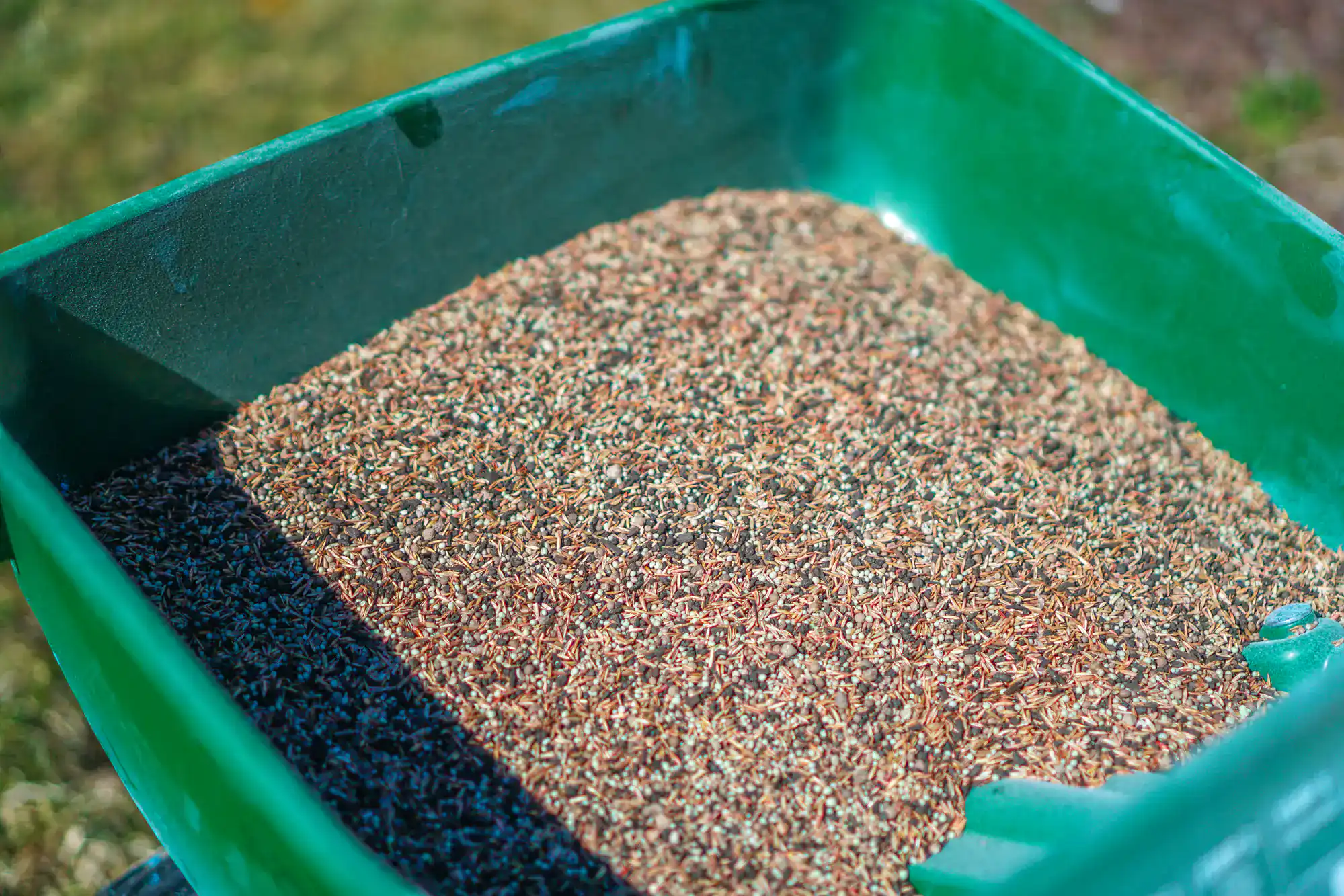
Our fertilization program covers the full picture not just the application itself, but the timing, the product, and the follow-through. The custom-blended fertilizer we use is formulated specifically for our programs, which means you’re not getting the same commodity product available at any big-box store. Slow-release formulations are selected based on your soil’s drainage rate, which matters a lot on Farmingville’s moraine terrain where nutrients can leach out quickly.
Weed control is built into the program as well. Nutgrass and bentgrass are real problems in central Suffolk County, and they require specific treatment not just a broadleaf spray that handles the easy stuff. If your lawn has compaction issues, which is common on older Farmingville properties with decades of foot traffic and freeze-thaw stress on coarse moraine soils, core aeration with our hydraulic equipment creates the channels that let water, air, and nutrients actually reach the root zone. Tow-behind aerators don’t pull plugs deep enough to make a meaningful difference on compacted ground.
If the lawn is past the point where a maintenance program can fix it, we also handle full lawn restoration and new installations from seed. Most competitors in this market offer fertilization and weed control only if your Farmingville property needs a real reset, that’s a complete service we can deliver from start to finish.
Suffolk County law prohibits fertilizer applications between November 1st and April 1st. This applies to all residential properties in Farmingville and throughout the county, and violations carry a fine of up to $1,000. The restriction exists to protect Long Island’s sole-source aquifer the underground water supply that the entire island depends on for drinking water.
In practical terms, this means your active fertilization window runs from early April through the end of October. The most important applications for cool-season turf are in early fall typically September when the grass is coming out of summer stress and actively growing again before dormancy. Spring applications are valuable too, but fall is where the real work happens for a Farmingville lawn. We know this schedule and plan around it automatically on every job.
Persistent bare spots on a Farmingville property usually come down to one of a few things: compacted soil that won’t let roots establish, fast-draining moraine soil that dries out faster than the grass can recover, heavy shade from tree canopy competing for moisture and nutrients, or a fertilization program that isn’t calibrated to those conditions. Applying more fertilizer to a compacted or drought-stressed lawn doesn’t fix the underlying problem it just adds more of something the roots can’t fully use.
The fix typically involves core aeration to break up compaction, followed by overseeding and a properly timed fertilization program. The best window for that work in Farmingville is mid-August through late September. If the bare areas are severe or widespread, a full lawn restoration from seed may be the more practical path especially on older Farmingville properties where the original turf was established on moraine soil without much preparation.
Bag fertilizers from a hardware store are formulated for a broad, generalized market they’re designed to work adequately across a wide range of soil types and conditions. They’re not designed for the specific drainage characteristics of Long Island’s moraine soils, the cool-season grass varieties common in central Suffolk County, or the shaded, hilly conditions that many Farmingville properties deal with. You’re essentially applying an average product to a specific problem and hoping for the best.
A custom-blended program accounts for how quickly your soil releases and retains nutrients, what grass types are present, what time of year the application is happening, and what your lawn’s history looks like. The fertilizer we use is blended specifically for our programs not sourced from a distributor and rebranded. That distinction matters when your soil drains as fast as Farmingville’s moraine terrain does, because the formulation has to hold nutrients in the root zone long enough for the grass to actually absorb them.
No and for most Farmingville homeowners, that’s the whole point. A lot of residents here commute, whether that’s via the LIE or over to the Ronkonkoma LIRR station, and they’re not home during the day to supervise a service visit. Our process is built around that reality. You don’t need to be present for the application, and you’ll receive notification that the work was completed.
After certain spray applications, DEC regulations require yellow flags to be placed on the treated lawn, notifying anyone entering the yard to wait at least 24 hours before going back on the grass. That’s a state requirement, and it’s handled automatically on every applicable job. If you have kids or pets, that 24-hour window is the main thing to plan around but other than that, the service is designed to run without requiring anything from you on the day of the visit.
The honest answer is that most lawns in Farmingville benefit from aeration, especially properties where the home was built in the 1950s or 1960s and the lawn has been walked on, driven near, and freeze-thawed for decades without any core aeration work. Compaction builds up gradually and isn’t always obvious from the surface but if water pools in areas after rain, if the lawn feels hard underfoot, or if fertilizer doesn’t seem to be making a noticeable difference, compaction is usually a factor.
On moraine soils specifically, aeration does more than just break up compaction. It creates channels for water and nutrients to move past the coarse surface layer and actually reach the root zone. We use hydraulic aerators commercial-grade equipment that pulls deeper plugs than the tow-behind units most smaller operators use. On a sloped Farmingville lot where runoff is already a challenge, that deeper penetration is the difference between a fertilizer application that feeds the roots and one that washes toward the street.
In New York State, any business applying pesticides for hire is required to register with the NYSDEC and employ at least one certified commercial pesticide applicator. That certification requires passing state exams and recertifying every three years with continuing education. A general landscaper who mows and trims isn’t automatically qualified or legally permitted to apply fertilizer and weed control products on your property.
Farmingville is the seat of Brookhaven Town government. Brookhaven Town Hall sits right here on Independence Hill, which means regulatory awareness and code enforcement in this community tend to be more visible than in some other hamlets. Hiring an unlicensed operator for pesticide applications isn’t just a quality risk it can create liability for the homeowner if an illegal application is made on your property. Our team is fully licensed, documented, and compliant with every Suffolk County and state requirement, including the neighbor notification rules that apply to spray applications within 150 feet of adjacent properties.
Useful Links
Other Services we provide in Farmingville