
Hear from Our Customers
Most lawns in the Three Villages area are not struggling because the homeowner is doing something wrong. They are struggling because the soil underneath them is working against every generic product being applied. Long Island’s glacially deposited soils are sandy, low in organic matter, and naturally acidic with North Shore topsoil pH values that can drop as low as 3.8 in residential areas. At that acidity level, your grass physically cannot absorb the nutrients in standard fertilizer, no matter how often it gets applied.
When the chemistry is corrected and the right program is in place, the difference shows up fast. Turf thickens, color deepens, and the thin or patchy areas that have been a problem for years start filling in. The shaded sections under the oaks and maples which are everywhere on North Shore properties stop thinning out because the program accounts for them specifically, not as an afterthought.
What you end up with is a lawn that holds up through summer heat, bounces back after stress, and does not require you to constantly wonder whether the company you hired is actually showing up and doing the job right. That last part matters just as much as the product.
We’ve been treating lawns in Suffolk County since 1987. That is not a marketing number it is a specific, verifiable fact that reflects decades of real experience with Long Island’s soil conditions, pest cycles, drought years, and turf diseases. We were working in the Three Villages area and around Stony Brook University long before most of the current competitors in this market existed.
Every technician who comes to your property holds a valid NYS DEC Commercial Pesticide Applicator Certificate a state credential that requires 30 hours of approved training, a written exam, and supervised field experience. This is not a business license. It is a professional qualification specific to pesticide application, and it means the person treating your lawn knows what they are applying, at what rate, and why.
The fleet of five fully wrapped trucks you may have already seen on Route 25A or Nicolls Road is not an accident. It is what a real, established operation looks like after nearly 40 years of doing the work right.
Before anything gets applied, we assess your lawn. Sun exposure, soil conditions, turf species, shade coverage from the mature canopy that defines so many North Shore properties, existing weed or pest pressure, and the overall health of what is already there. That assessment shapes the entire program because a shaded lot off a wooded street near the university has completely different needs from a full-sun property south of Route 347, and treating them the same way produces mediocre results on both.
From there, we apply a custom-blended fertilizer formulated specifically for our programs and for Long Island’s soil conditions. This is not an off-the-shelf product available to any operator with a wholesale account. It is a proprietary formulation calibrated for the nutrient deficiencies and leaching rates that are specific to the glacially deposited, sandy soils found throughout this area.
Timing is built around Suffolk County’s fertilizer blackout period, which runs November 1 through April 1 and prohibits nitrogen and phosphorus applications on turf. Every treatment window spring pre-emergent, early summer grub prevention, late summer aeration and overseeding, fall winterizer is scheduled around both the regulatory calendar and what your specific lawn actually needs at that moment in the season.
Ready to get started?
Our programs cover the full range of what a North Shore lawn needs across a season: fertilization with our custom-blended proprietary product, weed control, grub and pest management, aeration with hydraulic equipment that reaches three to four inches into compacted soil rather than the one-inch depth a rental-grade drum aerator delivers, overseeding with turf varieties appropriate for your specific conditions, and lime application where pH correction is needed. If your lawn is beyond routine maintenance grub damage that was never properly restored, years of thin and weedy turf, or bare soil from a renovation or construction project we also offer full lawn restoration and new installs from seed.
The grub prevention window matters more in this area than many homeowners realize. Japanese beetle pressure throughout the North Shore is significant, and the mix of ornamental plantings and established turf surrounding the Stony Brook University campus creates ideal conditions for egg-laying adults each summer. Preventive treatment applied in early summer stops the root damage before it happens. Waiting until dead patches appear in August means the damage is already done.
Suffolk County’s proximity to the sole-source aquifer that supplies all of Long Island’s drinking water is part of why every application is calibrated precisely correct rates, correct products, correct timing. That is what licensed professionals do, and it is the standard every Lawn Master visit is held to.
The most common reason is soil pH. The North Shore’s glacially deposited soils tend to run acidic, and residential sites in this area have recorded topsoil pH values as low as 3.8. Cool-season turf grasses need a pH between 6.0 and 7.0 to absorb nutrients effectively. If your soil is sitting at 4.5 or lower, the fertilizer you are applying is essentially unavailable to the grass the chemistry blocks uptake regardless of how much product goes down.
The fix is not more fertilizer. It is lime application to correct the pH, followed by a fertilizer program calibrated for the nutrient deficiencies and leaching rates specific to Long Island’s sandy soils. Once the chemistry is right, the same lawn that refused to respond for years will start showing real improvement within a single growing season. A soil test is the starting point it tells you exactly what you are working with before anything gets applied.
The timing question comes up every spring, and the answer in Suffolk County is more specific than most people expect. The county’s fertilizer blackout period runs from November 1 through April 1, prohibiting nitrogen and phosphorus applications on turf during those months. Violations carry fines of up to $1,000 per application, and the rules apply to commercial applicators and homeowners alike.
Once the blackout lifts on April 1, the spring window opens but the most important single application of the year for cool-season turf is actually the fall winterizer, applied in October before the November 1 cutoff. That application feeds root development through the dormant period and drives the green-up you see in spring. Missing it is one of the most common reasons lawns in this area look thin and slow to recover after winter. A properly timed program works with the regulatory calendar, not around it.
The classic sign is dead patches appearing in late August or September that do not respond to watering. If you can pull the turf back like a loose carpet because the roots have been eaten through grubs are almost certainly the cause. Japanese beetle larvae are the primary culprit throughout the North Shore, and the mix of ornamental plantings and mature turf surrounding the Stony Brook University area creates conditions that attract heavy egg-laying populations each summer.
The problem with waiting for visible damage is that by the time the patches appear, the root destruction is already done. Preventive grub control applied in early summer when adults are laying eggs and larvae are small and close to the surface stops the damage before it starts. Curative treatments applied after the fact can reduce the population, but they cannot restore the root system that has already been destroyed. That requires overseeding and a recovery program, which adds time and cost that preventive treatment would have avoided entirely.
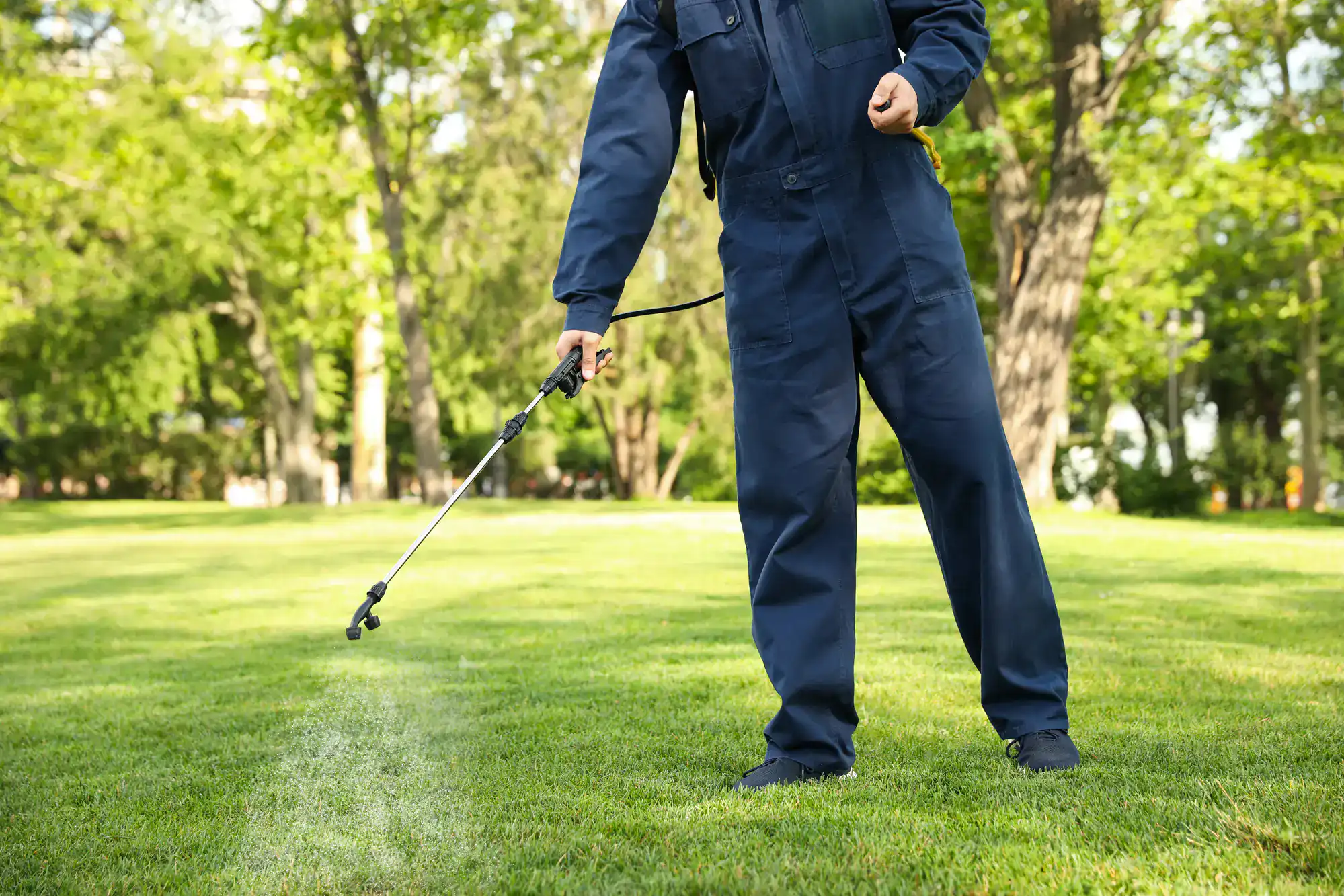
In New York State, any person applying pesticides commercially is required to hold a valid NYS DEC Commercial Pesticide Applicator Certificate in the appropriate category. Getting that credential requires 30 hours of approved training, passing a state examination covering pesticide chemistry, application techniques, safety, environmental impact, and integrated pest management, and demonstrating at least two years of supervised experience. It is a meaningful qualification not a formality.
An unlicensed applicator is not just cutting a corner on paperwork. They are applying products they may not fully understand, at rates they may not be calculating correctly, in a county with strict fertilizer regulations designed to protect the sole-source aquifer that supplies all of Long Island’s drinking water. In a community as close to Long Island Sound and the local watershed as the Stony Brook area, the difference between a calibrated professional application and an unlicensed guess matters. You can verify any commercial applicator’s license through the NYS DEC before you hire them and it is worth doing.
Aeration is genuinely one of the most useful things you can do for a Long Island lawn but only when it is done with the right equipment. The sandy soils in the Stony Brook area compact over time from foot traffic, mowing, and general use, and compacted soil restricts the water infiltration, air exchange, and root development that healthy turf depends on. Core aeration breaks that compaction and opens the soil profile.
The equipment distinction matters more than most homeowners realize. Lightweight drum aerators the kind many operators use and that you can rent yourself typically penetrate one inch or less into compacted suburban soil. That depth accomplishes very little. Hydraulic aerators reach three to four inches of core penetration with consistent spacing across the entire lawn, which is what actually changes how the soil behaves. When aeration is paired with overseeding in late summer or early fall the optimal timing for cool-season turf in this region seed-to-soil contact improves dramatically and the results show up clearly in the following spring.
The most meaningful difference is the fertilizer itself. Every national operator TruGreen included applies the same commercially available products that any operator with a wholesale account can purchase. We use a custom-blended fertilizer formulated specifically for our programs and for Long Island’s soil conditions. No other company in this market offers that. It is a proprietary product calibrated for the nutrient deficiencies, leaching rates, and pH challenges that are specific to the glacially deposited, sandy soils found throughout Suffolk County.
Beyond the product, the operational model is different. We have been in this specific market since 1987, which means the institutional knowledge of how North Shore soils behave across seasons, drought years, and disease cycles is real and accumulated not imported from a national franchise playbook. Every technician holds a NYS DEC Commercial Pesticide Applicator Certificate. Programs are customized to each property’s actual conditions rather than applied from a standardized route schedule. And if you have a question about what is happening on your lawn, you get a real answer from someone who knows not a call center reading from a service ticket.
Useful Links
Other Services we provide in Stony Brook University