
Hear from Our Customers
When your lawn is thin, patchy, or just plain dead-looking, it affects more than curb appeal. With median home values in East Patchogue approaching $520,000, a deteriorated lawn is real money left on the table and every season you wait makes the problem harder to reverse.
The South Shore environment is harder on grass than most homeowners realize. The sandy, fast-draining soils common throughout East Patchogue and the broader Patchogue area leach nutrients before roots can use them. Coastal humidity rolling in off Great South Bay creates the exact warm, wet conditions that brown patch and dollar spot thrive in. And grub pressure from Japanese beetle larvae one of the most common lawn destroyers in this part of Suffolk County can wipe out large sections of turf before you even notice it happening.
A properly restored lawn doesn’t just look better. It holds up through Long Island summers, resists the fungal pressure that coastal humidity brings, and stays thick enough to crowd out weeds without constant intervention. That’s the difference between a lawn that’s been treated and one that’s been genuinely fixed.
We’ve been restoring lawns across Suffolk County since the late 1980s. That’s 38 seasons of working in Long Island’s specific soil conditions, through drought years, grub cycles, and fungal outbreaks including every challenge that South Shore properties near Great South Bay regularly face. It’s the kind of experience that only comes from actually being here, doing the work, year after year in East Patchogue and the surrounding communities.
We’re NYS-licensed, which matters more than it sounds especially in East Patchogue, where Suffolk County’s fertilizer regulations are designed to protect waterways like Great South Bay. Every application we make is compliant, responsible, and calibrated for the soil and conditions on your specific property.
From the Hagerman corridor along County Road 80 to the neighborhoods closer to Montauk Highway, we know this area. Not because it’s on a map, but because we’ve been working these lawns for decades.
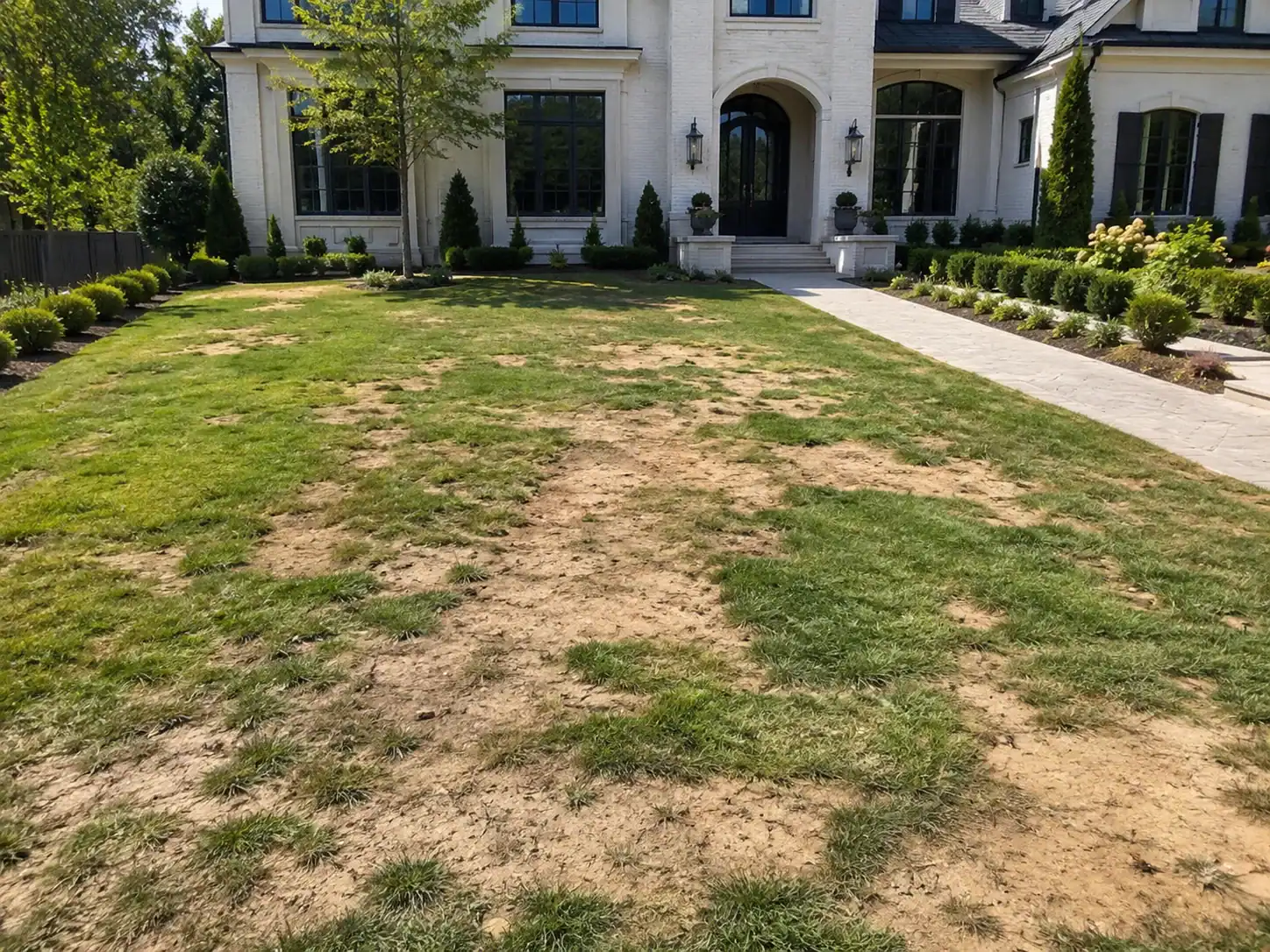
The most common reason lawn restoration fails in East Patchogue is that someone put seed down before the soil was ready to support it. Sandy South Shore soils with the wrong pH or compaction level will reject new grass no matter how much seed you use. That’s why we start with a thorough on-site assessment evaluating soil pH, drainage, thatch depth, compaction, and any active pest or disease pressure before a single product is applied.
Once the diagnosis is complete, soil correction comes first. That typically means pH adjustment through liming, organic matter amendment where needed, and addressing any active grub populations or fungal issues that would undermine new growth. On East Patchogue properties, this step is non-negotiable Haven Loam and the area’s sandy loam profiles require it.
From there, slice seeding puts new seed directly into the soil at the right depth not scattered on top where it dries out. The best window for this on Long Island is early September through mid-October, when soil temperatures still support germination but the summer heat and disease pressure have backed off. After seeding, a starter fertility program feeds the new growth through establishment. Then we assess results and transition you into a maintenance program that keeps the restoration holding long-term.
Ready to get started?
Lawn restoration is specifically for lawns that are still alive but struggling thin turf, bare patches, persistent brown areas, or overall decline that routine mowing and fertilizing haven’t solved. It is not the same as lawn renovation, which involves tearing out what exists and rebuilding from scratch. For most East Patchogue homeowners, restoration is the right first step, and it costs significantly less than a full rebuild. If your lawn genuinely can’t be saved through restoration, we’ll tell you that honestly and the renovation service is available when a full rebuild is the only real answer.
What’s included in a restoration program depends on what the diagnosis finds. At minimum, it covers soil assessment, pH correction, and slice seeding with appropriate turf varieties for Long Island’s cool-season climate. Grub damage, fungal disease, and thatch buildup each require their own targeted treatments, and those are addressed as part of the same program rather than sold as separate add-ons.
Because East Patchogue sits close to Great South Bay, every product we use is selected with Suffolk County’s water quality regulations in mind. NYS-licensed application means you’re not just getting a better lawn you’re getting one that was restored the right way, without cutting corners on compliance.
Restoration means bringing an existing lawn back to health diagnosing the root cause of the damage, correcting the soil, and rehabilitating the turf that’s already there. Renovation means removing what exists and starting over, which is more invasive, more disruptive, and significantly more expensive.
For most East Patchogue homeowners, restoration is the appropriate starting point. Even lawns that look completely dead from grub damage, drought stress, or fungal disease often have a viable soil and root environment that can support new growth once the underlying problem is corrected. The mistake most people make is assuming a bad-looking lawn needs to be torn out, when in reality it just needs the right diagnosis and the right sequence of treatment. Our process is specifically designed to determine which one you actually need before any work begins.
In most cases, yes it can be saved. The lawns that genuinely cannot be restored are those where the soil has been so severely compacted, contaminated, or structurally compromised that new growth simply cannot establish. That’s the exception, not the rule.
The more common scenario in East Patchogue is a lawn that’s been damaged by grubs, dried out by the area’s fast-draining sandy soils, or hit by fungal disease during a humid South Shore summer and then treated with the wrong solution, or no solution at all, for a season or two. By the time most homeowners call, the lawn looks worse than it actually is. A proper soil assessment almost always reveals that restoration is viable, and in those cases, it’s the smarter financial choice by a wide margin compared to a full renovation.
For fall restoration programs which are the most effective on Long Island you can expect to see germination within two to three weeks of seeding, assuming soil temperatures are still in the right range. Meaningful coverage and visible fill-in typically happens within four to six weeks. A fully established, dense lawn usually takes one full growing season to reach its final density, meaning a fall restoration will look significantly better by the following spring and reach peak condition by the following fall.
Spring restoration is possible but more complicated in Suffolk County. The timing conflicts with crabgrass pre-emergent applications, which means you either delay weed control to allow seeding or delay seeding to allow weed control neither is ideal. For East Patchogue homeowners starting the process in spring, we’ll walk you through the tradeoffs honestly so you can make the right call for your specific situation.
The most common causes in East Patchogue fall into four categories: grub damage, fungal disease, drought stress, and soil pH problems and they often show up together, which is why diagnosis matters so much.
Grub damage from Japanese beetle and European chafer larvae is extremely common on the South Shore. Grubs feed on grass roots just below the surface in late summer and fall, creating spongy, roll-up patches that look like dead turf. Fungal diseases like brown patch spread quickly in East Patchogue’s humid coastal climate, especially when nighttime temperatures stay warm. Drought stress is amplified by the area’s sandy soils, which drain quickly and don’t hold moisture at the root zone. And pH imbalance very common in Long Island’s naturally acidic soils prevents grass from accessing nutrients even when they’re present. Treating any one of these without identifying which one is actually causing the problem is the reason so many DIY and generic service attempts fail.
Cost depends on the size of the affected area, the severity of the damage, and what the soil assessment reveals. A straightforward restoration on a standard East Patchogue residential lot soil correction, slice seeding, and starter fertility is going to be priced differently than a property dealing with active grub damage, significant pH correction needs, and a fungal issue that requires treatment before seeding can begin.
What you should expect from any legitimate estimate is a clear breakdown of what’s being done and why not a flat number with no explanation. Our estimates are based on what the assessment actually finds, which means you’re not paying for treatments your lawn doesn’t need. Given that East Patchogue home values are approaching $520,000, the return on a properly executed restoration in curb appeal, property value, and avoided future damage typically makes the investment straightforward to justify.
Yes, and it’s one of the most important parts of the restoration process for South Shore properties. Grub damage is among the most common lawn problems in the Patchogue and East Patchogue area, and attempting to reseed a grub-damaged lawn without addressing the active pest population is one of the most reliable ways to waste money on a restoration that won’t hold.
The approach covers both sides of the problem treating the grub population to stop ongoing root damage and then restoring the turf that was lost. The timing matters here too. Grub treatments are most effective when applied at the right point in the pest’s life cycle, and that timing has to be coordinated with the seeding window to make sure new grass isn’t compromised before it establishes. Because we’ve been working Suffolk County South Shore properties for 38 years, that sequencing is built into the process not something figured out on the fly.
Useful Links
Other Services we provide in East Patchogue