
Hear from Our Customers
Most lawns on the South Shore aren’t failing because of the wrong fertilizer or the wrong seed. They’re failing because the soil underneath is so compacted that nothing you apply can get through. Water runs off. Nutrients sit on top. Roots stay shallow. You keep spending money on treatments that never reach the root zone and the lawn looks the same year after year.
Oakdale’s coastal plain soils are predominantly sandy, which sounds like they’d drain well and they do, once water gets past the surface. The problem is that the top layer compacts and develops a thatch barrier that sheds water before it ever reaches the sandy substrate below. If you’ve noticed your lawn drying out quickly after rain or irrigation, that’s not a watering issue. That’s compaction. Core aeration physically removes plugs of soil, opening up channels so water, air, and nutrients can move down to where the roots actually live.
For homeowners near the Connetquot River or along the South Shore waterfront, there’s another layer to this. Surface runoff from compacted lawns carries nitrogen and other nutrients directly into sensitive waterways. A properly aerated lawn absorbs more of what you apply, which means less of it ends up where it shouldn’t. Better turf health and better environmental stewardship aren’t competing goals here they’re the same outcome.
We’re a Suffolk County-based lawn care company serving residential and commercial properties across the Town of Islip and the surrounding South Shore communities, including Oakdale, Great River, West Sayville, and Bohemia. This isn’t a national franchise routing your call through a remote call center. When you reach out, you’re talking to people who know the difference between the sandy coastal plain soils along the Connetquot River corridor and the heavier inland soils further north in the county and who adjust our approach accordingly.
Every applicator on our crew holds a New York State DEC pesticide applicator license. That’s a state-mandated credential that requires passing exams and ongoing continuing education and it’s one that a surprising number of smaller operators in this market can’t produce. For Oakdale homeowners with properties near the Connetquot River or the Great South Bay, that licensing isn’t just a credential. It’s confirmation that the people working on your lawn understand New York’s fertilizer regulations, including the restrictions that apply directly to waterfront and near-waterfront properties in your area.
Before anything starts, we assess your lawn’s current condition thatch depth, compaction severity, turf density, and any areas with visible stress. On older Oakdale properties with mature trees along streets like Idle Hour Boulevard or Connetquot Drive, root competition and years of accumulated organic material often create compaction patterns that aren’t uniform across the lawn. Knowing where the worst areas are helps calibrate the pass pattern and ensures the machine is working where it needs to most.
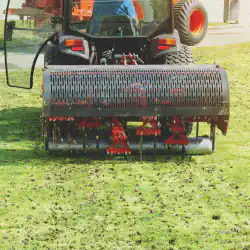
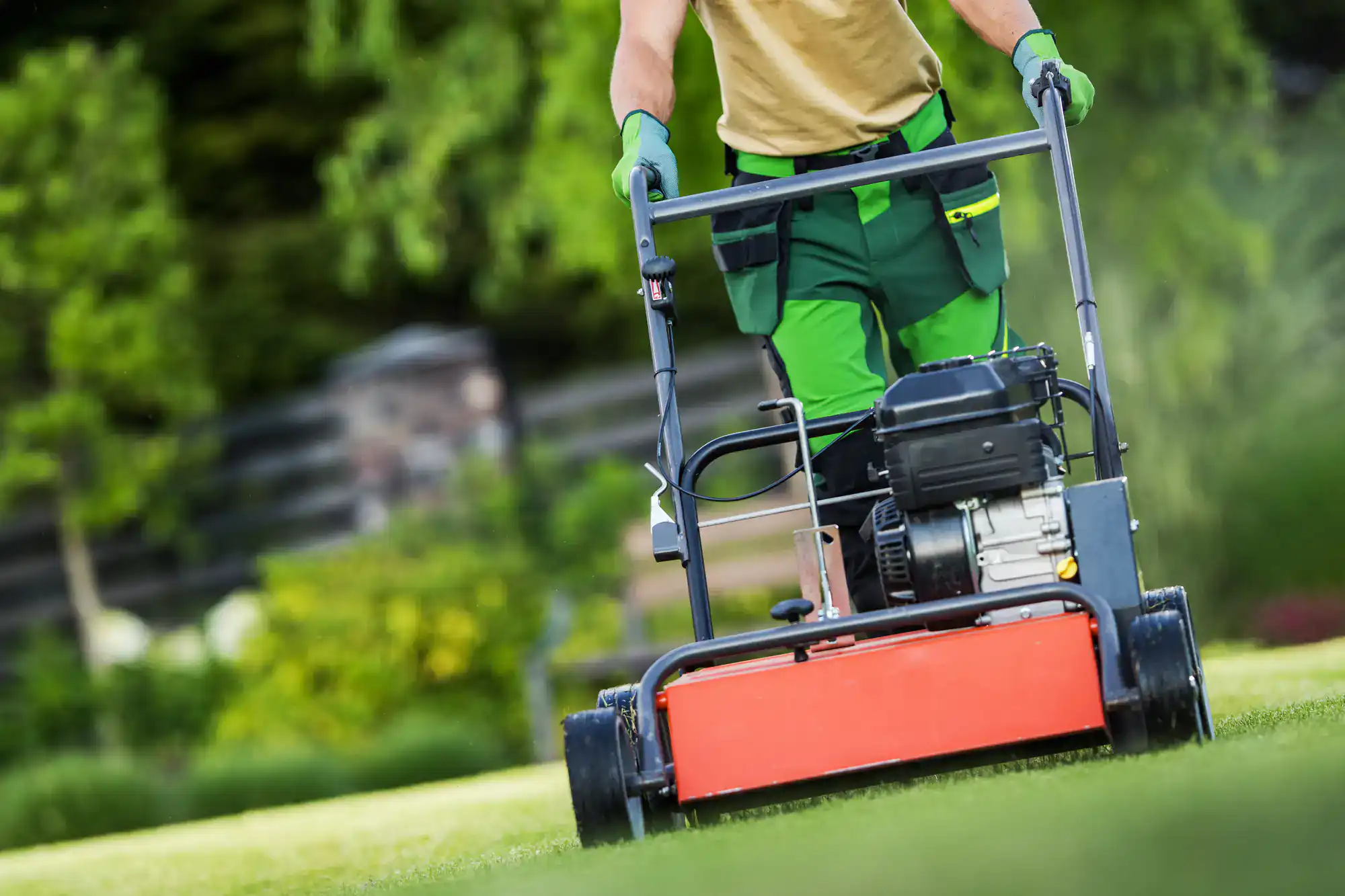
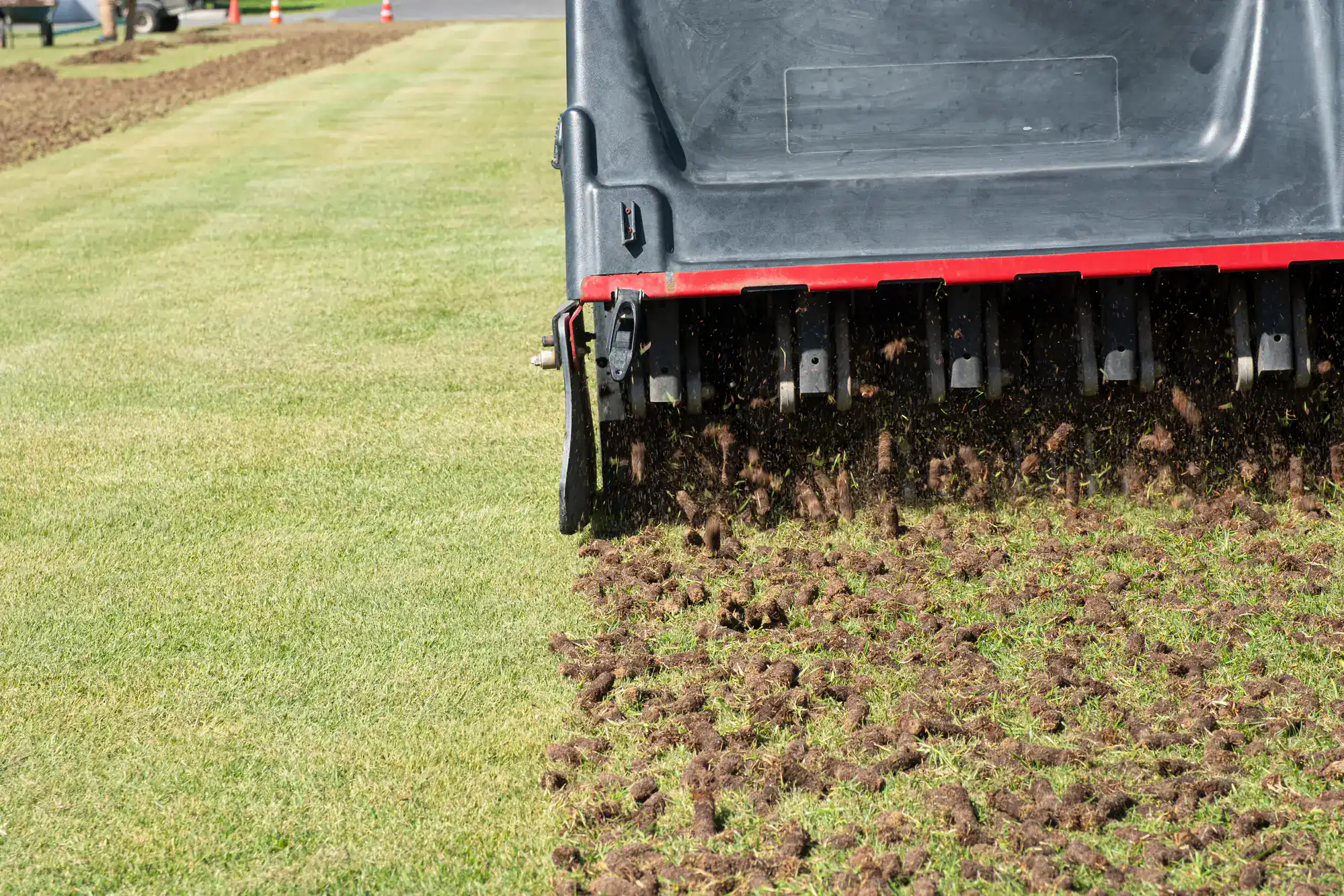
Then comes the equipment difference that actually matters. We use a hydraulic aerator not the drum-style machines available at Home Depot or U-Haul rental counters. A drum aerator bounces off compacted surface layers and rarely penetrates more than an inch and a half to two inches. On the South Shore’s compacted sandy soils, that’s not deep enough to reach the actual problem. Our hydraulic aerator drives tines three to four inches deep on every pass, pulling out real plugs and creating genuine decompression through the full compaction zone.
After the service, you’ll see soil cores scattered across the lawn. That’s not a problem that’s the job working. Those plugs contain soil microbes and organic matter that break down naturally over two to four weeks, returning nutrients to the surface and helping break down thatch in the process. If overseeding is part of your program, seed goes down immediately after aeration while the holes are open and ready to receive it. Fall is the right window for this in Oakdale soil temperatures stay warm enough for germination well into October on the South Shore, but that window closes, and scheduling fills up fast.
Ready to get started?
Core aeration and lawn aeration are the same service and at Lawn Master, it’s the foundation of everything else in our program. Fertilization, overseeding, and weed control all perform significantly better on a lawn that’s been properly aerated. If you’ve been running a fertilization program and not seeing the results you expected, compaction is almost always the reason. Studies consistently show fertilizer uptake efficiency improving by thirty to forty percent after proper core aeration not because the fertilizer changed, but because it can finally reach the root zone.
Overseeding pairs directly with aeration for good reason. Seed dropped on thatch-covered, compacted ground has almost no chance of establishing because it never makes contact with actual soil. The aeration holes solve that problem. Seed falls in, makes direct soil contact, and germinates at rates thirty to fifty percent higher than on un-aerated ground. For Oakdale lawns with bare patches under mature tree canopy common on older properties throughout the hamlet this combination is the most reliable way to fill in thin areas before winter.
Our NYS-licensed applicators also ensure that any fertilizer applied as part of your post-aeration program complies with Suffolk County’s Healthy Lawns, Clean Water guidelines and New York’s Nutrient Runoff Law. That includes the phosphorus restrictions and the twenty-foot buffer requirement near surface water regulations that apply directly to many properties in Oakdale given the hamlet’s position within the Connetquot River watershed. The cool-season grasses that dominate South Shore lawns tall fescue, Kentucky bluegrass, perennial ryegrass respond best to fall aeration, and our scheduling is built around that window.
For the cool-season grasses that make up most Oakdale lawns tall fescue, Kentucky bluegrass, and perennial ryegrass fall is the right window. Late August through October is the optimal range, and Oakdale’s South Shore location actually works in your favor here. The maritime influence from the Great South Bay moderates temperatures into the fall, keeping soil warm enough for overseeding germination slightly longer than inland Suffolk County communities. That gives you a bit more runway than homeowners further north in the county.
That said, the window is still finite. Once soil temperatures drop consistently below fifty degrees, new seed won’t establish, and the recovery benefits of aeration are reduced going into winter dormancy. Spring aeration is possible April through early May but the sandy South Shore soils warm fast in spring, which means the pre-emergent timing window closes earlier in Oakdale than in heavier-soil communities. For most homeowners, fall is the right call, and booking early in the season is the best way to secure a spot before the schedule fills.
This is the most common frustration we hear from Oakdale homeowners, and the answer is almost always the same: compaction. On Oakdale’s sandy coastal plain soils, the surface layer compacts and develops a thatch barrier that prevents fertilizer, water, and oxygen from reaching the root zone. The fertilizer you’re applying is sitting on top of that barrier, washing off with rain, and never doing the job you’re paying for. It’s not the product failing it’s the soil blocking it.
Core aeration removes physical plugs of compacted soil, opening up direct channels through that barrier. Once those channels exist, fertilizer can move down through the profile to where the roots actually are. Research consistently shows fertilizer uptake efficiency increasing thirty to forty percent after proper aeration which means the same fertilizer program you’ve been running can produce noticeably better results simply because the soil is no longer blocking it. If your lawn has been on a treatment program for multiple seasons without meaningful improvement, aeration isn’t just worth trying it’s almost certainly the missing piece.
Core aeration removes a physical plug of soil from the ground typically two to four inches deep and about three-quarters of an inch in diameter. That removal creates real decompression and open channels for water, air, and nutrients. Spike aeration, by contrast, pushes a solid spike into the ground to create a hole without removing any material. The problem with spike aeration is that it displaces soil rather than removing it, which means the soil around each hole actually becomes more compacted in the process.
On the sandy surface soils common to Oakdale and the South Shore coastal plain, this distinction matters more than it might in other soil types. Sandy soils compact at the surface in a specific way the particles pack tightly together and create a dense, hydrophobic layer. Driving a spike into that layer pushes those particles tighter together around the hole. Core aeration is the only mechanical method that genuinely relieves that compaction. If you’ve used a spike aerator or a spike attachment on a rolling tool and seen little improvement, the method was the problem not the concept.
Mechanical core aeration the process of removing soil plugs has no restrictions near waterways. It’s a physical process with no chemical inputs, so there are no regulatory limitations on where it can be performed. Fertilizer applications near the Connetquot River are a different matter, and this is where working with a licensed applicator becomes important.
New York State’s Nutrient Runoff Law prohibits fertilizer application within twenty feet of any surface water, and Suffolk County’s Healthy Lawns, Clean Water program adds local restrictions on nitrogen applications and bans phosphorus fertilizer on established lawns entirely. These regulations apply directly to many properties in Oakdale, particularly those along Connetquot Drive and the river corridor. Our NYS DEC-licensed applicators understand these restrictions and apply them as standard practice not as an afterthought. Interestingly, aeration itself supports compliance: a properly aerated lawn absorbs significantly more of the fertilizer applied to it, which means less nutrient runoff into the river regardless of how close you are to the water.
The minimum effective depth for core aeration on compacted South Shore soils is around three inches. The compaction layer on Oakdale’s coastal plain soils typically forms between one and three inches below the surface which is exactly why standard rental aerators so often fail to produce visible results. Drum-style aerators available at Home Depot, U-Haul, and similar rental locations typically penetrate one and a half to two inches under normal conditions, and on compacted sandy surfaces, they frequently bounce and penetrate even less than that. They’re skimming the surface of the problem without reaching it.
Our hydraulic aerator operates differently. It applies consistent downward pressure through a hydraulic mechanism, driving tines three to four inches deep regardless of surface resistance. On the compacted sandy soils along the South Shore where the surface layer is dense but the substrate below is loose this depth difference is what separates a treatment that produces visible results from one that doesn’t. If you’ve aerated before and seen no improvement, depth is the first question worth asking about the equipment that was used.
Core aeration pricing in Oakdale typically ranges from around $150 to $350 for a standard residential lawn, depending on square footage, lawn condition, and whether overseeding or fertilization is being added to the service. Larger properties or lawns with severe compaction that require multiple passes will fall toward the higher end of that range. Properties near the Connetquot River waterfront, which often have irregular lot shapes and mature landscaping that requires more careful equipment navigation, may also factor into final pricing.
The more useful way to think about cost is in terms of what you’re already spending. If you’re running a fertilization program and your lawn isn’t responding, a meaningful portion of that spend is being wasted on nutrients that can’t reach the root zone. A single aeration treatment that improves fertilizer uptake by thirty to forty percent pays for itself quickly not as a theory, but as a straightforward calculation on what you’re currently investing in treatments that aren’t working at full efficiency. We provide free estimates, so you’ll have a specific number for your property before committing to anything.
Useful Links