Hear from Our Customers
If your lawn keeps breaking down in the same areas year after year, the problem isn’t your grass seed or your irrigation schedule. It’s an undiagnosed fungal disease that’s still active in the soil and every time you reseed without treating it, you’re planting directly into a pathogen that will kill the new growth before it establishes.
Fort Salonga’s position on Long Island Sound makes this worse than most people realize. Maritime air off the Sound keeps grass blades wet overnight, and summer humidity here regularly creates the extended leaf-wetness windows that brown patch needs to spread. On a one-acre lot which is typical for this area a brown patch outbreak can reach a 20-foot circle before it’s even visible from your driveway. By the time you notice it, the disease has already been active for days.
The sandy, fast-draining soils common to the North Shore add another layer. They stress turf during dry spells, which is exactly the condition dollar spot exploits. And when red thread moves through in spring or fall, it can spread up to eight feet from a single infected area. A targeted fungicide application timed to the actual disease window stops the damage before it compounds.
Lawn Master is a New York State DEC-licensed commercial pesticide applicator serving Fort Salonga and the surrounding North Shore communities. That license isn’t a marketing credential it’s a legal requirement under New York State Environmental Conservation Law, and it’s the line that separates accountable professional service from the unlicensed operators that are common across Suffolk County.
What the license actually means for your lawn: access to restricted-use fungicides that aren’t available at any retail store, legally compliant application rates, written documentation after every visit, and mandatory neighbor notification compliance as required by New York State. These aren’t extras they’re legal obligations that we fulfill and unlicensed operators can’t.
Fort Salonga sits within the Crab Meadow Watershed, which drains directly to Long Island Sound. We follow NYSDEC application protocols designed for environmentally sensitive areas on Long Island so the treatment your lawn receives is both effective and appropriate for where you live.
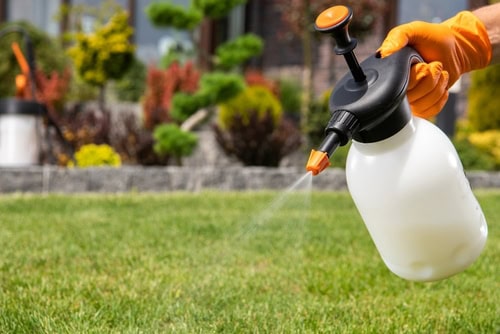
The first thing that happens is an on-site assessment of your lawn. Not a quote call an actual evaluation of what’s growing, what’s dying, and what’s causing it. Brown patch, dollar spot, and red thread each require different fungicide chemistries and different application timing. Spraying without identifying the disease first is guessing, and guessing on a one-acre North Shore lawn is an expensive mistake.
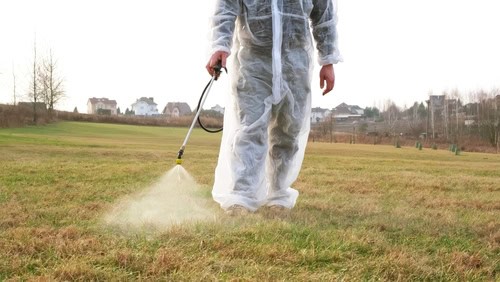
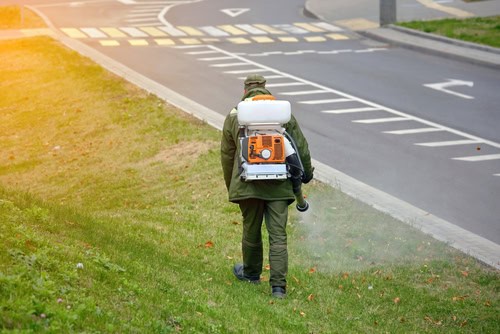
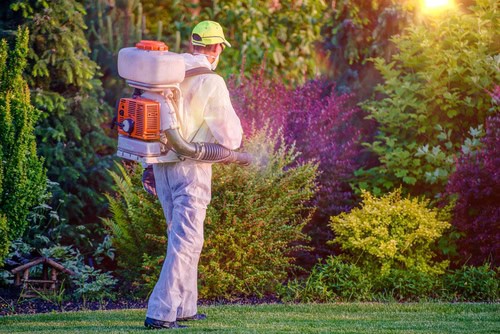
Once the disease is confirmed, we select the appropriate professional-grade fungicide formulations that are restricted to licensed commercial applicators and unavailable at any home improvement store. Application is timed to the specific disease window for your lawn’s conditions: the coastal humidity patterns near Long Island Sound, your soil’s drainage profile, the amount of shade and airflow across your property. These factors directly affect when and how a fungicide treatment needs to be applied to actually work.
One application is often not the complete answer. We rotate chemistries across the treatment season triazole-based and strobilurin-based products used in sequence to prevent resistance from building in the fungal population. After every visit, you receive written documentation of what was applied, at what rate, and when. That’s not optional; it’s a legal requirement for licensed applicators in New York State, and it’s your record of professional, compliant service.
Ready to get started?
The three fungal diseases that drive the most damage on Fort Salonga lawns are brown patch, dollar spot, and red thread and they don’t all behave the same way or respond to the same products. Brown patch (Rhizoctonia solani) is the summer threat, most destructive when nighttime temperatures climb above 70°F and the lawn stays wet conditions that are routine here from June through August. Dollar spot (Clarireedia jacksonii) moves in on nitrogen-deficient, drought-stressed turf, which is common on the sandy North Shore soils that drain quickly and leave grass vulnerable during dry stretches. Red thread (Laetisaria fuciformis) is the cool-season problem, peaking in April, May, September, and October when temperatures sit in the 60–75°F range. The North Shore’s gradual seasonal transitions give red thread a longer active window than inland communities see.
Our professional fungicide spray program in Fort Salonga covers all three. Each treatment starts with identification, moves to chemistry selection, and ends with written documentation including the product name, active ingredient, application rate, and date. Because Fort Salonga straddles the Town of Huntington and the Town of Smithtown, we’re familiar with the regulatory landscape on both sides of Bread and Cheese Hollow Road and apply accordingly. Whether your property is near Crab Meadow Beach or closer to the Kings Park side of the hamlet, the treatment is calibrated to your lawn’s actual conditions not a one-size schedule.
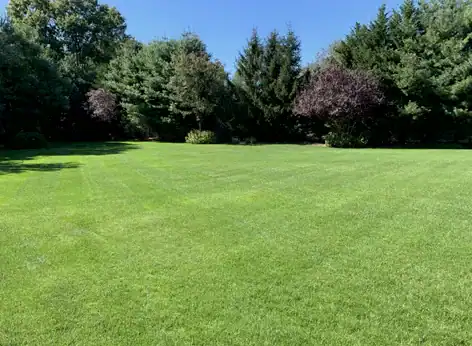
Brown patch is caused by a soil-borne fungus called Rhizoctonia solani, and it thrives under the exact conditions Fort Salonga produces every summer. When nighttime temperatures stay above 70°F and the grass surface stays wet for extended periods, the fungus becomes active and spreads quickly sometimes doubling in size within 48 hours. Fort Salonga’s position on Long Island Sound means overnight dew from maritime air is common, and that moisture keeps grass blades wet well into the morning, which is precisely the environment brown patch needs.
The other factor is lot size. On a typical Fort Salonga property of one acre or more, the disease can spread to a significant area before it’s visible from the house. By the time you see the brown circles, the fungus has already been active for days or longer. A preventative fungicide application timed before the summer humidity peaks is far more effective than waiting to treat an outbreak that’s already in progress.
This is one of the most common misdiagnoses on North Shore lawns, and it’s an expensive one to get wrong. Drought damage tends to affect turf uniformly across open, sun-exposed areas and improves within a few days of watering. Fungal disease follows different patterns it tends to appear in irregular circles or patches, often in areas with shade, poor airflow, or consistent moisture, and it doesn’t recover with irrigation. In fact, overwatering a lawn with active brown patch or dollar spot makes the disease worse.
On Fort Salonga’s sandy, fast-draining soils, drought stress and fungal disease can occur simultaneously, which is why a visual assessment by a trained eye matters. Dollar spot in particular looks like scattered straw-colored patches easy to confuse with dry spots but it’s caused by a fungal pathogen that won’t respond to any amount of water. If you’ve been watering consistently and the dead areas aren’t recovering, you’re likely dealing with active lawn disease, not drought.
If you’re hiring someone to apply pesticides on your property in New York State, that business is legally required to be registered with the NYSDEC and must employ at least one certified commercial applicator. This isn’t a suggestion it’s a requirement under New York’s Environmental Conservation Law. A business that applies pesticides for hire without this license is operating illegally, and you have no legal recourse if the treatment fails, damages your lawn, or causes a runoff issue.
For Fort Salonga homeowners, this matters beyond just legal compliance. The hamlet sits within the Crab Meadow Watershed, which drains to Long Island Sound and the Jerome A. Ambro Memorial Wetlands Preserve. The NYSDEC has a Long Island Pesticide Pollution Prevention Strategy specifically designed to protect water quality in sensitive coastal areas like this one. A licensed applicator follows those protocols. An unlicensed one doesn’t and on a property that drains toward the Sound, that’s a real environmental concern, not a theoretical one.
Red thread is a fungal disease caused by Laetisaria fuciformis. It appears as pinkish-red threads on grass blades sometimes described as the lawn looking singed or bleached at the tips and it’s most active when temperatures are between 60 and 75°F with consistent moisture. On Long Island’s North Shore, that window opens in April and May, then returns again in September and October. Because Fort Salonga’s coastal position means spring arrives gradually and fall lingers longer than inland communities, red thread has a wider active window here than in most of Suffolk County.
The reason it keeps coming back is that the fungus overwinters in the soil and in infected thatch. If you treat the visible symptoms without addressing the underlying turf health particularly nitrogen deficiency, which red thread exploits the disease returns the following season in the same spots. We address the active pathogen with fungicide, but the long-term answer also involves a soil and nutrition assessment to reduce the conditions that make your lawn vulnerable to it in the first place.
You can, but the results are rarely comparable and there are a few specific reasons why. Consumer-grade fungicides available at home improvement stores are formulated at lower concentrations and use a limited range of active ingredients. The professional-grade products that licensed commercial applicators use are restricted-use formulations legally unavailable to the general public and they work at concentrations and with systemic action that over-the-counter options can’t match. The gap in effectiveness is real, particularly for established fungal infections on larger lawns.
The second issue is resistance. Applying the same fungicide chemistry repeatedly which is what most homeowners do when they buy the same product season after season builds resistant fungal strains in the soil. Once resistance develops, the product that used to work stops working, and you’re left with a more difficult disease problem than you started with. A professional fungicide program rotates chemistries across the season specifically to prevent this, which is something that’s difficult to execute correctly without access to multiple professional-grade products and knowledge of mode-of-action rotation.
It depends on your lawn’s disease history, its specific conditions, and which diseases are active or likely. A lawn with a history of brown patch near a shaded, moisture-retaining area on a large North Shore lot is going to need a different approach than a lawn with occasional red thread on a drier, more open property. There’s no single answer that applies to every Fort Salonga yard.
That said, most lawns with recurring fungal disease benefit from a preventative program rather than a single reactive treatment. For brown patch, that typically means an application timed before the summer humidity peaks in late June, with follow-up applications through August if conditions remain favorable for the disease. For red thread, applications in April and again in September cover the two active windows that the North Shore’s gradual seasonal transitions create. Dollar spot may require mid-season intervention on lawns with nutrient-stressed turf. After the initial assessment, we’ll give you a straightforward recommendation based on what your specific lawn actually needs not a package designed to maximize visits.
Useful Links
Other Services we provide in Fort Salonga