Hear from Our Customers
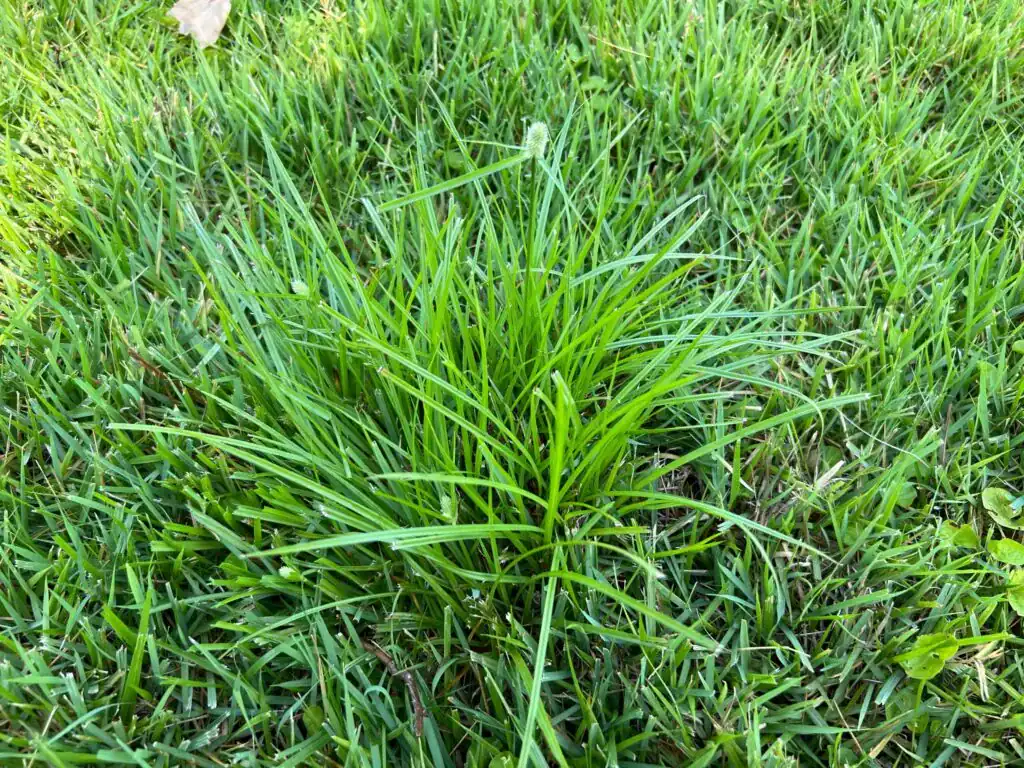
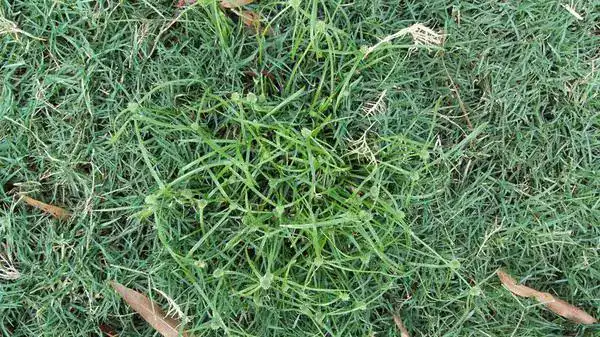
If you’ve watched a dark green, mat-forming patch slowly take over your Blue Point yard while the rest of your lawn struggles through summer, you already know what kyllinga looks like in action. It doesn’t slow down. It doesn’t respond to the weed killers at Home Depot. And in Blue Point, where the Great South Bay keeps the water table elevated and the soil stays consistently moist, it has every advantage a moisture-loving sedge could ask for.
What changes after a properly structured treatment program isn’t just the absence of kyllinga it’s the return of a lawn that looks uniform, grows evenly, and doesn’t have that tell-tale patch that stands out from the street. In Blue Point, where curb appeal genuinely matters and properties along the bay command premium values, that difference is visible and real.
The flat, sandy terrain throughout Blue Point and the documented drainage challenges that come with bayfront living mean kyllinga isn’t just a lawn problem here it’s a recurring condition that needs a treatment approach built around your specific soil and moisture environment, not a generic weed control program designed for drier inland communities. Pest pressure is common here too, so we provide flea & tick control in Blue Point.
We’re a locally owned lawn care company based in Port Jefferson Station, serving Blue Point and the broader Bayport–Blue Point area. This isn’t a national franchise applying a national template to a local problem. Every lawn we work on is in the same county, on the same soil types, dealing with the same Long Island conditions and that kind of focused experience shows up in the results.
Our applicators hold the NYSDEC Commercial Pesticide Applicator License (Category 3a, Ornamental and Turf) required by New York State to legally purchase and apply the professional-grade herbicides that actually eliminate kyllinga. We’re also fully familiar with Suffolk County’s pesticide application regulations, including the SCDHS buffer zone requirements that matter especially for properties near the Great South Bay.
When you call us, you reach someone who knows Blue Point the soil, the drainage conditions, the seasonal moisture patterns not a call center routing your job to whoever’s available. For lawns past repair, we also offer Blue Point new lawn installation.
It starts with identification. Kyllinga is a sedge, not a grass and not a broadleaf weed and it’s commonly misidentified as nutsedge, crabgrass, or just “a different kind of grass.” Treating the wrong plant with the wrong product wastes your time and money. Before anything gets applied to your lawn, we confirm exactly what species is present, assess the size of the infestation, and evaluate the site conditions drainage, soil moisture, turf density that are influencing how aggressively it’s spreading.
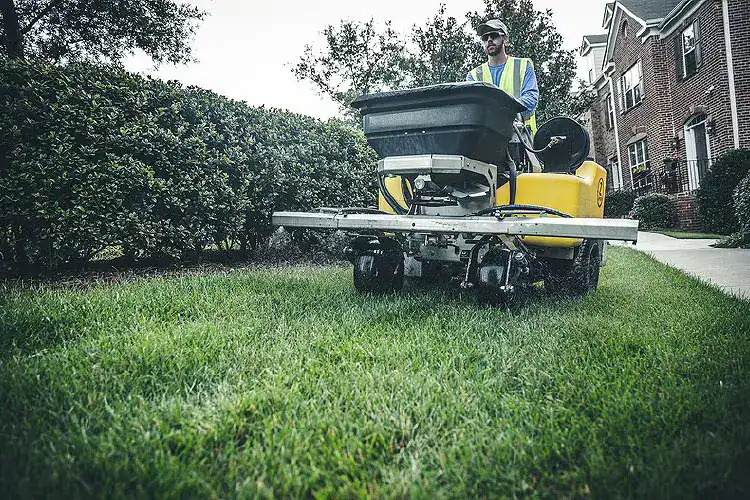
From there, we apply a targeted herbicide program using professional-grade sedge-active chemistry specifically halosulfuron-methyl or sulfentrazone, depending on the situation. These are not available in retail formulations. They require a state license to apply, and they work on a biological level that store-bought products simply cannot reach. In Blue Point’s moist coastal environment, a single application is rarely enough to address an established infestation. A properly structured program involves a minimum of two to three treatments spaced four to six weeks apart during the active growing season, typically late May through late August.
After the kyllinga has been eliminated, the bare or thinned areas it leaves behind need attention. Without overseeding and soil restoration, those open patches become re-entry points especially in a yard where the underlying moisture conditions haven’t changed. The job isn’t finished when the weed is dead. It’s finished when your lawn is growing back in and competing on its own.
Ready to get started?
Every kyllinga control program in Blue Point starts with a site assessment not a quick walkthrough, but a real evaluation of the infestation, the soil conditions, and the drainage environment specific to your property. Blue Point’s proximity to the Great South Bay and the elevated water table that comes with it means the same program that works on a drier inland lawn in Medford or Coram may not be the right approach here. Your treatment is built around your actual conditions.
The herbicide applications themselves use licensed, professional-grade chemistry that targets sedge at the root level. We apply during the window when kyllinga is most metabolically active and most vulnerable typically late spring through midsummer and we follow up with a second application to address regrowth from the rhizome network that survives the first treatment. Every application we make in Blue Point is fully compliant with Suffolk County’s pesticide notification requirements and the SCDHS buffer zone regulations that govern properties near coastal water sources.
Post-treatment lawn restoration overseeding the areas where kyllinga was crowding out your desirable turf is part of the conversation from the start. Kyllinga leaves behind thin, stressed turf when it’s eliminated, and in a bayfront community where the moisture conditions that created the problem in the first place aren’t going away, a restored, dense turf stand is your best long-term defense against reinfestation.

Kyllinga is a perennial sedge with a rhizome root system that spreads laterally beneath the soil surface. Even when the visible plant tissue dies back or appears to respond to treatment, the root network can survive and regenerate new growth the following season especially if the initial treatment didn’t use a sedge-active herbicide that penetrates to the root level.
In Blue Point specifically, the elevated water table caused by the Great South Bay’s tidal influence creates a consistently moist soil environment that kyllinga thrives in year after year. It’s not just coming back because the treatment wore off it’s coming back because the underlying conditions that favor its growth haven’t changed. Effective long-term management requires both the right herbicide program and post-treatment cultural work, including overseeding and, where feasible, addressing drainage to reduce the persistent moisture that gives kyllinga its competitive advantage.
Because kyllinga is a sedge not a grass, not a broadleaf weed and the overwhelming majority of retail herbicides are not formulated to affect it. Products marketed for crabgrass, dandelions, clover, and general weed control work through mechanisms that simply don’t impact sedge biology. You can apply them repeatedly and see zero meaningful effect on kyllinga, which is exactly what most homeowners experience.
The herbicides that actually work halosulfuron-methyl (sold commercially as Sedgehammer) and sulfentrazone (sold as Dismiss) are professional-grade products that require a valid NYSDEC Commercial Pesticide Applicator License to purchase and apply in their effective commercial formulations. What’s available on the shelf at a hardware store is not the same thing. This isn’t a technicality it’s the core reason DIY kyllinga treatment fails almost universally, and it’s the most straightforward argument for hiring a licensed applicator rather than spending another season trying products that aren’t built for this problem.
For most established infestations, a minimum of two to three targeted applications is necessary spaced roughly four to six weeks apart during the active growing season, which runs from late May through late August on Long Island. A single application will show results on the visible plant tissue, but kyllinga’s underground rhizome network can survive and push out new growth before the season ends if follow-up treatment isn’t made.
In Blue Point’s moist, coastal-influenced soil environment, where the water table stays elevated and the conditions that support kyllinga growth are essentially constant, the rhizome system tends to be well-established and resilient. That’s not a reason to be discouraged it’s just the biological reality of dealing with a perennial sedge in this kind of environment, and it’s why a properly structured multi-application program produces dramatically better results than a one-and-done approach. After the infestation is cleared, overseeding the affected areas helps restore turf density and reduces the likelihood of reinfestation the following season.
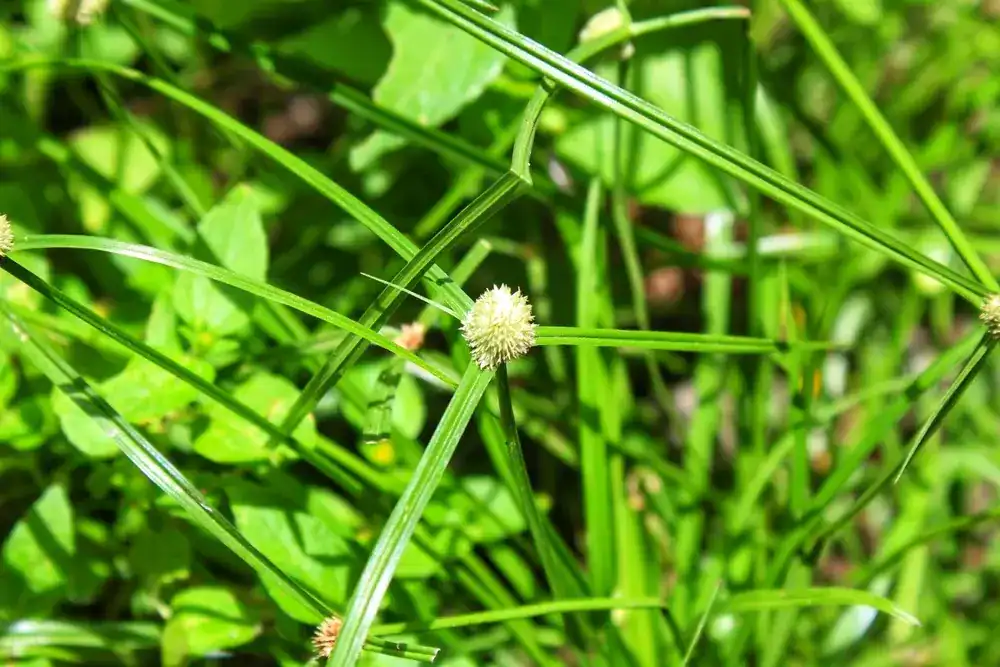
They’re related both are sedges in the family Cyperaceae but they’re different plants, and the distinction matters for treatment. Nutsedge (yellow and purple) produces small tubers called nutlets underground, which are a significant part of why it’s so persistent. Kyllinga, specifically green kyllinga (Kyllinga brevifolia), spreads primarily via rhizomes and produces a distinctive round, white or pale green seed head rather than the elongated seed head you see on nutsedge. Kyllinga also tends to grow lower and form a denser mat than nutsedge, which grows more upright.
From a treatment standpoint, both respond to halosulfuron and sulfentrazone, but the program structure and timing may differ depending on which species or combination of species is present. Misidentifying kyllinga as nutsedge and treating accordingly can produce incomplete results. That’s why identification before treatment isn’t just a formality it’s what determines whether the program you’re paying for is actually matched to the plant growing in your lawn.
Kyllinga is found throughout the eastern United States, but it’s particularly problematic in coastal and low-lying areas where soil moisture is consistently elevated which describes a significant portion of Long Island’s South Shore, including Blue Point and the surrounding Bayport area. The flat terrain, sandy coastal soils, and the influence of the Great South Bay on the local water table create conditions that favor kyllinga establishment and spread in ways that drier inland communities simply don’t experience at the same level.
It’s also worth noting that kyllinga thrives in lawns with in-ground irrigation systems, which are common in Blue Point given the community’s high homeownership rate and the investment homeowners here make in their properties. Set-and-forget irrigation schedules that water more than the lawn actually needs can accelerate kyllinga spread significantly. Adjusting irrigation frequency and duration particularly during the summer months when kyllinga is most aggressive is one of the cultural changes that supports the herbicide program and reduces the risk of reinfestation.
Hand-pulling kyllinga is not an effective control strategy, and in some cases it can make the problem worse. Kyllinga spreads through a rhizome network a web of underground stems that extend laterally beneath the soil surface. When you pull the visible plant, you rarely remove the full root system, and the disturbance can actually stimulate new growth from rhizome fragments left in the soil. It’s a similar dynamic to why pulling nutsedge by hand tends to multiply the problem rather than reduce it.
In Blue Point’s moist, sandy coastal soils where the rhizome network has consistent subsurface moisture to support it hand removal is particularly ineffective. The root system is well-fed and resilient, and the conditions that allowed kyllinga to establish in the first place don’t change just because the visible growth was removed. The only approach that produces lasting results is a licensed, sedge-active herbicide program applied during the correct growth window, followed by overseeding to restore turf density in the cleared areas. Physical removal can be used to manage small, newly emerging patches before a treatment program begins, but it is not a standalone solution for an established infestation.
Useful Links
Other Services we provide in Blue Point