
Hear from Our Customers
Most lawns in Wading River don’t struggle because of neglect. They struggle because whoever’s treating them isn’t accounting for what’s actually happening here. The sandy loam soil that made this area such productive farmland for generations drains fast which means standard fertilizers wash out of the root zone before the grass can use them. Add in the coastal wind and salt spray coming off Long Island Sound, and you’ve got a lawn that needs a program built around those specific conditions, not a five-step template designed for somewhere in central Suffolk County.
When your fertilization program is dialed in correctly, you stop chasing problems. No more brown patches in July that you can’t explain. No more thin spots after a dry stretch. No more spending money on treatments that give you a quick green flush and then disappear. A well-fed lawn with strong roots handles the heat stress, the coastal exposure, and the dry spells that Wading River summers are known for without you having to think about it.
The difference shows up in how your lawn looks in August, when every poorly treated lawn in the neighborhood starts fading. Yours doesn’t have to be one of them.
Lawn Master has been serving Suffolk County since 1987, with deep roots in Wading River and the surrounding North Shore communities. We know this area because we’ve worked it, season after season, on properties from Wildwood State Park’s wooded edges to the open lots along Route 25A and the waterfront neighborhoods closer to Long Island Sound.
Every technician we send is a licensed pesticide professional not seasonal labor. Suffolk County requires licensed applicators for a reason, and we take that seriously. We follow the county’s fertilizer blackout period, the phosphorus restrictions, the Neighbor Notification requirements all of it. In a community as close to the Sound and the Peconic River watershed as Wading River, that matters more than it does in most places.
We also use a custom-blended fertilizer made specifically for Lawn Master not a product off a warehouse shelf. It’s formulated for Long Island soil. That distinction is real, and your Wading River lawn will show it.
It starts with understanding what your lawn is actually dealing with. Before anything gets applied, we look at what you’ve got sun and shade exposure, soil drainage, grass type, any visible problem areas. Wading River properties near the Sound bluffs have different needs than a wooded lot closer to Wildwood State Park, and we don’t treat them the same.
From there, we build a program around your lawn’s specific conditions and apply our custom-blended fertilizer at the right timing, in the right amounts, across the season. On Long Island, that window matters. The best time to set your lawn up for summer is early spring when soil temps hit around 55°F. The most critical window for aeration and overseeding to fill in any thin spots from summer stress runs mid-August through late September. We work within those windows because that’s when the work actually takes hold.
Suffolk County prohibits fertilizer applications between November 1 and April 1. We follow that law, and we plan your program accordingly so you’re covered through every legal treatment window without gaps. If your lawn needs more than fertilization core aeration with our hydraulic equipment, overseeding, or restoration work we handle that too, all under the same program.
Ready to get started?
The fertilizer we apply isn’t something you can buy at a big-box store or find in a national chain’s supply truck. It’s a custom blend made specifically for Lawn Master, calibrated for the soil chemistry and drainage characteristics common to Long Island residential properties. In Wading River, where sandy soil loses nutrients faster than most, that precision matters. A slow-release, properly formulated product feeds your lawn over time instead of spiking and leaching away.
Beyond fertilization, we bring hydraulic aerators and seeders to every job that needs them commercial-grade equipment that pulls deeper plugs and creates better channels for water and nutrients to reach the root zone. If your lawn has thatch buildup or compaction from rainfall, that step makes everything else work better. And if grubs have sponged out sections of your turf a real and documented problem on North Shore properties we address that as part of a complete program, not as an upsell you have to ask for.
We also handle full lawn restoration and new lawn installation from seed. If your property has been through the kind of summer that left it thin, patchy, or worse, we can bring it back. Most fertilization-only companies in this area can’t offer that. We can, and we do it with the same licensed professionals and the same custom-blended products we use on every other job.
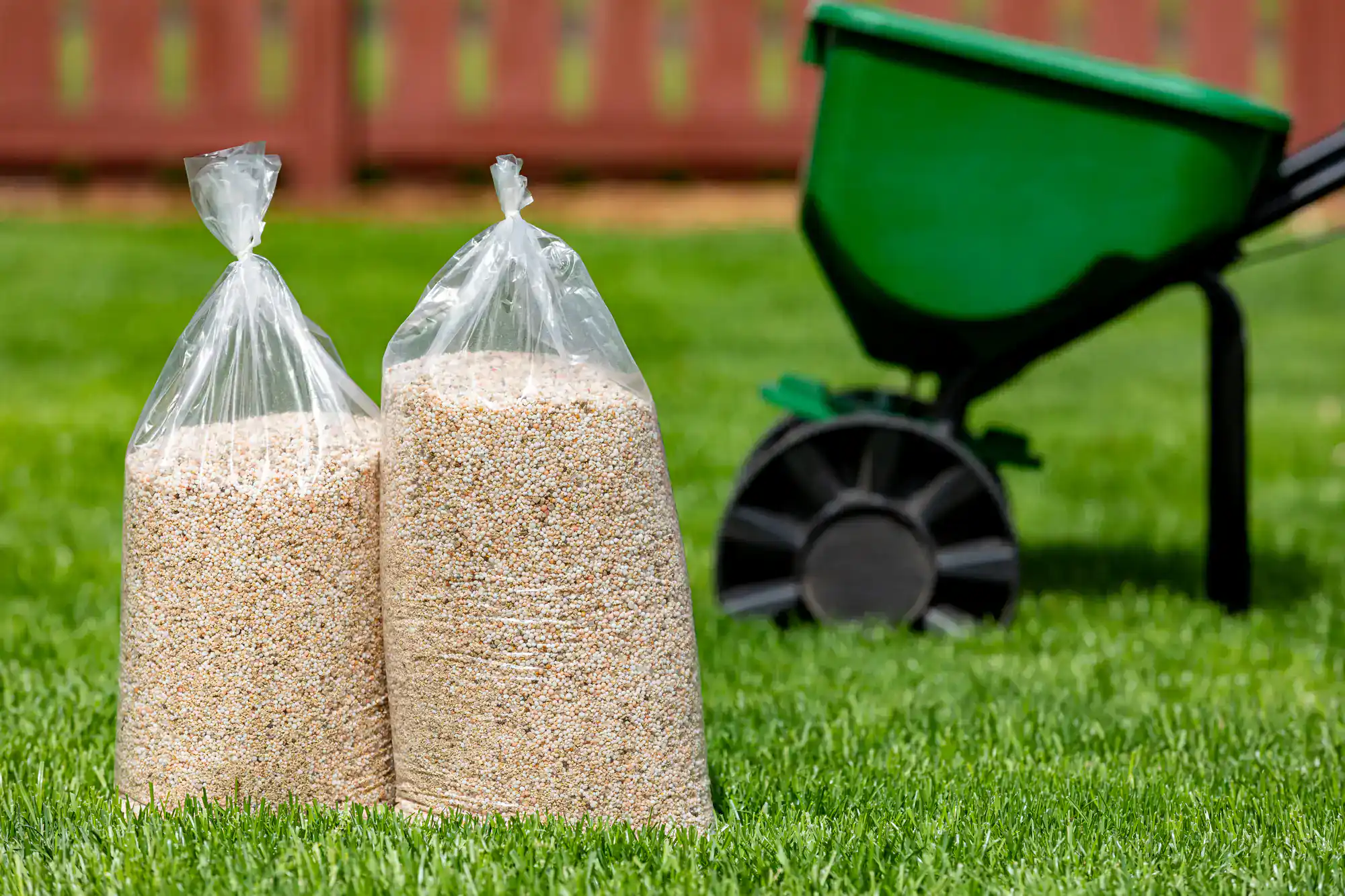
Sandy soil drains fast, and when it drains fast, it loses moisture and nutrients quickly especially during a hot, dry stretch. Most Wading River lawns sit on sandy loam that was historically great for agriculture but creates a real challenge for turf because the root zone dries out and depletes faster than denser soils further inland. If your lawn is thinning in summer, it’s usually not a watering problem alone it’s a nutrition problem compounded by drainage.
The fix is a fertilization program that accounts for how your soil actually behaves. A slow-release, properly formulated fertilizer feeds the lawn over weeks, not days, so the nutrients are there when the grass needs them during heat stress. Add in the coastal exposure that Wading River properties deal with salt spray off the Sound pulls moisture from grass blades and can cause tip burn that looks like drought damage and you can see why a generic program designed for a Centereach or Holbrook lawn is going to underperform here. The program needs to be built for your specific conditions.
For most lawns on Long Island, a well-structured program runs four to six applications across the growing season typically starting in mid-spring when soil temperatures reach around 55°F and running through early fall before Suffolk County’s fertilizer blackout period kicks in on November 1. That blackout runs through April 1, so every application needs to happen within that legal window. A company that offers “winter treatments” during that period is operating outside the law.
The timing of each application matters as much as the number. An early spring feeding sets the lawn up for summer. A late summer or early fall application ideally timed with aeration and overseeding if your lawn needs it helps the turf recover from heat stress and thicken up before the season ends. In Wading River, where the soil drains quickly and coastal conditions add extra stress, spacing those applications correctly makes the difference between a lawn that recovers well and one that enters next spring already behind.
In New York State, any business applying pesticides for hire is legally required to employ at least one NYSDEC-certified commercial pesticide applicator. That certification requires passing both a core general standards exam and a category-specific exam, with recertification requiring 24 continuing education hours every three years. An unlicensed operator applying pesticides to your lawn is doing so illegally and without the training to do it safely.
In Wading River, this carries more weight than it might in other parts of Suffolk County. Your property sits in proximity to Long Island Sound, the Peconic River watershed, and the area’s sole-source aquifer system. The community has also lived with the ongoing story of groundwater contamination at the former Grumman site in Calverton so what goes into the ground on your property isn’t an abstract concern here. A licensed applicator knows the county’s phosphorus restrictions, the buffer zone requirements around drinking water wells, and the Neighbor Notification Law that requires 48-hour advance notice to neighbors within 150 feet of a pesticide application. That knowledge protects your lawn, your neighbors, and the local environment.
Yes, and it’s more common in Wading River than most homeowners realize. Salt spray carried by coastal wind off the Sound draws moisture out of grass blades through a process called desiccation the salt essentially pulls water out of the plant tissue faster than the roots can replace it. The result looks a lot like drought stress or disease: browning tips, faded color, thinning in exposed areas. Homeowners often treat it as a watering problem and keep irrigating without seeing improvement.
Properties closer to the North Shore bluffs and along the waterfront areas including neighborhoods with Sound access tend to see this most acutely, but wind-driven salt spray can reach further inland than people expect, especially after storms. The right response is a fertilization program that keeps the turf nutritionally strong and well-rooted so it can handle that moisture stress without breaking down. Grass that’s underfed is far more vulnerable to salt damage than grass on a consistent, properly timed program. If you’re seeing unexplained browning on the windward side of your property, salt exposure is worth ruling out before assuming it’s something else.
There are real legal restrictions, and they apply to every lawn in Wading River. Suffolk County Local Law prohibits fertilizer applications between November 1 and April 1. Violations carry a $1,000 fine. So no, a legitimate lawn care company cannot and should not be treating your lawn during that window and if someone is offering to do it, that’s a red flag worth taking seriously.
Within the legal season, a properly structured program gives you consistent coverage from mid-spring through early fall. The most important windows are early spring for the first feeding, midsummer for sustained nutrition during heat stress, and late summer through early September for the fall application which is also the ideal time for aeration and overseeding if your lawn needs it. Suffolk County’s Healthy Lawns Clean Water guidance specifically recommends early September for fall fertilizer timing on Long Island. We plan every program around these windows so you’re getting the most out of every application within the season you’re legally allowed to treat.
The honest answer is that it depends on how much living turf you actually have left. A fertilization program works by feeding and strengthening existing grass if the lawn is thin but mostly intact, a good program will thicken it up over a season. But if you’ve got large bare patches, grub damage that’s left sections of turf peeling up like carpet, or areas that have been taken over by weeds or invasive grasses like nutsedge, fertilizer alone isn’t going to fix that. You need renovation first.
In Wading River, grub pressure from Japanese beetle and European chafer larvae is a documented local issue the sandy soil conditions that characterize much of the hamlet are exactly the kind of environment where grubs establish. If you’re seeing spongy, brown areas that lift away from the soil, that’s a grub problem, not a fertilization problem. Full restoration means addressing the underlying damage, aerating, overseeding with the right seed mix for your sun and shade conditions, and then bringing the lawn into a proper feeding program once the new turf is established. We do all of that in-house you don’t need to hire a separate company for each step.
Useful Links
Other Services we provide in Wading River