
Hear from Our Customers
If you’ve been reseeding the same bare patches every fall and watching them disappear again by August, the problem isn’t the seed. It’s active fungal disease that never got properly treated. New grass can’t establish in soil where the pathogen is still present so no matter how much seed or topsoil you put down, you’re running in circles.
What changes with a proper fungicide program is the cycle itself. Brown patch, dollar spot, and red thread are identified before the damage spreads, treated with the right chemistry for the specific disease, and managed on a timeline that accounts for Setauket’s actual conditions not a generic Long Island schedule. Properties near Strongs Neck and the Old Field Road corridor face compounded pressure: tidal moisture off Conscience Bay, reduced airflow under mature tree canopy, and sandy-loam soils that stress turf during dry spells. A program that doesn’t account for those factors isn’t really a program.
The result is a lawn that holds through summer instead of falling apart in July. Less reseeding, less frustration, and a yard that actually reflects the investment you’ve made in your property.
We are a New York State DEC-licensed pesticide applicator and in this state, that’s not a given. Any business applying pesticides for hire is legally required to hold that license, pass category-specific exams, and renew with continuing education every three years. A lot of operators in Suffolk County don’t lead with that credential, or don’t hold it at all. We do, and it’s verifiable through the NYSDEC’s public registry.
That license also means access to professional-grade fungicide formulations the same active ingredients used on golf courses and professional sports turf that aren’t sold at any retail outlet. When a store-bought product hasn’t worked on your Setauket lawn, the chemistry is usually the reason.
Based in Port Jefferson Station and serving the Three Village area, we know the neighborhoods along Route 25A from the waterfront lots near Conscience Bay to the shaded, established properties off Old Field Road. This isn’t a regional franchise routing a technician from two counties away. We’re a local company that knows what your lawn in Setauket is actually dealing with.
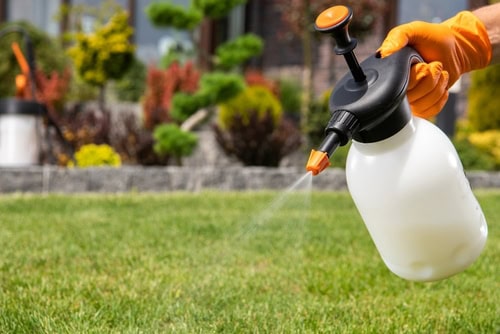
The first step isn’t spraying it’s identifying what’s actually wrong. Brown patch, dollar spot, and red thread each require different fungicide chemistry, different timing, and different follow-up. Applying the wrong product to the wrong disease doesn’t just waste money it lets the infection keep spreading while you think it’s being handled. We start with a property assessment: grass species, sun exposure, drainage patterns, proximity to water, and any visible signs of active disease.
Once the pathogen is identified, treatment is matched to it. For Setauket lawns, that means accounting for the coastal humidity window brown patch pressure typically peaks from June through August when overnight moisture off Long Island Sound keeps grass blades wet well past sunrise. Preventative applications go down before that window opens, not after the damage is already visible. Curative treatments, when needed, are applied at the right rate with documented product records, as required under New York State law.
After treatment, you receive written documentation of exactly what was applied, at what rate, and when. That’s a legal requirement for licensed applicators in New York and it’s the kind of accountability that unlicensed operators simply can’t offer. If a second application is warranted, the timing is calibrated to the disease pressure, not a preset calendar.
Ready to get started?
The three diseases we treat most frequently in the Setauket area are brown patch, dollar spot, and red thread and each one has a distinct profile. Brown patch shows up as large circular tan areas in perennial ryegrass and tall fescue, most aggressively during the humid coastal nights of July and August. Dollar spot produces small, silver-dollar-sized bleached spots and tends to hit hardest when turf is drought-stressed a common condition in Setauket’s sandy-loam soils during dry summer stretches. Red thread appears in spring and fall as pink-red threads on grass blades, and it’s especially persistent in the shaded, low-airflow areas under the mature tree canopy that defines neighborhoods like Strongs Neck and Old Field.
Treatments use professional-grade systemic fungicides including active ingredients like azoxystrobin and propiconazole that provide both protective and curative action. These are restricted-use formulations not available at retail, accessible only to licensed commercial applicators. To prevent resistance from developing over time, we rotate fungicide modes of action across the treatment season rather than applying the same chemistry repeatedly.
New York State also requires neighbor notification before commercial pesticide applications a compliance step that licensed operators handle automatically and unlicensed ones routinely skip. Every application we perform in the Three Village area is fully documented and compliant with NYS DEC requirements.
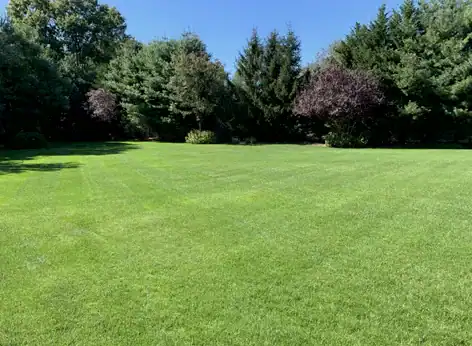
The short answer is that Setauket’s position near Conscience Bay and Setauket Harbor creates overnight humidity conditions that are nearly ideal for brown patch development. Rhizoctonia solani the fungus behind brown patch becomes most destructive when nighttime temperatures stay above 70°F and grass blades stay wet for extended periods. Coastal air off Long Island Sound keeps that moisture on the turf well past sunrise, which extends the infection window significantly compared to lawns just a few miles inland.
Properties closest to the water along Strongs Neck, near Little Bay, or anywhere with tidal exposure tend to see brown patch earlier in the season and more severely than properties farther from the shoreline. If your lawn in Setauket is in one of those areas and you’re seeing large tan or brown circular patches appearing in July or August, that’s almost certainly brown patch. The fix isn’t more water or more fertilizer it’s a correctly timed fungicide application with the right active ingredient for Rhizoctonia, applied before the peak humidity window, not after the damage is already widespread.
Preventative fungicide treatment is applied before active disease is present the goal is to create a protective barrier on the turf that stops the pathogen from establishing when conditions become favorable. Curative treatment is applied after disease is already visible and active. Both have a place in a well-managed fungicide program, but preventative timing is almost always more effective and less costly than trying to stop an infection that’s already spreading.
In Setauket specifically, preventative applications for brown patch are typically timed to go down in late May or early June before the coastal humidity window peaks. If you wait until you see the damage in July, you’re already managing an active outbreak rather than preventing one. For dollar spot and red thread, the timing windows are different, which is part of why a diagnosis-first approach matters. Applying a brown patch fungicide to a lawn with red thread won’t do much the chemistry needs to match the disease. A licensed applicator identifies what’s present before selecting the product, which is why professional treatment consistently outperforms a store-bought spray applied on a guess.
Yes fungal pathogens can spread between adjacent properties, and in a community like Setauket where lots are established and mature landscaping often bridges property lines, that’s a real consideration. Fungal spores travel through several vectors: wind, water runoff, foot traffic, lawn equipment, and even mowing. If an infected lawn is mowed without cleaning the equipment, spores can move from one property to the next. Water moving downhill during rain events can carry active disease from an untreated lawn to a healthy one.
This is also why New York State requires neighbor notification before commercial pesticide applications it’s not just a formality. It creates awareness and gives adjacent property owners the chance to assess their own turf. If you’ve had recurring disease on your lawn and your neighbors haven’t treated theirs, or vice versa, you may be dealing with a source that keeps reintroducing the pathogen each season. We can help you identify whether the disease pressure is coming from within your property or from an external source and that distinction affects both the treatment approach and the realistic expectation for long-term results.
Each disease has a fairly distinct visual signature, though they can look similar to an untrained eye which is exactly why misidentification leads to wasted money on the wrong product. Brown patch typically shows up as large, roughly circular tan or brown areas, often with a darker “smoke ring” border visible in the morning when dew is present. It tends to appear suddenly and spread quickly during humid summer nights. Dollar spot produces much smaller bleached or straw-colored spots roughly the size of a silver dollar scattered across the lawn, and the individual grass blades often show an hourglass-shaped lesion with a tan center and reddish-brown border. Red thread is the most visually distinctive: you’ll see pink or red thread-like strands extending from the tips of grass blades, most visible in cool, damp weather in spring or fall.
In Setauket, all three diseases are common, but their timing differs. Red thread tends to peak in April through June and again in September and October. Dollar spot is a summer-long threat, especially on lawns that are drought-stressed from sandy soil drainage. Brown patch is the most aggressive in July and August when coastal humidity is highest. If you’re not sure what you’re looking at, a professional assessment before any treatment is applied is always the right call guessing and spraying is how you end up with the same problem next season.
When applied by a licensed pesticide applicator, fungicide treatments are applied at the correct rate for the product and the target disease which is a meaningful distinction from DIY applications where over-application is common. Under New York State DEC requirements, licensed applicators are required to document every application and provide you with written records of the product used, the active ingredient, and the application rate. That documentation tells you exactly what was applied to your lawn, which takes the guesswork out of any safety questions.
Generally speaking, most professional fungicide products used for lawn disease treatment have a short re-entry interval the period after application during which you should keep people and pets off the treated area. That window is typically listed on the product label and is communicated to you as part of the service. For Setauket families with children and pets who use the backyard regularly, the practical answer is: keep everyone off the lawn while the application is wet, follow the re-entry interval on the product documentation you receive, and you’re operating within the parameters the product was designed for. We’ll give you that information directly it’s part of the job.
There are usually a few things happening when an over-the-counter fungicide doesn’t deliver results. The most common is a chemistry mismatch the product you bought may not contain the right active ingredient for the specific disease on your lawn. Retail fungicides are formulated to cover a broad range of diseases at a lower concentration, which means they’re often neither specific enough nor strong enough to stop an established infection. Applying a contact fungicide to a systemic disease like brown patch, for example, will treat the surface but won’t stop the pathogen that’s already inside the plant tissue.
The second issue is that restricted-use fungicide formulations the professional-grade products with higher concentrations of active ingredients like azoxystrobin and propiconazole are not available at any retail outlet in New York. They’re legally restricted to licensed commercial applicators. These are the same formulations used on golf courses and athletic turf, and they deliver meaningfully better efficacy and residual protection than anything sold at a home improvement store. If your lawn in Setauket has been dealing with recurring disease for more than one season and store-bought products haven’t held it, the product itself is likely a significant part of the problem not just the timing or the application.
Useful Links
Other Services we provide in Setauket