
Hear from Our Customers
Most Sayville homeowners have already spent real money on fertilization programs. The frustrating part isn’t the investment it’s watching the lawn stay thin, patchy, or stressed season after season despite it. What’s happening beneath the surface is the problem. Sayville sits on Plymouth loamy sand, the dominant soil type across the South Shore plain. Sandy soil compacts at the surface under foot traffic, mowing, and repeated irrigation cycles, forming a dense layer that blocks water and nutrients from reaching the root zone. Fertilizer applied to compacted ground doesn’t feed your lawn it sits on the surface, washes off with the next rain, and ends up somewhere it was never meant to go.
Core aeration pulls that compacted layer apart. Once it’s open, water moves through the soil instead of pooling or running off, and the fertilizer you’re already paying for actually reaches the roots. Studies show fertilizer uptake efficiency increases 30–40% after proper aeration meaning the program you’ve been running all along finally starts working the way it should. For properties near the Great South Bay, that’s also better for the water. Fertilizer that stays in your lawn doesn’t end up in the bay’s watershed.
Older Sayville homes and there are plenty of them, with some dating back to the late 1800s along Main Street often have lawns that haven’t been aerated in years, if ever. Decades of mowing and foot traffic without decompression treatment means the compaction layer is deep and stubborn. That’s exactly where professional-grade equipment makes the difference between a treatment that actually works and one that barely scratches the surface.
We are a Suffolk County lawn care company not a franchise, not a call center routing your job to a subcontractor. When you book with us, the crew showing up to your Sayville property is accountable to the same local reputation that keeps this business running across Sayville, Bayport, Oakdale, West Sayville, and the surrounding South Shore communities.
Every applicator on our team holds a New York State DEC pesticide applicator license. That’s a legal requirement in New York and one that a surprising number of smaller operators in this market can’t demonstrate. It matters especially here, where Sayville’s proximity to the Great South Bay and the Connetquot River watershed means fertilizer runoff isn’t just a lawn care issue it’s an environmental one. Licensed applicators know the rules and follow them.
Our approach isn’t built around selling individual services. Core aeration is the foundation of a complete lawn health system one that integrates overseeding and fertilization in a sequence that actually makes sense agronomically. That’s how lawns on the South Shore get better and stay better, not just look okay for one season. For severely damaged turf, we provide Sayville new lawn installation.
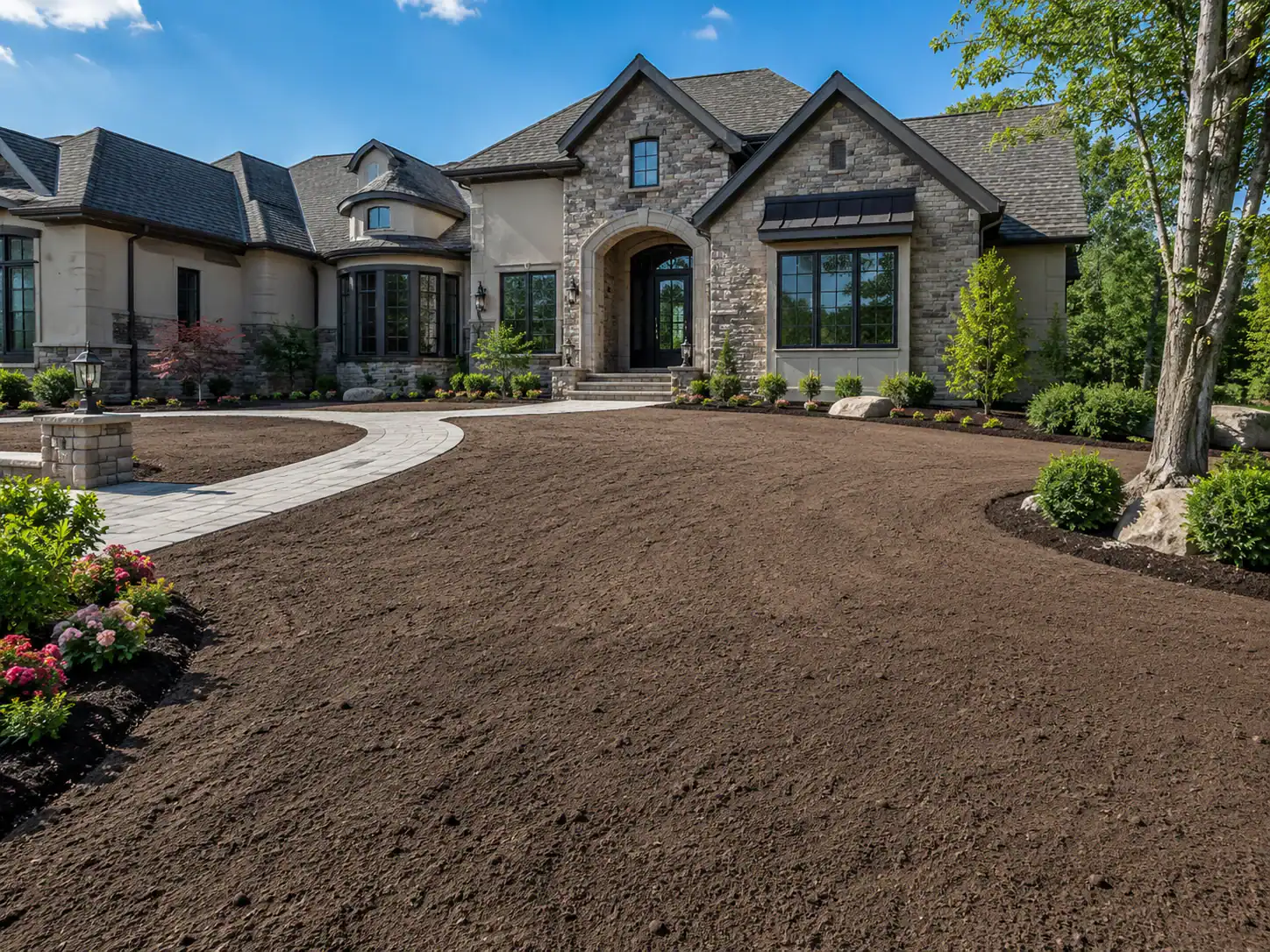
It starts with a property assessment. Before anything runs across your lawn, our crew evaluates your turf conditions compaction depth, thatch accumulation, grass type, and any areas of particular concern. On South Shore properties, that assessment often reveals a thatch layer well above the half-inch threshold where it starts blocking water and nutrients. Sayville lawns with decades of mowing history frequently show thatch buildup of an inch or more. Knowing what we’re working with shapes how the job gets done.
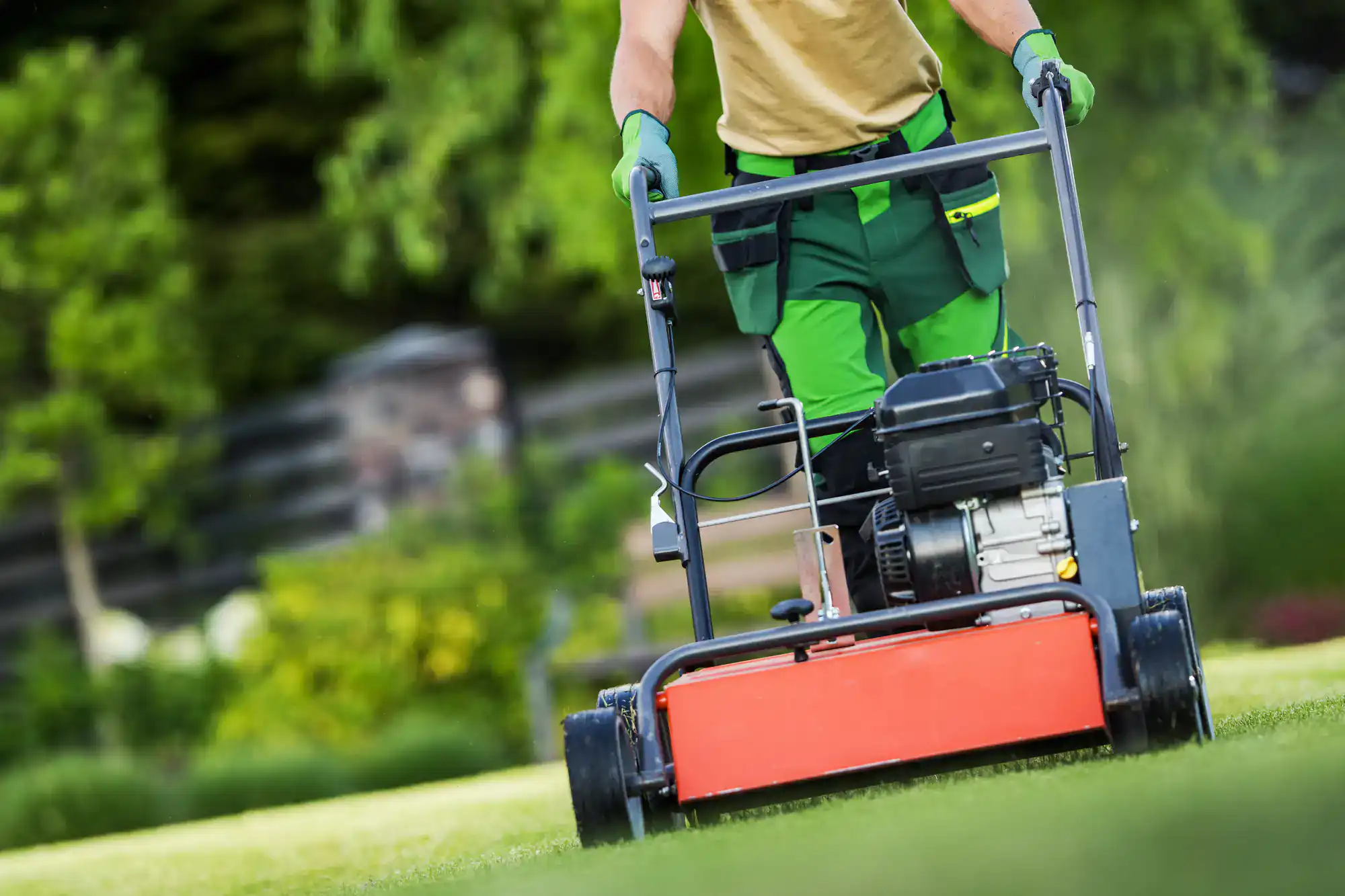
Then comes the aeration itself. We use a commercial hydraulic aerator not a drum rental machine, not a franchise-branded tool. The hydraulic aerator drives tines 3–4 inches into the soil, compared to the 1.5–2 inches a standard drum aerator achieves under ideal conditions, and considerably less on compacted ground. On Sayville’s sandy-over-dense-substrate soils, that depth difference is the whole point. Shallow passes leave the actual compaction layer untouched. The hydraulic aerator reaches it.
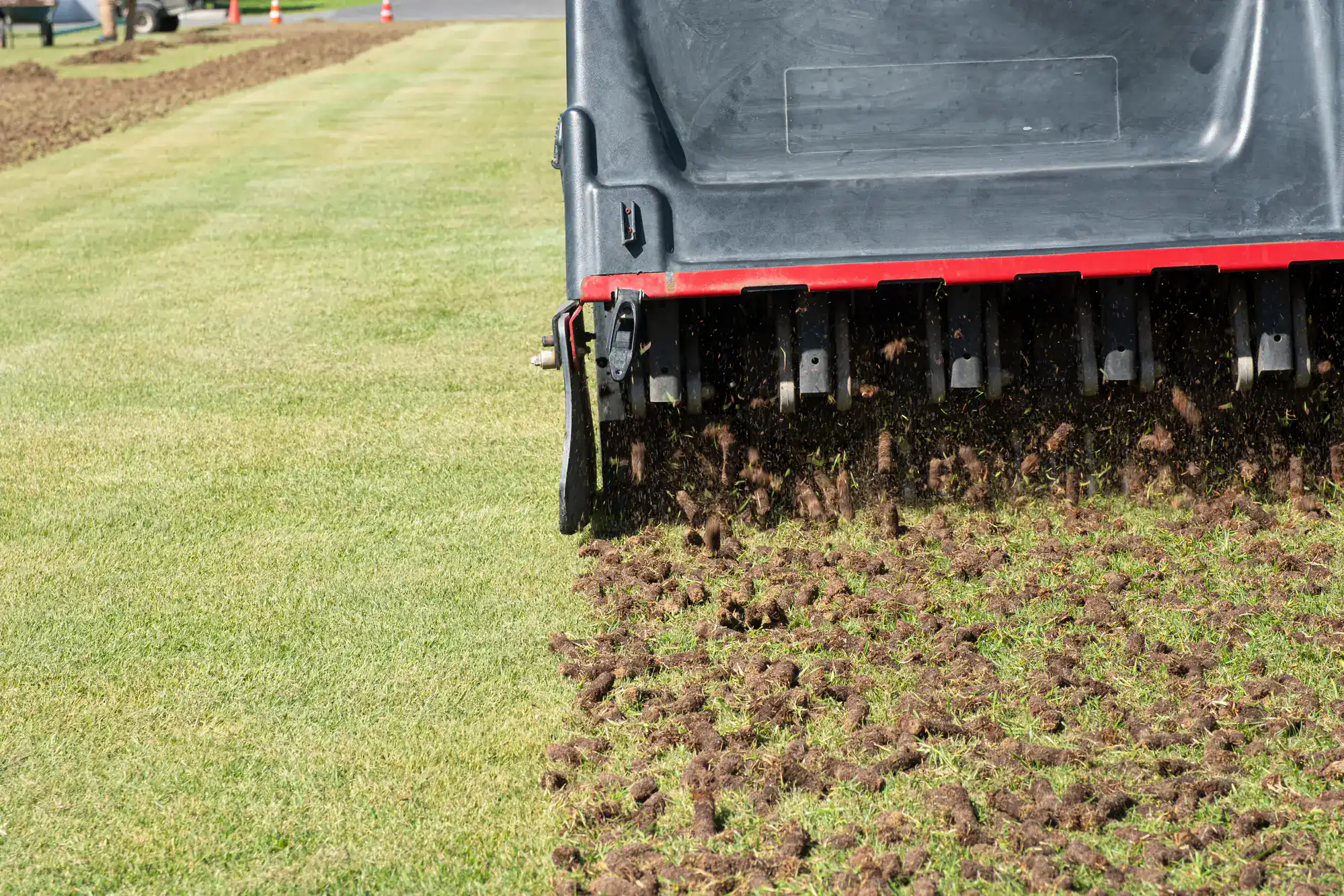
After aeration, the soil cores small plugs pulled from the ground are left on the surface. This is intentional. Those plugs contain soil microbes that break down the thatch layer as they decompose. They’re gone within 2–4 weeks under normal conditions. If overseeding follows, seed falls directly into the aeration holes and makes contact with the soil which is why germination rates on aerated lawns run 30–50% higher than on un-aerated ground. On Long Island’s South Shore, the optimal window for that combination is mid-September through mid-October, when soil temperatures are still warm enough for cool-season grass to establish before winter sets in.
Ready to get started?
Core aeration and lawn aeration refer to the same service and it’s the foundation of everything we do for Suffolk County lawns. The process pairs naturally with overseeding and fertilization, and that sequence is where the real transformation happens. Aeration opens the soil, overseeding fills in the thin and bare areas with direct seed-to-soil contact, and fertilization feeds the new and existing root systems through channels that are now actually open. Each step amplifies the one before it.
For Sayville properties specifically, the service accounts for the conditions that make South Shore lawns behave differently than lawns further inland or on the North Shore. The sandy loam soil profile here drains differently, compacts differently, and responds to treatment differently than the heavier glacial soils in communities like Smithtown or Stony Brook. Salt air exposure near the bay adds another layer of stress grass that can’t access water and nutrients through compacted soil has no buffer against the dehydrating effect of coastal air. Aeration addresses that directly.
We also serve the surrounding South Shore communities West Sayville, Bayport, Oakdale, Great River, and beyond with the same equipment and the same licensed crew. If you’re in the Sayville area and your lawn has been underperforming despite consistent care, the answer is almost always in the soil. A free estimate gives you a clear picture of what’s actually going on and what it’ll take to fix it.
The best window for core aeration in Sayville is mid-September through mid-October. That’s when soil temperatures are still warm enough for cool-season grasses tall fescue, Kentucky bluegrass, and perennial ryegrass, which dominate Long Island lawns to germinate and establish before the ground cools for winter. Fall aeration paired with overseeding gives new seed the best possible start.
One thing worth knowing about Sayville specifically: our sandy soils cool faster in fall than the heavier clay-influenced soils on the North Shore. That means the effective germination window here can close a week or two earlier than homeowners expect. Waiting until late October is a real risk soil temperatures may already be too low for reliable establishment. If you’re planning fall aeration and overseeding, booking in late August or early September gives you the best chance of hitting the window before it closes.
Core aeration removes a physical plug of soil from the ground, creating open channels for water, air, and nutrients to move through the soil profile. Spike aeration pushes a solid tine into the soil without removing anything which means the soil around each hole gets displaced and compacted further. On paper, spike aeration creates holes. In practice, it can make the compaction problem worse.
For Sayville’s sandy loam soils, this distinction matters more than it might elsewhere. Sandy soils compact at the surface in a specific way the particles pack tightly together under pressure, forming a dense, hydrophobic layer. Spike aeration doesn’t break that layer; it just pushes it aside temporarily. Core aeration removes material from it, creating genuine decompression. If a provider is offering you “aeration” without specifying that it’s core aeration, it’s worth asking exactly what equipment they’re using before you commit.
Compaction is almost always the answer. When the surface layer of your soil is compacted which is extremely common on South Shore properties, especially older homes in Sayville where lawns haven’t been aerated in years fertilizer applied to the surface doesn’t penetrate. It sits on top, breaks down in the sun, or washes off with rain before it ever reaches the root zone. You’re paying for a program that can’t deliver because the soil isn’t letting it through.
This is one of the most common frustrations among Sayville homeowners who have been running fertilization programs consistently without seeing the results they expect. The fix isn’t a different fertilizer or a different schedule it’s opening the soil first. Core aeration improves fertilizer uptake efficiency by 30–40%, which means the program you’re already on starts producing results you can actually see. Aeration doesn’t replace fertilization; it makes fertilization work the way it was supposed to all along.
When water sits on the surface of your lawn instead of absorbing, the instinct is to blame drainage. But on most Sayville residential properties, the real cause is surface compaction. The soil is packed tightly enough at the top that water can’t infiltrate at a normal rate so it pools, runs off, or evaporates before reaching the root zone. Soil compaction can reduce water infiltration by up to 50%, which means half the water you’re putting on your lawn may never be getting to the roots.
This is especially common on older Sayville properties where the lawn has been mowed and walked on for decades without any decompression treatment. Core aeration mechanically disrupts that compacted surface layer and restores permeability. After aeration, water moves through the soil the way it should which also means your irrigation system or natural rainfall is actually doing its job instead of running off the surface and into the storm drainage system.
The soil cores left on your lawn after core aeration are supposed to be there leave them. Each plug contains soil microbes and organic matter that, as they break down over the next 2–4 weeks, return nutrients to the surface and help decompose the thatch layer underneath. Raking them up removes one of the key biological benefits of the service.
In a community like Sayville where curb appeal matters and neighbors notice, a lawn scattered with soil cores can look alarming if you weren’t expecting it. That’s why we explain this before every job not after. Within a month under normal conditions, the plugs are gone, the holes have filled in with new growth, and the lawn looks dramatically better than it did before the treatment. If overseeding follows aeration, you’ll also start seeing new growth emerging from the aeration holes within 10–14 days, which is one of the clearest signs the process is working.
For a typical Sayville residential lot roughly 5,000 to 8,000 square feet core aeration generally runs in the range of $125 to $200. Larger properties, corner lots, or homes on the waterfront streets of West Sayville with more square footage will be priced higher, often in the $200 to $350 range depending on the specific conditions. The best way to get an accurate number is a free on-site estimate, because lot size, turf condition, and compaction severity all factor into the scope of the job.
It’s also worth framing the cost against what you’re already spending. If you’re running a fertilization program that costs $400 to $600 per season and your lawn isn’t responding, that investment is largely being wasted on compacted soil that can’t absorb it. A single aeration treatment that unlocks the full value of your existing program tends to pay for itself quickly not as a marketing claim, but as a straightforward agronomic reality. The fertilizer you’ve already been buying starts working the way it was designed to.
Useful Links
Other Services we provide in Sayville