
Hear from Our Customers
Most Commack homeowners who’ve tried lawn care before aren’t frustrated because grass is hard to grow. They’re frustrated because the program they paid for wasn’t designed for this soil. Long Island sits on sandy, glacially deposited outwash and that means nutrients leach through the root zone faster than most generic fertilizer programs can account for. You end up with a lawn that looks thin and weedy after a full season of paid treatments, and no real explanation for why.
When the fertilizer is actually formulated for your soil with slow-release nitrogen that stays in the root zone long enough for the grass to use it the results look different. Thicker turf. Fewer weeds crowding in to fill the gaps. A lawn that holds its color through the summer heat instead of fading out by July.
There’s also the grub issue, which hits Commack hard every year. Japanese beetle grubs feed on grass roots from late summer through fall, and the damage shows up as dead patches that peel back like carpet. A program that includes properly timed grub control applied before the eggs are laid, not after the damage is done is the difference between a lawn that recovers and one that needs full restoration. That’s just how Commack lawns work.
We’ve been treating lawns in Commack and throughout Suffolk County since 1987. That’s not a rounded number it’s a specific founding date that means we were already operating in this market before most of our current competitors existed. We know what Commack lawns look like in a drought year. We know the grub cycles that roll through Commack neighborhoods on a predictable schedule. We know the fertilizer blackout rules, the restricted-use pesticide requirements, and exactly what the sandy soils from Commack down through Hauppauge and Dix Hills need to actually support dense, healthy turf.
Every job is handled by a licensed pesticide professional not an unlicensed laborer following a route sheet. The custom-blended fertilizer we use was made specifically for our programs and for Long Island soil conditions. No other company serving Commack offers that. And with five fully wrapped trucks running routes throughout the county, there’s a good chance you’ve already seen us working in your neighborhood. For peace of mind outdoors, ask about flea and tick treatment in Commack.
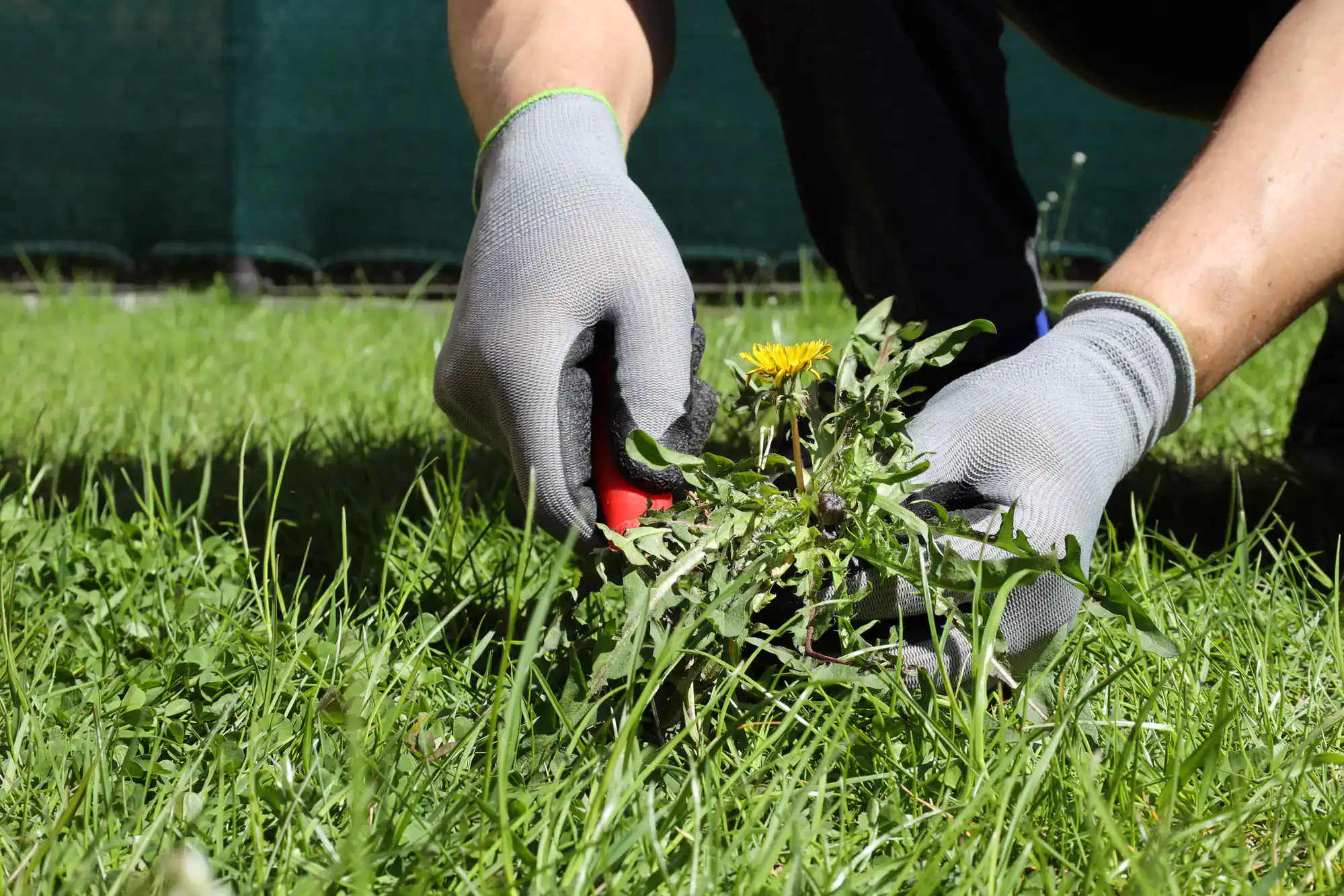
It starts with an honest look at what’s actually going on with your lawn the turf species, the sun exposure, the soil condition, the weed and pest pressure that’s already present. Commack’s housing stock ranges from compact postwar ranches with heavy shade from mature oak canopy to newer colonials with wide-open, full-sun properties. Those lawns don’t need the same program, and treating them the same way is exactly why generic services consistently underdeliver here.
From there, the treatment schedule is built around what your lawn needs and when it needs it. In Commack, that means a pre-emergent crabgrass application timed to soil temperature in early spring, broadleaf weed control in late spring, grub preventive in early summer before the beetles lay eggs, and then the most important window of all fall aeration and overseeding in September and October, when cool-season turf establishes most aggressively. The winterizer application goes down before Suffolk County’s November 1st fertilizer blackout deadline, locking in root development for the following spring.
We use hydraulic aerators for the aeration not the lightweight drum aerators that barely scratch compacted Long Island soil. Better penetration means better water absorption, better root growth, and better seed-to-soil contact when overseeding follows. You’ll see the difference by the following spring.
Ready to get started?
The core of what we deliver is a custom-tailored fertilization and weed control program using our proprietary blended fertilizer a formulation made specifically for Long Island’s sandy, low-CEC soils. It’s not something you can buy at a hardware store, and it’s not what TruGreen or Lawn Doctor of the North Shore is applying. It was designed to hold nutrients in the root zone long enough for grass to actually absorb them, which is the single biggest variable separating lawns that improve every season from ones that stay stuck.
Beyond fertilization, our program includes pre-emergent and post-emergent weed control, grub prevention using restricted-use materials that are only legally available to licensed applicators in Suffolk County consumer products for grub control cannot be sold or used in this county and fall aeration and overseeding using hydraulic equipment. For lawns that are too far gone for a maintenance program to fix, we also offer full lawn restoration and new lawn installs from seed. That’s the complete rebuild: addressing compaction, pH, thatch, and soil structure before laying down new turf.
All applications are designed around Suffolk County Local Law 41-2007 the fertilizer blackout period, the phosphorus restrictions, the 20-foot buffer requirements near water and storm drains. You won’t have to think about any of that. It’s already built into how every program is managed.
The most common reason is a mismatch between the fertilizer and the soil. Commack sits on Long Island’s sandy outwash plain, which has a very low cation exchange capacity meaning it doesn’t hold nutrients well. Standard fertilizer formulations are designed for the national average soil, which has far more organic matter and nutrient-holding capacity than what’s under most Commack lawns. The nitrogen and potassium wash through the root zone before the grass can absorb them, and the result is exactly what you’re describing: a lawn that looks like it should be improving but isn’t.
The fix is a slow-release fertilizer formulation calibrated for sandy Long Island soil, applied on a schedule that accounts for how quickly nutrients move through the ground in Commack. That’s the foundation of every program we run a custom-blended fertilizer made specifically for these conditions, not a generic product pulled from a national distributor’s catalog.
Grub damage usually shows up in late summer or early fall as irregular brown patches that feel spongy underfoot. If you grab the turf and it peels back like a loose rug roots gone, bare soil underneath that’s grubs. You may also notice skunks, raccoons, or birds tearing up sections of the lawn overnight. They’re hunting the grubs, and the digging compounds the damage significantly.
Here’s the part most Commack homeowners don’t know: the most effective grub control products are restricted-use pesticides in New York State, and consumer grub products cannot legally be sold or used in Suffolk County. That means if you’ve been trying to handle this yourself with products from a hardware store, you’re either using something that doesn’t work or something that’s restricted in this county. Our licensed technicians have the credentials to apply the materials that actually prevent infestations and the timing matters. Preventive treatment goes down in early summer, before the eggs are laid. Reactive treatment after the damage is visible is far less effective and far more expensive in the long run.
For cool-season turf which is what most Commack lawns are running, typically tall fescue, Kentucky bluegrass, or perennial ryegrass the two most important fertilizer windows are late spring and late fall. The fall application, specifically the winterizer, is the single most impactful treatment of the year. It feeds the root system during the period when the grass is storing energy for the following spring, and it’s what separates lawns that green up thick in April from ones that limp out of dormancy looking thin.
That winterizer has to go down before November 1st. Suffolk County Local Law 41-2007 prohibits fertilizer applications between November 1st and April 1st, with fines up to $1,000 per violation. We build that deadline into the program automatically. If you’re managing this yourself or working with an operator who doesn’t know the county’s rules, that window can easily get missed and you’ll feel the difference the following spring.
The most direct difference is the fertilizer. TruGreen applies nationally standardized products the same formulations used across their entire service territory, from Long Island to Louisiana. We use a custom-blended fertilizer made specifically for our programs and for Long Island’s soil conditions. That distinction matters enormously when your lawn is sitting on the sandy outwash soils that define most of Suffolk County, because those soils don’t respond the same way as the average American lawn.
The second difference is who actually treats your lawn. TruGreen’s model scales by adding routes and technicians, which means a different person shows up most visits with no real continuity or knowledge of your specific lawn’s history. We send licensed pesticide professionals on every job people who know what they’re applying, why, and at what rate. And if you’ve read the TruGreen reviews coming out of the Long Island market, the pattern is consistent: skipped treatments, generic results, and difficulty getting anyone on the phone. That’s a franchise model problem, not a one-off complaint.
For most Commack properties, yes and it’s often the most undervalued treatment in a lawn care program. The older neighborhoods in Commack, many developed in the 1950s and 1960s, have soils that have been compacted by decades of foot traffic and natural settling. Compacted soil blocks water infiltration, restricts root development, and creates conditions where weeds outcompete grass. Aeration physically breaks up that compaction by pulling cores from the ground, opening channels for water, air, and nutrients to reach the root zone.
Most Commack lawns benefit from aeration once a year, ideally in early fall when cool-season turf is actively growing and can recover quickly. The equipment used matters more than most people realize. Lightweight drum aerators the kind many operators use because they’re cheaper and easier to transport don’t penetrate compacted Long Island soil effectively. We use hydraulic aerators that pull deeper cores with more consistent spacing. If you’ve had aeration done before and didn’t see much difference, the equipment was likely the issue.
A standard five or six-application fertilization and weed control program for a typical Commack residential lawn generally runs somewhere in the range of $400 to $800 per year, depending on lawn size and condition. Programs that include aeration, overseeding, and grub control can run $800 to $1,200 or more annually. Those numbers vary by property, so a site assessment is the only way to get an accurate figure for your specific lawn.
The more useful way to think about it: Commack’s median home value is over $800,000. The lawn is the first thing every neighbor, visitor, and potential future buyer sees. Spending $800 to $1,200 a year to maintain and improve that curb appeal isn’t a luxury expense it’s routine maintenance on a significant asset. And when you factor in the cost of a full lawn restoration after years of deferred care or ineffective treatments, the annual program cost looks even more reasonable. We offer online invoice payment by credit card, so the process is straightforward from billing to scheduling.
Useful Links
Other Services we provide in Commack