
Hear from Our Customers
If you’ve been watching the same brown patches come back every July in your Bayport yard, the problem isn’t the grass it’s what’s living in the soil underneath it. Fungal disease in Bayport doesn’t just show up randomly. It follows a pattern driven by the bay’s humidity, the shade from mature trees on older properties south of Middle Road, and the way Suffolk County’s sandy, fast-draining soils stress turf during dry spells. When those conditions line up, brown patch, dollar spot, and red thread don’t need an invitation.
What a proper fungicide treatment program actually does is break that cycle. Not by spraying on a schedule and hoping for the best, but by identifying which pathogen is active, applying the right chemistry at the right time, and rotating products so resistance doesn’t build up over seasons. After treatment, the damaged areas stop spreading. The turf that’s still alive stabilizes. And if reseeding is eventually needed, it actually takes because you’re not seeding into soil that’s still infected.
For homeowners near the water in Bayport, or with lawns under heavy tree canopy, the difference between a treated lawn and an untreated one by mid-August is significant. One looks like a lawn. The other looks like a problem you’ve been dealing with for years.
We are a NYS DEC-licensed commercial pesticide applicator serving Suffolk County, including Bayport and the surrounding South Shore communities. That license isn’t a marketing badge it’s a legal requirement that most of the people who show up with a sprayer don’t actually have. Getting it means passing state exams, meeting experience requirements, and renewing every three years with documented continuing education. It also means access to restricted-use fungicide formulations that aren’t available at any retail store in Bayport or anywhere else.
We focus exclusively on Suffolk County, which means the conditions here Haven Loam soils, South Shore disease timing, the specific pressure that comes with living near the Great South Bay aren’t something we read about. They’re what we work in every season. Homeowners from Bayport Beach to the neighborhoods around the Bayport-Blue Point school district have lawns that behave differently than those five miles inland, and we treat them accordingly.
It starts with a proper look at your lawn not a glance from the truck. Brown patch and drought stress can look almost identical to the untrained eye, and treating drought stress with fungicide does nothing. Treating brown patch with more water makes it worse. Before anything gets applied, we identify what’s actually going on: the pattern of the damage, the location relative to shade and moisture, the condition of the turf and soil, and whether the problem is fungal or something else entirely.
Once the disease is confirmed, we select the appropriate fungicide based on the specific pathogen. For brown patch, that typically means a broad-spectrum systemic product applied as nighttime temperatures start holding above 70°F which on the South Shore, due to the bay’s thermal effect, can happen earlier in the season than most homeowners expect. For dollar spot, timing is tied to drought stress cycles in Bayport’s fast-draining soils. For red thread, the spring and fall windows on the South Shore are longer than inland, and early treatment stops a small patch from becoming a lawn-wide problem.
After the application, you receive written documentation of exactly what was used, at what rate, and when a legal requirement for licensed applicators in New York State, and something any homeowner on a property worth $700,000 or more should expect from whoever is treating their lawn.
Ready to get started?
Every fungicide treatment program we offer starts with a disease diagnosis not an assumption. We identify the specific pathogen before selecting chemistry, which matters because brown patch, dollar spot, and red thread each respond to different active ingredients and require different application timing. Treating the wrong disease, or treating the right disease with the wrong product, wastes your time and money.
The products we use are restricted-use professional formulations the same chemistry used on golf courses and athletic turf that aren’t available to homeowners at any retail outlet. We rotate between different modes of action across the season, pairing triazoles like propiconazole with strobilurins like azoxystrobin, specifically to prevent resistance from developing in your lawn’s fungal population. This is standard practice in professional turf management and something most DIY programs never account for.
For Bayport properties with in-ground irrigation systems, we also flag timing issues that contribute to disease. Evening watering that keeps blades wet overnight is one of the most consistent contributors to brown patch development on the South Shore, and catching that early is part of what makes the treatment stick. Every application is fully documented per NYS DEC requirements, and we comply with New York State’s neighbor notification rules for commercial pesticide applications because your neighbors along Montauk Highway or near the bay deserve that transparency too.
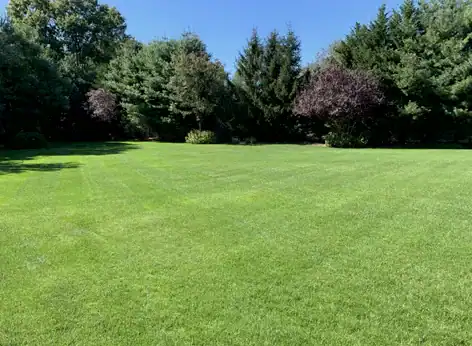
The Great South Bay is the main reason. Brown patch caused by the fungus Rhizoctonia solani needs two things to spread aggressively: nighttime temperatures above 70°F and elevated humidity. Bayport gets both, reliably, from mid-June through late August. The bay’s thermal mass keeps South Shore nights warmer than inland communities, and the moisture coming off the water keeps humidity elevated even when it hasn’t rained in days. That combination creates conditions where brown patch doesn’t just appear it spreads fast.
If your lawn also has shaded areas, older trees, or sits on a property south of Middle Road where the canopy is denser and air circulation is lower, those spots dry out slower after morning dew. That extra wet time on the blade surface is exactly what the fungus needs. The fix isn’t watering less or more it’s identifying the disease accurately and treating it with the right product before it spreads beyond the point where the existing turf can recover.
It matters a lot, because the response to each is opposite. Drought damage happens when turf dries out and goes dormant the right move is consistent, deep watering to help it recover. Brown patch is a fungal disease that spreads in wet, humid conditions adding more water accelerates it. If you treat drought damage like brown patch, your lawn stays dry and weak. If you treat brown patch like drought damage, you water the disease and watch it double in size within a week.
The visual difference can be subtle. Brown patch typically shows up as circular or irregular patches with a darker, water-soaked ring around the edge sometimes called a “smoke ring” especially visible in the morning. Drought damage tends to be more uniform across open, sun-exposed areas and follows the contour of the lawn rather than appearing in distinct circular patterns. In Bayport, where summer humidity is high and the bay keeps nights warm, brown patch is far more common than most homeowners assume, and it gets misdiagnosed as heat stress regularly. A proper diagnosis before any treatment is the only way to know for certain.
You can try, but there’s a real ceiling on what retail products can do. Consumer-grade fungicides available at garden centers and home improvement stores contain lower concentrations of active ingredients than professional formulations, and they’re limited to general-use products that don’t require a license to purchase. The restricted-use fungicide formulations that licensed commercial applicators like us use the same products applied on golf courses and professional sports turf are simply not available for retail sale in New York State.
Beyond product access, the bigger issue is diagnosis. Most homeowners applying store-bought fungicide are doing it without confirming which disease they’re treating. Applying a product that targets brown patch when you actually have dollar spot won’t produce meaningful results. And applying any fungicide without rotating chemistries across the season builds resistance over time, which is why some homeowners find that “the stuff stopped working” after a few years. A licensed professional diagnoses first, selects the right product, and rotates modes of action that’s the gap between a DIY attempt and a program that actually works.
Dollar spot shows up as small, straw-colored patches roughly the size of a silver dollar sometimes described as bleached or tan spots that can merge into larger dead areas if left untreated. Unlike brown patch, which tends to appear in large, spreading circles, dollar spot creates a more scattered, polka-dot pattern across the lawn. You might also notice white, cobweb-like mycelium on the grass blades early in the morning when dew is still present.
In Bayport specifically, dollar spot is driven by the combination of Haven Loam soil and dry summer periods. Haven Loam the dominant soil type across Suffolk County has a sandy, fast-draining subsoil that loses moisture quickly during dry stretches. When turf gets drought-stressed and nitrogen levels drop, it becomes the ideal target for dollar spot. Homeowners who underwater during July and August, or whose irrigation systems don’t compensate for how quickly the soil dries out, are particularly vulnerable. Treating dollar spot without addressing the underlying soil stress and nitrogen deficiency is a short-term fix a complete program accounts for both.
Red thread can fade on its own under the right conditions mainly if temperatures shift out of its preferred range and nitrogen levels recover but waiting it out is risky, especially on the South Shore. Red thread spreads through spores that can travel up to eight feet from an infected area, and by the time the distinctive pink-red threads are visible on the blade tips, the disease has often already been active for several days. On Long Island’s South Shore, where the bay’s influence keeps spring and fall temperatures milder than inland areas, the red thread window runs longer than most homeowners expect from roughly April through June in spring, and again from September into October.
The practical risk of waiting is that a small, manageable patch becomes a lawn-wide problem. Red thread doesn’t kill turf outright the way brown patch can, but it thins the stand significantly and leaves the lawn looking ragged and discolored for weeks. If your lawn is already nitrogen-deficient which is common in Bayport’s fast-draining soils recovery without treatment is slow. A targeted fungicide application, combined with correcting the nitrogen deficit, stops the spread and speeds recovery considerably faster than letting it run its course.
This is one of the most common cycles we see in Bayport, and it almost always points to an undiagnosed fungal disease. Here’s what’s happening: the lawn develops brown patches in summer, the homeowner assumes it’s heat or drought damage, overseeds in September, the new grass either fails to establish or looks fine until the following summer and then the same patches die again. The reseeding didn’t fail because of bad seed or poor technique. It failed because the fungal pathogen was still active in the soil, and new turf seed can’t successfully establish in infected ground.
The fix isn’t better seed or more seed. It’s treating the disease before you reseed. Once the pathogen is identified and a proper fungicide program is applied, the soil environment changes, and new seed has a real chance of establishing and surviving. One professional treatment season often costs less than three or four years of failed reseeding and it actually solves the problem instead of covering it up temporarily. If you’ve been reseeding the same spots on your Bayport lawn for more than two consecutive falls, a fungal disease diagnosis should be the first step, not another bag of seed.
Useful Links
Other Services we provide in Bayport