
Hear from Our Customers

Most lawns in Patchogue don’t fail overnight. They thin out gradually a few bare patches here, some off-color turf there until one season you’re looking at a lawn that’s more weeds and dirt than grass. The problem usually isn’t what’s happening above the surface. It’s what’s happening below it.
Patchogue’s sandy, loamy coastal soils drain fast. Nutrients leach through before the roots can absorb them, and years of that cycle leaves the soil depleted and the turf chronically stressed. Add the salt air that rolls in off the Great South Bay and settles on your lawn week after week, and you’ve got a compounding problem that watering and bagged fertilizer from the hardware store won’t fix.
When the soil gets corrected pH balanced, organic matter restored, compaction relieved the grass responds. Dense, uniform turf that holds its color through summer heat, resists weed pressure, and actually looks like it belongs on a property in a neighborhood where home values are climbing. That’s what lawn restoration near Patchogue looks like when it’s done right.
We’ve been restoring lawns across Suffolk County since the late 1980s. That’s nearly four decades of working in south shore soil the same sandy, salt-stressed, fast-draining substrate that runs through Patchogue, East Patchogue, North Patchogue, and the canal communities along the Patchogue River. We didn’t learn this from a training manual. We learned it lawn by lawn, season by season, on Long Island.
Every technician who works on your property is a NYS-licensed pesticide applicator. That’s not optional in a community this close to the Great South Bay and the village’s tidal waterways it’s a legal requirement, and it matters for your lawn’s safety and your property’s compliance.
When you call us, you’re not reaching a regional call center routing jobs to whoever’s available. You’re reaching a Suffolk County team that knows exactly what Patchogue lawns deal with and has the track record to back it up.
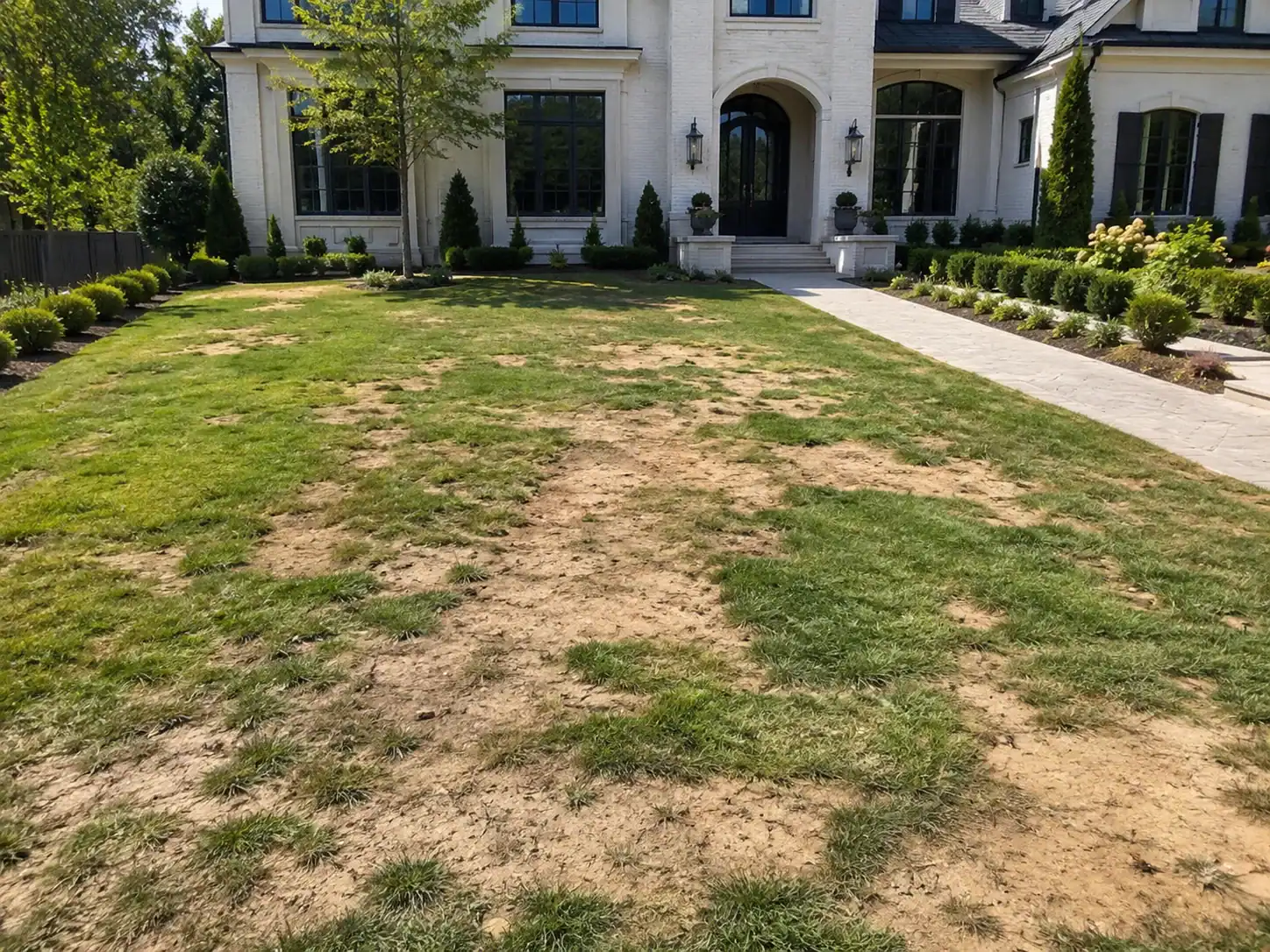
It starts with a real assessment. Before anything goes down no seed, no amendment, no application we walk the property and read what’s actually happening. Bare patches from grub damage look different from drought stress, and both look different from salt injury or fungal disease. Getting that diagnosis right is the difference between a lawn that recovers and one that gets treated for the wrong problem twice.
From there, soil correction comes first. In Patchogue’s coastal environment, that typically means addressing pH imbalance, replenishing depleted organic matter, and relieving compaction that’s blocking water and root penetration. Once the soil is ready, we use slice seeding not broadcast overseeding to place seed directly into the soil profile at the right depth. In sandy south shore soils, seed-to-soil contact is everything. Broadcast seeding on top of Patchogue’s fast-draining substrate fails more often than it works.
Fall is the optimal window for lawn restoration near Patchogue, NY. Cooler temperatures, reduced weed competition, and reliable moisture from September through mid-November create the best conditions for establishment. If you’re calling us after a rough summer or a grub outbreak, that timing works in your favor and we’ll have a plan ready before the window opens.
Ready to get started?
This distinction matters, and we’ll be straight with you about it. Lawn restoration is the right move when your existing turf is salvageable when the soil structure is intact, some viable grass remains, and the damage came from a specific cause: grubs, drought, salt stress, compaction, or a season or two of neglect. Restoration brings that lawn back through diagnosis, soil correction, slice seeding, and a targeted recovery program. It’s not a full teardown.
Lawn renovation is a different service entirely a full rebuild for lawns that are too far gone to recover. If your lawn is beyond saving, we’ll tell you that honestly, and we offer renovation as well. You won’t get a restoration quote on a lawn that actually needs to be replaced. That kind of honesty is what keeps clients coming back for 38 years.
For Patchogue homeowners specifically, our restoration programs account for the conditions that make south shore turf uniquely vulnerable: salt accumulation from bay exposure, the nutrient leaching that comes with sandy coastal soils, and the grub pressure that peaks across Suffolk County every late summer. All chemical applications are performed by NYS-licensed applicators in full compliance with Suffolk County’s groundwater protection standards which matters on a property this close to the Great South Bay and the Patchogue River watershed.
Restoration means bringing an existing lawn back to health the soil structure is still workable, some viable turf remains, and the damage has a recoverable cause. That’s the scenario where we come in, correct the soil, slice seed the bare or thin areas, and build a recovery program around what’s already there. Renovation is a full rebuild stripping out what’s left, regrading if needed, and starting over from bare soil.
The honest answer is that most Patchogue lawns we see are restoration candidates, not renovation candidates. Even lawns that look completely dead after a bad grub season or a dry summer often have recoverable root systems and soil that just needs correction. We assess that on the first visit and give you a straight answer. If your lawn genuinely needs renovation, we’ll tell you and we offer that service too. But we’re not going to recommend a full rebuild when restoration will get you where you want to go.
In most cases, yes and this is one of the most common calls we get from Patchogue homeowners in September and October. Japanese beetle grubs feed on grass roots from late summer through fall, and the damage shows up as dead patches that peel back from the soil like a loose carpet. It looks catastrophic, but the soil underneath is usually still intact and workable.
The key is addressing it in the right order. First, we confirm the grub activity is over or treat any remaining population. Then we assess root damage depth and soil condition before putting any seed down. Slice seeding into corrected soil not broadcast seeding on top of sandy, depleted ground gives the new turf the best chance of establishing before winter. Grub damage caught in early fall, with a proper restoration program in place, can produce a visibly recovered lawn by the following spring. Waiting until spring to address fall grub damage extends the timeline significantly.
Salt stress is a real and chronic issue for Patchogue properties within a mile or so of the bay which, in a village that’s only 2.2 square miles, covers a significant share of residential lots. Salt deposits on grass blades pull moisture out of the plant, and salt that accumulates in the soil disrupts the root system’s ability to absorb nutrients. The result looks like drought stress or fertilizer deficiency off-color, thinning turf that doesn’t respond the way you’d expect to watering or feeding.
The fix involves flushing accumulated salt from the soil profile, amending organic matter to improve the soil’s buffering capacity, and selecting grass varieties with stronger salt tolerance for the restoration seeding. It’s not a one-application fix it’s a program. But it works. Lawns on the canal streets and bay-adjacent blocks in Patchogue can absolutely be restored to dense, healthy turf when the salt issue is addressed as part of the soil correction process, not ignored in favor of just throwing seed down.
For a fall restoration program near Patchogue which is the optimal window you should expect to see germination and initial coverage within three to four weeks of seeding, assuming soil temperatures stay above 50°F and moisture is consistent. Full establishment, meaning a dense, uniform stand of turf, typically takes one full growing season. By the following spring and summer, a properly restored lawn should be performing significantly better than it was before.
Timeline depends on the severity of the damage, the soil conditions going in, and how well the establishment period is managed particularly irrigation in the first few weeks after seeding. Sandy coastal soils near Patchogue dry out faster than inland Suffolk County soils, so keeping moisture consistent after slice seeding is more critical here than it would be in, say, Smithtown or Commack. We walk you through exactly what’s needed after we leave so the establishment phase doesn’t get undermined by something avoidable.
The main cost drivers are lawn size, the extent and type of damage, and what the soil correction requires before seeding can happen. A lawn with isolated bare patches from grub damage costs less to restore than one with widespread thinning from years of salt stress and pH imbalance because the soil prep work is more involved in the second scenario. Slice seeding alone is one cost; slice seeding plus soil amendment, pH correction, and targeted grub treatment is a different scope.
Property-specific factors also matter near Patchogue. Bay-adjacent lots with documented salt accumulation may need more intensive soil flushing and amendment. Older properties in the village especially those with decades of compacted, never-aerated soil often require more prep work before the seeding phase. The only way to give you an accurate number is to walk the property and assess what’s actually there. That’s what the estimate visit is for, and there’s no obligation attached to it.
Fall is the better window for lawn restoration near Patchogue, NY and the reasons are specific to south shore conditions, not just general turf advice. Cooler air temperatures reduce heat stress on newly germinated seedlings. Crabgrass and other warm-season weeds are no longer competing for the same soil space. And Patchogue’s sandy coastal soils, which dry out fast in summer, tend to hold moisture more reliably from September through mid-November.
Spring restoration is possible, but it comes with real tradeoffs here. You’re racing against crabgrass germination, which typically kicks off when soil temperatures hit 55°F and Patchogue’s sandy soils warm up faster than inland areas, so that window is shorter than homeowners expect. Pre-emergent crabgrass applications conflict with overseeding, which forces a choice between weed control and establishment. Fall avoids that conflict entirely. If you’ve got grub damage or drought damage from this past season, the fall window is when to act not next spring.
Useful Links
Other Services we provide in Patchogue