
Hear from Our Customers
When a lawn fertilization program is done right, the results aren’t subtle. Thicker turf, fewer weeds crowding in, and grass that holds its color through the stress of a Long Island summer those are the outcomes a well-built program produces. What you stop dealing with is just as important: the patchy spots that never fill in, the crabgrass that shows up every July, and the frustration of paying for treatments that don’t seem to change anything.
In Hauppauge, most of the residential lots were built out in the 1960s and 70s. That means decades of foot traffic, mowing, and freeze-thaw cycles have compacted the soil on a lot of these properties. Nutrients from surface applications can’t reach the root zone the way they should on compacted ground which is one of the main reasons lawns in established neighborhoods stop responding to basic fertilization over time. The fix isn’t more product. It’s a program that accounts for what’s actually happening beneath the surface.
Hauppauge also sits within the Nissequogue River watershed, and the water table here is naturally high it’s literally what the name means in Algonquian. That’s not just an interesting local fact. It means what gets applied to your lawn has a shorter path to the groundwater than in most other communities. A licensed professional who understands Suffolk County’s fertilization laws and applies the right products at the right time isn’t just better for your lawn it’s better for the water your neighborhood depends on.
We’ve been working in Suffolk County since 1987, with deep roots in Hauppauge and the surrounding communities. That’s not a tagline it’s just the reality of what it takes to stay in business in this market for nearly four decades. The companies that cut corners don’t last. The ones that send unlicensed crews and apply generic product off a truck don’t build the kind of reputation that keeps customers coming back year after year.
Every job that goes out under the Lawn Master name is handled by a licensed pesticide professional not a seasonal hire handed a spreader. The fertilizer we use on your lawn is custom-blended specifically for Lawn Master, not pulled from the same commercial warehouse that supplies a dozen other operators in the area. And every program we build is around the actual conditions of your property, not a five-step template applied identically from Hauppauge to Holbrook.
If you’ve driven past Blydenburgh County Park or watched the Nissequogue River fill up after a hard rain, you already have a sense of how ecologically connected this area is. We’ve been working in that environment long enough to know exactly what responsible, effective lawn care looks like here and what it doesn’t.
It starts with understanding what you’re actually working with. Hauppauge properties vary more than people expect soil drainage near the lower-lying areas around the Nissequogue watershed behaves differently than lots on higher ground closer to the Industrial Park corridor. Sun exposure, existing grass type, shade from mature tree canopies, compaction levels all of it factors into what your program looks like before a single application goes down.
From there, we build a schedule around the seasonal windows that matter most for cool-season grasses on Long Island. Spring applications focus on getting the lawn moving after winter and getting ahead of crabgrass before it germinates. Summer treatments are dialed back and targeted cool-season turf goes through natural stress in July and August, and pushing it with heavy fertilization during that window does more harm than good. Fall is where the real work happens. The September through October window is the most important of the year for Long Island lawns: roots are rebuilding, the grass is recovering from summer, and what we put down now determines how the lawn comes back in spring.
It’s also worth knowing that Suffolk County law prohibits fertilization between November 1st and April 1st. That’s not a guideline it’s a $1,000 fine if violated. A properly timed fall application by a licensed professional means your lawn enters that blackout period in the best possible shape, without any last-minute scrambling or compliance risk.
Ready to get started?
The core of what we deliver is a multi-application fertilization program using a custom-blended fertilizer formulated specifically for our operation not a generic product available to any operator who places an order. That distinction matters more than it sounds. Suffolk County’s dominant soil type is Haven Loam, but Hauppauge’s position along the Ronkonkoma Moraine means some properties carry clay lenses from glacial deposition that affect drainage and nutrient retention differently than the sandy loam found further south. A product calibrated for Long Island’s specific soil chemistry performs better here than anything off a standard commercial shelf.
Beyond fertilization, we build programs to address the real weed and turf problems that show up on Hauppauge lawns specifically. Nutsedge also called nutgrass thrives in moist, poorly drained soil, and it’s a persistent problem in areas where soil moisture runs higher. Crabgrass control timing is critical in Zone 7a, and missing the pre-emergent window by even a week or two can mean a summer full of it. Bentgrass patches, grub damage, and thinning from shade are all conditions that a generic program doesn’t account for and a custom one does.
For lawns that are past the point where a treatment schedule can turn things around, we also handle full lawn restoration and new installs from seed using the same seeding equipment and custom fertilizer that go into our ongoing programs. If your lawn needs a fresh start, that’s a service most fertilization-only competitors in the area simply can’t offer.
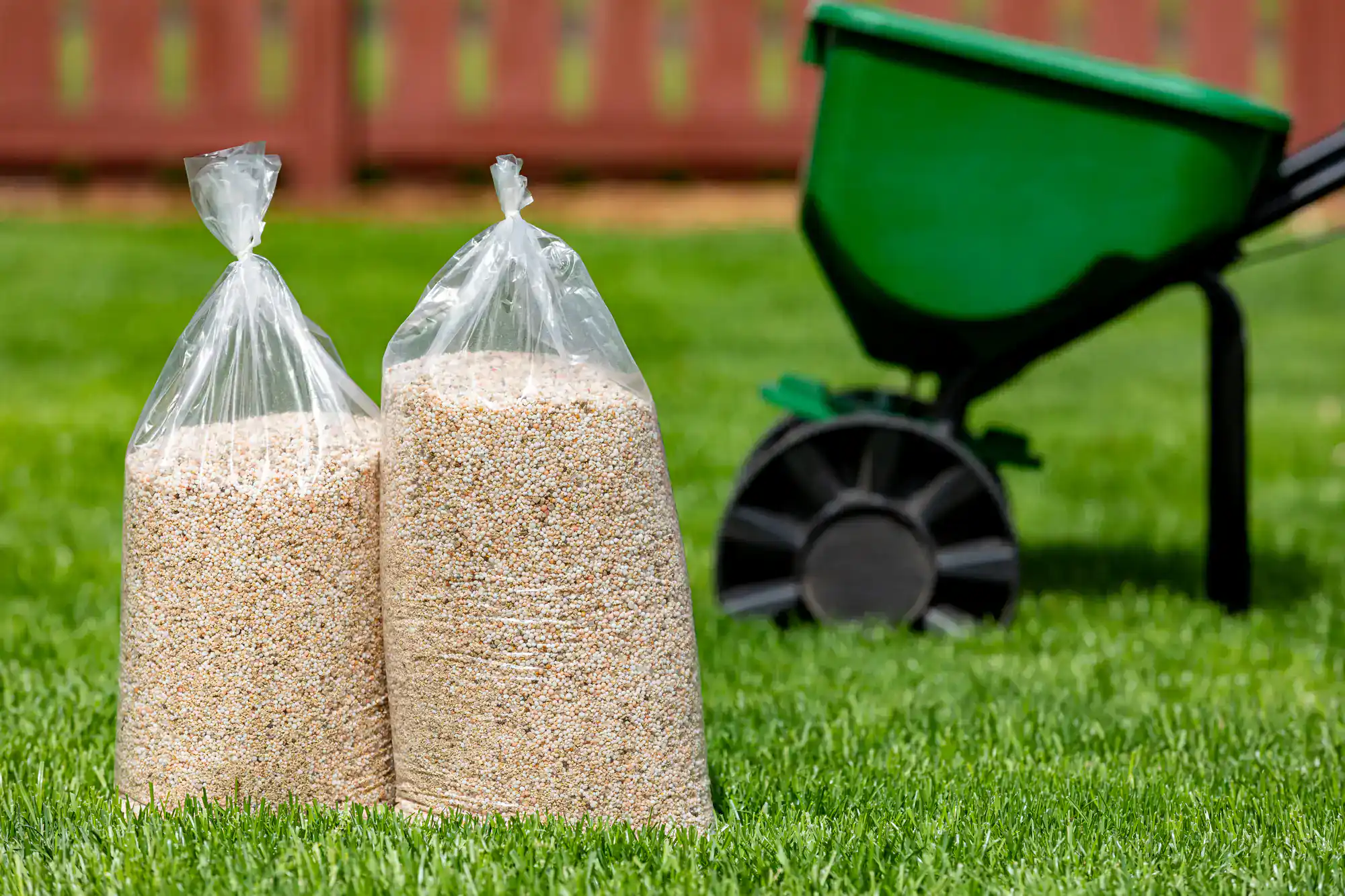
The most important window for Hauppauge lawns is early fall specifically the first few weeks of September. Cool-season grasses like Kentucky bluegrass, perennial ryegrass, and tall fescue which are the standard turf types in this area recover from summer heat stress and build root reserves during this period. What you apply in September and October directly affects how the lawn performs the following spring.
Spring fertilization matters too, but it needs to be timed carefully. Starting too early, before the grass is actively growing, wastes product and can push excessive top growth at the expense of root development. Mid-April is generally the right window for Long Island. It’s also when pre-emergent crabgrass control needs to go down that timing is non-negotiable if you want to stay ahead of it.
One hard deadline to know: Suffolk County law prohibits any lawn fertilization between November 1st and April 1st. Violations carry a $1,000 fine. A properly timed fall program wraps up before that cutoff and sets the lawn up to come through winter in good shape.
This is one of the most common frustrations homeowners bring up, and it almost always traces back to one of two things: the program wasn’t built around the actual conditions of the property, or the applications weren’t timed correctly for the season.
A lot of national lawn care operators including the larger chains that service Hauppauge from branches in other towns run the same five-step program on every property regardless of soil type, sun exposure, drainage, or grass condition. On a compacted lot from the 1960s with a mature tree canopy and clay-influenced soil, that approach produces mediocre results at best. Nutrients applied to compacted ground can’t penetrate the root zone efficiently, which means the lawn never gets the full benefit of what’s being put down.
The other issue is summer. Cool-season grasses in Zone 7a naturally slow down and stress under July and August heat. If a company is pushing heavy fertilization during that window, they’re working against the grass, not with it. Results look worse because the program isn’t designed around how Long Island turf actually behaves through the seasons.
Yes in New York State, any business applying pesticides or fertilizer-pesticide combination products for hire is required to register with the NYSDEC and employ at least one certified commercial pesticide applicator. Certification requires passing both a Core exam and a category-specific exam, and recertification requires 24 continuing education hours every three years. It’s a real credential with real ongoing requirements, not a one-time registration.
In Hauppauge specifically, this matters beyond just legal compliance. The community sits within the Nissequogue River watershed, and the water table here is naturally high the area’s Algonquian name literally references its underground springs. The proximity of lawn applications to the groundwater supply is shorter here than in many other parts of Suffolk County, which is exactly why the county has strict fertilizer laws and why the NYSDEC’s Neighbor Notification Law which requires 48-hour advance written notice to neighbors within 150 feet for certain spray applications exists.
When you hire a licensed professional, those requirements are handled automatically. When you hire an unlicensed crew, they often aren’t and the liability falls on the property owner.
The fertilizer you find at a hardware store or home improvement center is formulated for the broadest possible range of conditions it has to work reasonably well on lawns from Long Island to Louisiana. That means it’s optimized for no one in particular. The nutrient ratios, release rates, and formulation are built around average conditions, not the specific soil chemistry and grass types you’re working with in Hauppauge.
A custom-blended fertilizer is formulated with a specific region and application program in mind. In our case, that means a product calibrated for Long Island’s soil conditions including the Haven Loam that dominates Suffolk County and the variation that comes with Hauppauge’s position along the Ronkonkoma Moraine. The nutrient profile, particle size, and release timing are dialed in for the way the product will actually be used, on the grass types that grow here, in the seasonal windows that matter on Long Island.
The practical difference shows up in results. A lawn that’s been on a custom program for a full season looks noticeably different from one that’s been on a generic commercial product better color retention, more even density, and fewer stress responses through the summer.
Core aeration is the process of pulling small plugs of soil out of the ground to break up compaction and create channels for water, air, and nutrients to reach the root zone. On a lawn that’s been mowed, walked on, and maintained for 50 years which describes most properties in Hauppauge, given the neighborhood’s median construction year of 1969 compaction is a real and ongoing issue. Surface fertilization on compacted soil is significantly less effective because the nutrients can’t move where they need to go.
The right window for aeration in this area is late August through late September. That timing lines up with the fall fertilization window, which means you’re opening up the soil right before the most important application of the year goes down. The combination of aeration followed by fertilization and overseeding in early fall produces better results than either service done alone.
Equipment matters here too. Hydraulic aerators pull deeper, more consistent plugs than the tow-behind units many smaller operators use. On Hauppauge’s older, more compacted lots, that difference in penetration depth translates directly into how well the lawn responds to everything that follows.
The honest answer is that it depends on how much viable turf you’re actually working with. A fertilization program can do a lot it can thicken thin areas, improve color, crowd out weeds over time, and help the lawn recover from a rough summer. But it can only work with what’s there. If more than 50 percent of the lawn is bare ground, dead patches, or dominated by weeds and unwanted grasses, you’re often better off starting fresh than trying to nurse a struggling lawn back through treatments alone.
In Hauppauge, a few specific situations tend to push lawns past the point of recovery: grub damage that went undetected for a season or two, construction or renovation work that stripped or buried the topsoil, and years of compaction without aeration that have essentially choked out the root system. These aren’t situations where more fertilizer helps they need a clean slate.
A full lawn restoration from seed, done with the right seeding equipment and a custom fertilizer program from day one, typically produces a healthier, denser lawn than patching over a struggling one. It’s a bigger upfront investment, but for a property in Hauppauge South or Hauppauge Northwest where home values are approaching and exceeding $750,000, the return on a properly installed lawn is real and visible.
Useful Links
Other Services we provide in Hauppauge