
Hear from Our Customers
If you’ve been reseeding the same dead spots in your Coram lawn every fall and they keep coming back, there’s a reason and it’s not your grass seed. Active fungal disease kills new seedlings before they can root. Until the underlying pathogen is identified and treated, nothing you plant is going to survive. That cycle ends when you stop guessing and start treating the actual problem.
Coram’s inland position in central Suffolk County creates a specific disease window that catches a lot of homeowners off guard. Unlike communities along the Great South Bay that get consistent maritime breezes to break the heat, Coram’s summer temperatures build and hold. When overnight lows stay above 70°F for several consecutive nights which happens regularly here from late June through August brown patch can spread across a lawn in a matter of days. A lawn that looks fine on Sunday can show serious damage by Thursday.
The sandy soils near the Central Pine Barrens don’t help either. They drain fast, which means turf dries out quickly during dry stretches, and drought-stressed grass is exactly what dollar spot feeds on. We understand how Coram’s soil profile and summer climate interact to create recurring disease pressure and we treat accordingly, not on a generic national calendar.
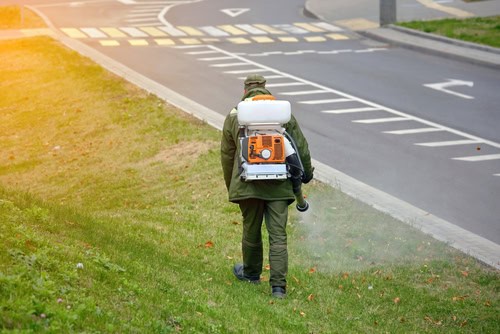
We’re a licensed commercial pesticide applicator based in Port Jefferson Station, serving homeowners across central Suffolk County including Coram, Selden, and the communities that make up the Longwood and Middle Country school districts. Our NYS DEC commercial pesticide applicator license isn’t a badge we put on a brochure. It’s a legal requirement to purchase, possess, and apply the restricted-use fungicide formulations that actually work on established disease and it requires passing state exams, meeting experience prerequisites, and renewing every three years.
What that license means for Coram homeowners is straightforward: our applicators have access to professional-grade chemistry that isn’t available at any hardware store or home improvement center, and we’re accountable to a documented application record every time we treat your property. You get a written contract before every application and documentation of exactly what was used, at what rate, and when something no unlicensed operator can offer.
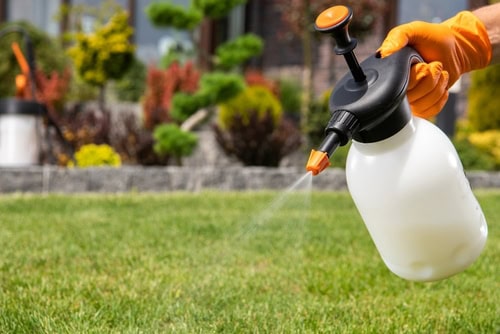
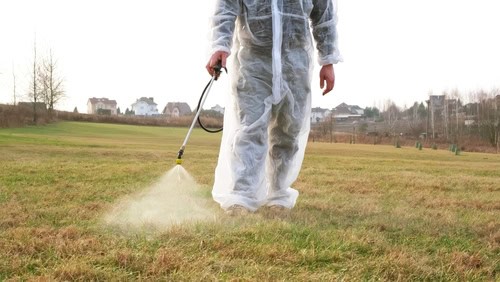
The first thing we do is look at your lawn actually look at it. Brown patch, dollar spot, and red thread each have distinct visual signatures, and they each require different chemistry to treat. Applying the wrong fungicide to the wrong disease doesn’t just waste money; it gives the actual pathogen more time to spread while you wait for results that aren’t coming. Diagnosis comes first, every time.
Once the disease is identified, the right fungicide is selected and timed to where the infection is in its cycle. A lawn with early-stage dollar spot on sandy Coram soil during a dry July stretch gets treated differently than a lawn with active brown patch spreading through a dense stand of turf during a humid August night. Preventative applications are timed to disease pressure windows specific to central Suffolk County not a generic schedule built for lawns in a different climate entirely.
After treatment, we rotate fungicide chemistries across applications. This isn’t just good practice it prevents resistance from developing in the pathogen population, which is what happens when the same mode of action gets used repeatedly. It keeps your program effective season after season, not just for the first application.
Ready to get started?
Our fungicide treatment program covers the three diseases most common on Long Island cool-season turf: brown patch, dollar spot, and red thread. Brown patch is a summer disease it activates when heat and humidity align, and Coram’s inland location means that window is long and unrelenting from late June through August. Dollar spot is a drought-stress disease, and on the sandy, fast-draining soils that define this part of central Suffolk County near the Pine Barrens, it’s a recurring threat every time rainfall falls short. Red thread shows up in spring and again in early fall, spreading fast in the cool, damp conditions that central Long Island delivers in both shoulder seasons.
Because we hold a NYS DEC commercial pesticide applicator license, our program uses restricted-use fungicide formulations the same class of professional-grade chemistry used on golf courses and athletic fields that are simply not available at retail. These aren’t consumer-grade dilutions. They’re the real products, applied at the right rates, by someone who knows what they’re treating.
Every application comes with a written contract, documented treatment records, and neighbor notification as required under New York State law. For Coram homeowners who are mindful of the community’s proximity to the Central Pine Barrens watershed, that documentation matters. You know exactly what went on your lawn, applied by a licensed professional following label requirements not guesswork.
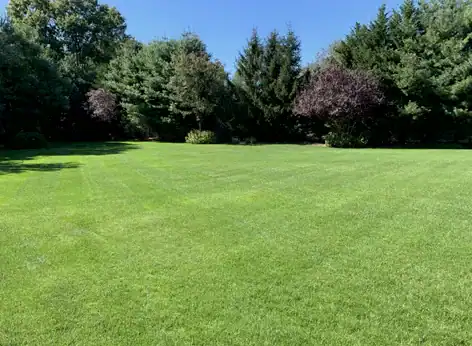
Each disease has a distinct look, and getting that identification right is the difference between a treatment that works and one that doesn’t. Brown patch shows up as irregular, roughly circular patches of tan or brown grass often with a darker outer ring when conditions are actively wet. It tends to appear fast during Coram’s humid summer nights when temperatures stay above 70°F. Dollar spot produces smaller, roughly silver-dollar-sized straw-colored spots scattered across the lawn, and it’s especially common on drought-stressed turf which is a real issue on Coram’s sandy, fast-draining soils during dry stretches in July and August. Red thread is easier to spot up close: you’ll see pink or red thread-like strands extending from the grass blades, usually in the cooler, wetter weeks of spring and early fall.
The honest answer is that visual identification takes experience, and misreading one disease for another is exactly why store-bought treatments so often fail. If you’re not sure what you’re looking at, that’s the right time to call a licensed applicator who can make the call correctly before any product gets applied.
There are a few reasons this happens, and they’re all fixable but only with the right approach. The most common issue is chemistry mismatch: consumer fungicide products contain a limited selection of active ingredients, and if the product you bought doesn’t match the specific pathogen in your lawn, it won’t work regardless of how carefully you apply it. The second issue is concentration. Retail fungicide products are formulated at lower concentrations than the restricted-use products that licensed commercial applicators like us are legally permitted to use. The same active ingredient at a lower rate often isn’t enough to control an established infection.
Timing is the third factor. Fungicides are most effective when applied preventatively or at the very early stages of infection. By the time most homeowners notice visible damage and make a store run, the disease is already well established and a curative application at that stage requires the right product at the right rate, applied by someone who understands the disease cycle.
Timing depends on which disease you’re targeting and what your lawn’s history looks like. For brown patch the most destructive summer disease on Long Island cool-season turf the preventative window opens in early to mid-June, before overnight temperatures consistently hit 70°F. In Coram, that threshold arrives reliably by late June most years, and once it does, brown patch can spread quickly on established turf. Getting ahead of it with a preventative application is significantly more effective than trying to stop an active outbreak.
Dollar spot is active from late spring through early fall, with peak pressure during dry, hot stretches in July and August exactly the conditions Coram’s sandy soils amplify by drying out quickly between rain events. Red thread has two windows: a spring window in April and May when soils are cool and wet, and a fall window in September and October. If your lawn has a history of recurring disease, a preventative program timed to these windows is almost always more cost-effective than repeated curative treatments after the damage is already visible.
Yes, and this is worth knowing before you hire anyone. Under New York State law, any business applying pesticides for hire including fungicide must hold a NYS DEC commercial pesticide applicator registration and employ at least one certified commercial applicator. That certification requires passing state exams and renewing every three years with continuing education. It’s not a formality, and not every company operating in Coram holds it.
Beyond the license itself, NYS DEC regulations require a written contract before every commercial lawn application. Your neighbors must also be notified before treatment, as required by state law. On top of that, Suffolk County Chapter 647 adds county-level compliance requirements for residential pesticide applications, including visual notification. We comply with all of these written contracts, documented application records, neighbor notification every time. If a company is offering to spray your lawn without mentioning any of this, that’s a gap worth asking about.
It can, and it does. Fungal pathogens spread through spores, and those spores travel easily on foot traffic, on mowing equipment, on wind, and in some cases through water runoff. Red thread is particularly aggressive in this regard: its spores can travel up to eight feet from a single infected area, which in Coram’s suburban neighborhoods where properties sit relatively close together means an untreated lawn can become a source of infection for adjacent yards.
Brown patch and dollar spot spread more slowly but follow the same principle: the longer an active infection goes untreated, the larger the spore load in your soil becomes, and the more likely it is to affect surrounding turf. This is one reason professional treatment matters beyond just your own lawn. A licensed fungicide application that actually eliminates the pathogen not just suppresses the symptoms temporarily reduces the overall disease pressure in your immediate area. Treating early and correctly is the responsible move for your lawn and your neighbors’.
It depends on your lawn’s history and what diseases have shown up before. Coram lawns with a track record of summer brown patch or recurring dollar spot generally benefit from a preventative program typically two to three applications timed to the disease pressure windows that central Suffolk County’s climate creates. That means an early summer application before brown patch season peaks, a mid-summer follow-up if conditions stay hot and humid, and potentially a fall application targeting red thread and late-season dollar spot.
Lawns that haven’t had visible disease problems may only need a single curative treatment in a year where conditions are particularly favorable for infection a wet, humid summer with extended stretches of overnight heat, for example. The honest answer is that there’s no universal schedule that fits every Coram lawn. The right frequency depends on your soil, your grass type, your irrigation habits, and what diseases have historically shown up on your property. Our licensed applicators assess all of that before recommending a program because the goal is effective treatment, not more applications than your lawn actually needs.
Useful Links
Other Services we provide in Coram