
Hear from Our Customers
When a subdivision goes up, heavy construction equipment grades and compacts the soil before a single home is built. Topsoil gets removed, buried, or graded away. The lawn that grows back on top is sitting on a compacted base that’s been there for 50, 60, sometimes 70 years and no amount of fertilizer or watering corrects that on its own. That’s the baseline condition of most residential properties in Coram, and it’s exactly why so many homeowners here keep spending money on lawn care without seeing real results.
Core aeration changes the equation. By pulling plugs of soil from the ground, it creates channels that let water, air, and nutrients actually reach the root zone instead of pooling on the surface or running off. Roots grow deeper. The grass handles drought better which matters during the hot, dry stretches that central Brookhaven gets every summer, further inland and without the coastal buffer that communities closer to the Sound enjoy. A lawn that could barely survive August starts holding its color through September.
The other thing that changes is how your other lawn care investments perform. Fertilizer applied to compacted soil is largely wasted it sits in the thatch layer or runs off before it reaches the roots. After aeration, those same inputs go where they’re supposed to. You’re not spending more. You’re finally getting what you were already paying for.
We’ve been working in Suffolk County since 1987, and that means we were restoring Long Island lawns before most of our current competitors opened for business. We know the glacial soil variability across central Brookhaven and Coram specifically, the way the freeze-thaw cycle re-compacts lawns every winter, and exactly how the fall aeration window plays out against Suffolk County’s November 1 fertilizer ban. That kind of local knowledge takes decades to build.
Every job runs with licensed pesticide professionals not seasonal labor supervised by an off-site certificate holder. Our equipment is hydraulic, professional-grade, and built to pull clean cores from even the most stubborn compacted soil. The fertilizer is custom-blended specifically for Lawn Master, formulated for Long Island’s specific soil chemistry rather than some national average that doesn’t exist anywhere on this island.
From the residential neighborhoods off Route 112 to the properties along the Longwood School District corridors, we’ve been showing up with the same five fully wrapped trucks and the same standard of work since before some of our customers bought their first home. Ongoing care is handled by our Coram lawn treatment company.
It starts with an honest assessment of your lawn’s actual condition not a canned program applied to every property on the block. Soil type, thatch depth, grass variety, compaction level, and sun exposure all factor in. Coram properties can vary significantly depending on whether they sit closer to the moraine zones near Bald Hill or on sandier outwash profiles further south, and that difference affects how we sequence the treatment and what gets applied afterward.
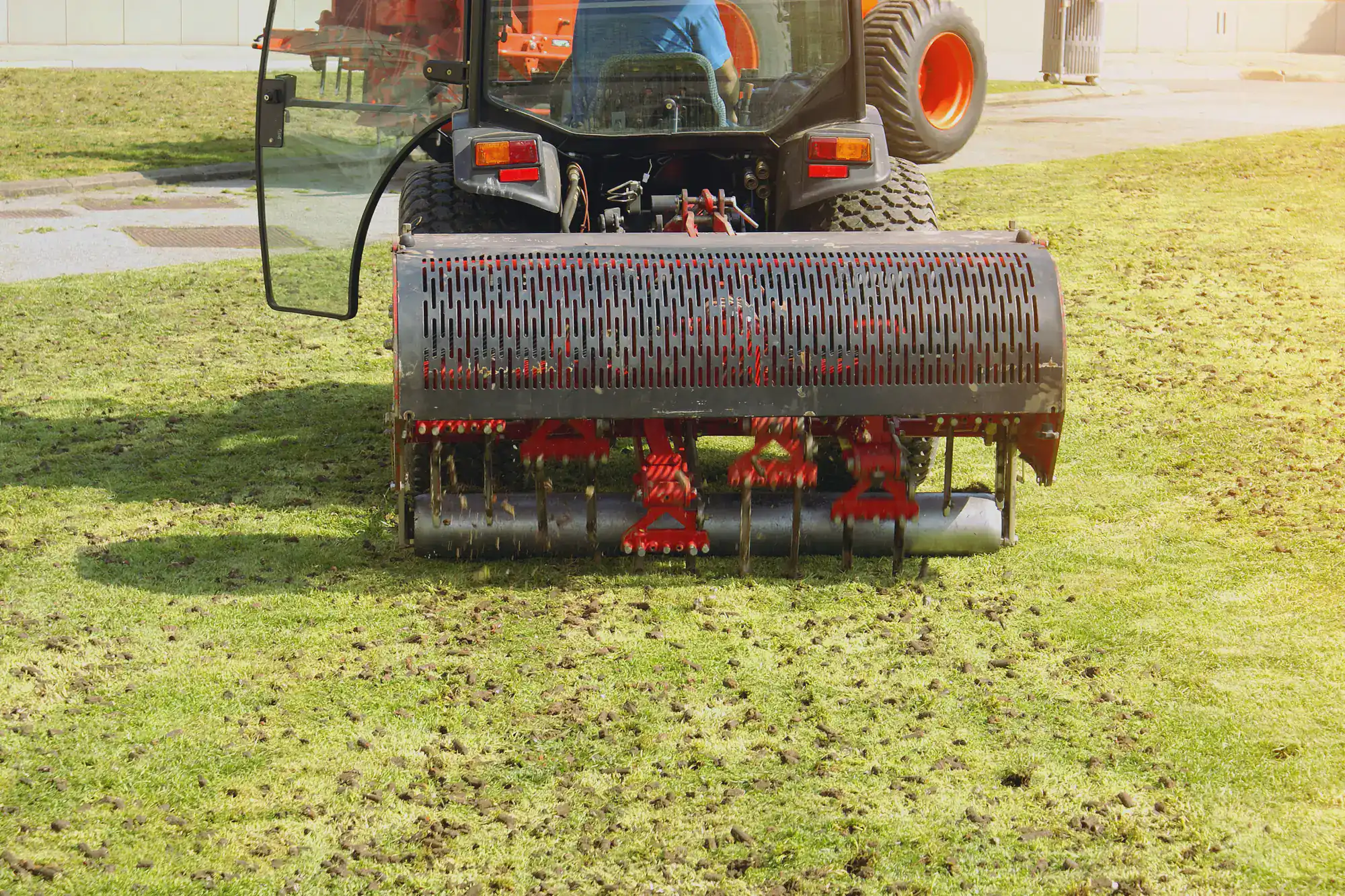
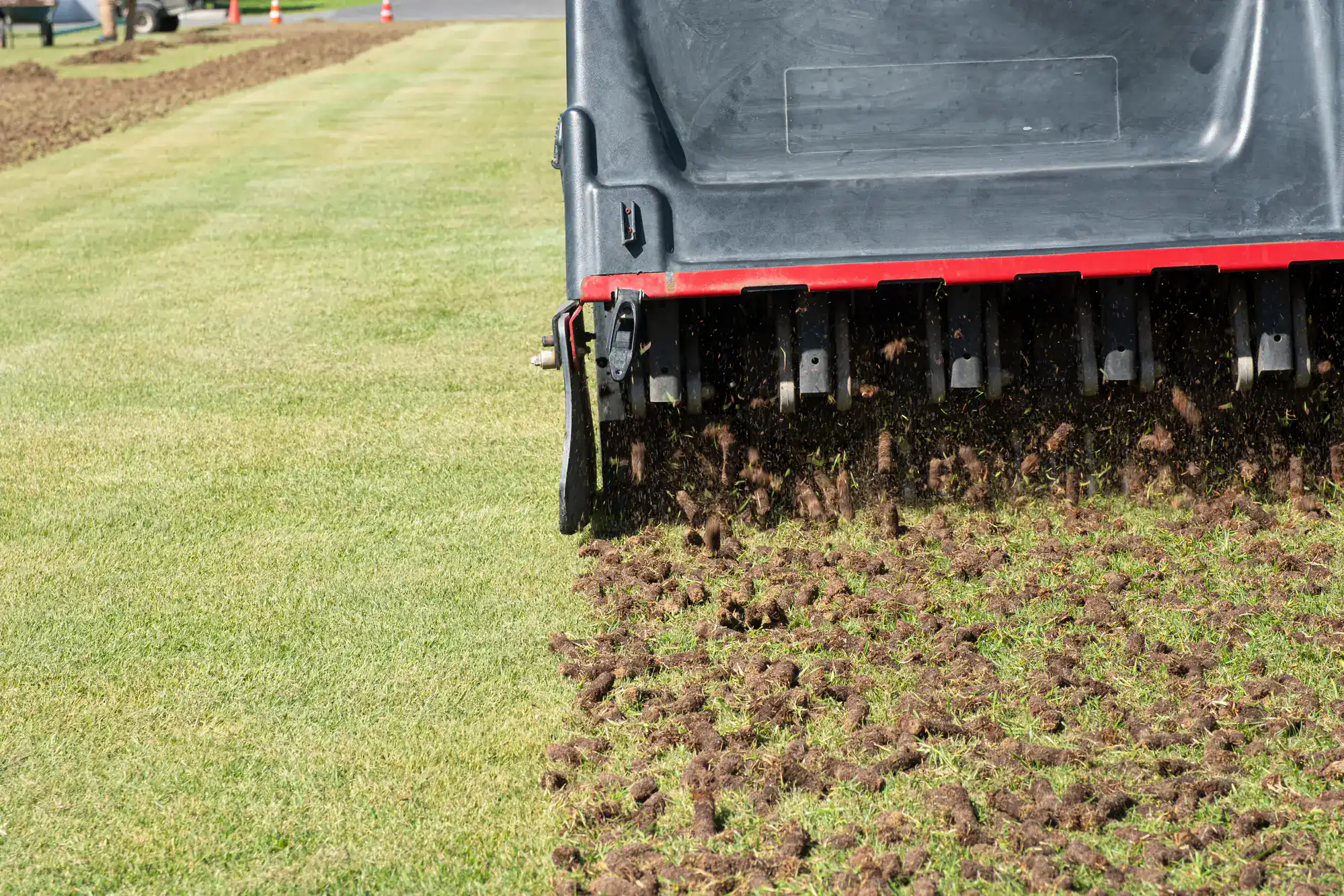
Once the assessment is done, our hydraulic aerator goes to work. Unlike the walk-behind rental machines available locally, hydraulic equipment applies consistent downward pressure regardless of soil resistance which means cleaner cores, deeper penetration, and more consistent spacing across the entire lawn. The cores pulled from the ground are left on the surface to break down naturally, returning organic matter to the soil as they decompose.
If overseeding and fertilization are part of your program, those follow immediately after aeration while the channels are open. This is where timing matters: Suffolk County prohibits fertilizer applications between November 1 and April 1, so the full fall program aeration, overseeding, and fertilization needs to be completed before that window closes. We plan the schedule around that deadline, not after it. By the time the season ends, your lawn has everything it needs to come back stronger in the spring.
Ready to get started?
Lawn aeration cost for a typical Coram residential property generally falls between $100 and $200, depending on lawn size, soil condition, and whether overseeding or fertilization are added to the program. Renting a machine locally runs $75 to $107 per day before you factor in your time, physical effort, and the reality that consumer-grade aerators don’t penetrate as deeply or remove cores as cleanly as professional hydraulic equipment. For most homeowners, the professional option delivers better results at a comparable or lower total cost when you account for what you actually get.
What we bring to a Coram property isn’t a fixed tier or a preset bundle. Every program is built around what your specific lawn needs assessed on-site, not guessed at over the phone. If your lawn needs core aeration plus overseeding plus a custom fertilizer application, that’s what gets designed. If it only needs aeration this season, you won’t be upsold on services that don’t apply to your situation. The custom-blended fertilizer used in every program is formulated specifically for Long Island soil chemistry not an off-the-shelf product applied the same way everywhere.
For lawns that are past the point of maintenance and need a full reset, we also handle complete lawn restoration and new lawn installs from seed. Whether your Coram property needs a tune-up or a full restart, the approach is the same: licensed professionals, hydraulic equipment, and a program that’s actually built for your lawn.
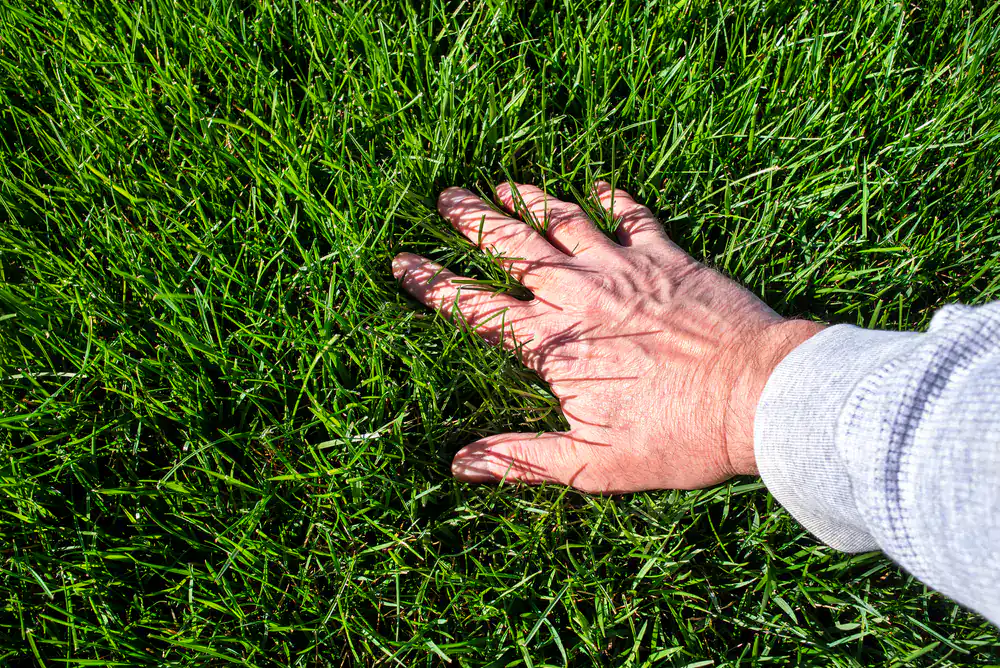
The most straightforward test is the screwdriver check: after watering your lawn, push a standard 6-inch screwdriver into the soil. If it won’t go down 3 inches without real effort, your soil is compacted and aeration will make a measurable difference. Beyond that, watch for water pooling on the surface after rain, grass that looks thin or stressed during summer dry spells, or bare patches that don’t respond to overseeding. These are all signs that water and nutrients aren’t reaching the root zone.
In Coram specifically, the baseline condition of most residential lawns already points toward compaction. The post-war subdivisions that make up the majority of the hamlet’s housing stock were built on soil that was graded and compacted by heavy construction equipment before the first sod was ever laid. Fifty or sixty years of foot traffic, mowing, and freeze-thaw cycling on top of that foundation means most Coram lawns are dealing with compaction whether the symptoms are obvious yet or not. If your home was built before 1990 and you’ve never had the lawn aerated, it’s a reasonable assumption that the soil needs it.
For the cool-season grasses that cover most Coram lawns fescues, bluegrasses, and perennial ryegrasses the optimal window is late August through October. Soil temperatures are still warm enough to support grass recovery and new seed germination if you’re overseeding, but the air is cooling down, which reduces stress on the turf during the recovery period. This fall window consistently produces better results than spring aeration for Long Island lawns.
There’s also a hard deadline to keep in mind: Suffolk County prohibits fertilizer applications between November 1 and April 1. Since fertilization is typically part of a complete fall aeration program, the entire sequence aeration, overseeding, and fertilization needs to be wrapped up before November 1. That makes the practical booking window shorter than most homeowners expect, usually running from late August through mid-October. Waiting until the last minute often means either rushing the job or losing the fertilization window entirely. Booking early in the fall season is the straightforward way to avoid that problem.
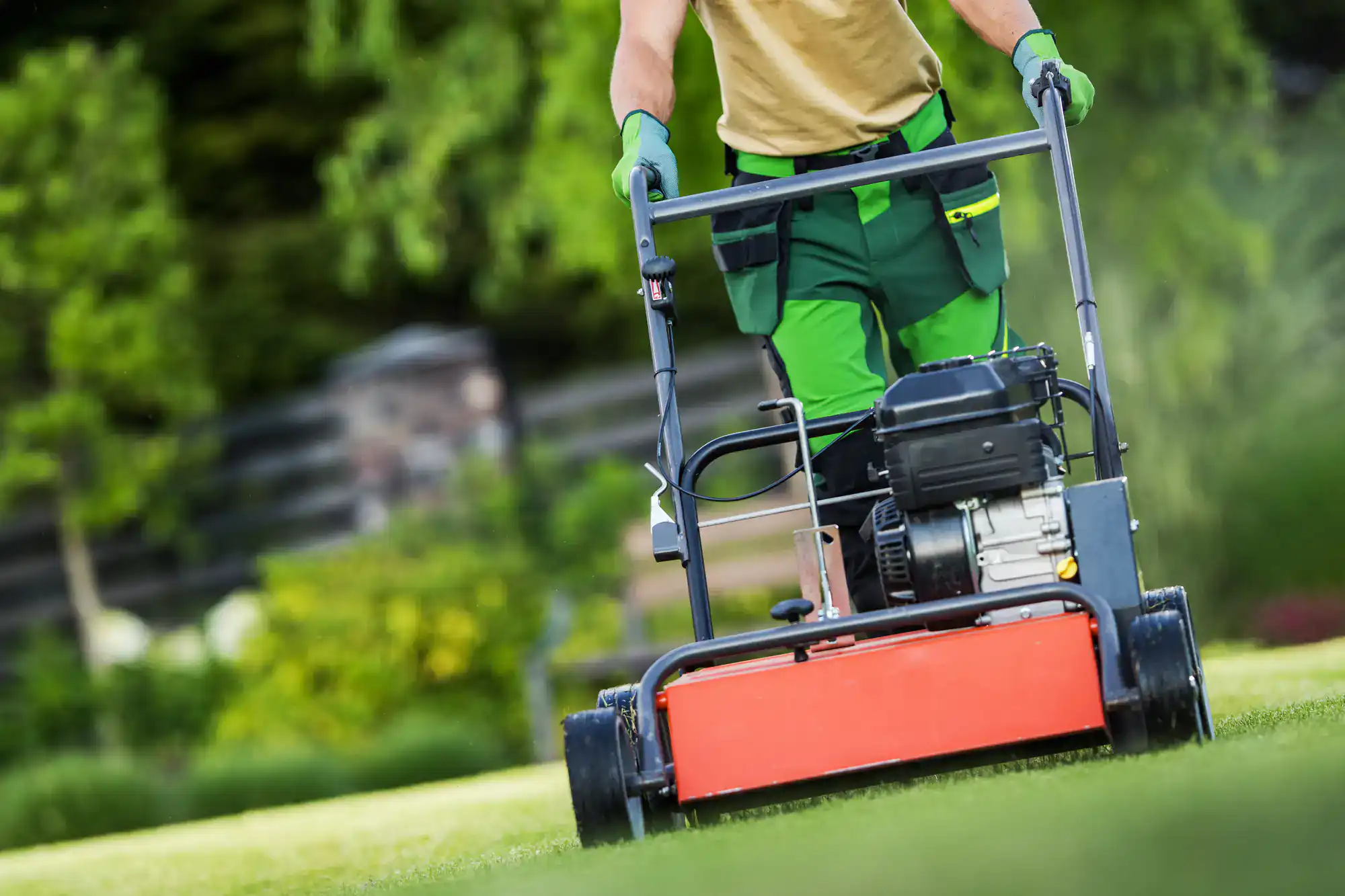
Rental aerators exist, and they work to a point. The machines available at local hardware stores are consumer-grade walk-behind or tow-behind units designed for light residential use on relatively uniform soil. They don’t apply consistent downward pressure, which means they struggle in compacted clay zones and don’t pull clean cores in heavier soil profiles. On a Coram property where the soil has been compacted since the subdivision was built, a rental machine may barely scratch the surface.
Professional hydraulic aerators apply consistent mechanical force regardless of soil resistance. They penetrate deeper, remove cleaner cores, and space them more evenly across the entire lawn. The difference in results is real and visible. Add in the cost of the rental ($75–$107/day), the physical labor involved, the time it takes to haul the equipment, and the fact that you’re doing this yourself without a soil assessment guiding the process and the professional option starts looking like the more practical choice for most homeowners, not just the more expensive one.
Yes, and it’s one of the more underappreciated benefits. Thatch is the layer of dead grass stems, roots, and organic debris that accumulates between the soil surface and the living grass above it. A thin thatch layer is normal and even helpful it insulates the soil and retains moisture. But when it gets too thick, it blocks water, air, and nutrients from reaching the root zone and creates an environment where disease and pests thrive.
Core aeration helps break down thatch in two ways. First, the cores pulled from the ground contain soil microorganisms that, when left on the surface, accelerate thatch decomposition as they break down. Second, the channels created by aeration improve drainage and airflow through the thatch layer, which slows future buildup. On Long Island lawns where cool-season grasses tend to produce thatch more readily and the humid summers create conditions favorable to thatch-related disease regular aeration is one of the most practical tools for keeping thatch at a manageable level without resorting to mechanical dethatching, which is more disruptive to the lawn.
Combining aeration and overseeding is one of the most effective things you can do for a thinning lawn, and the timing works naturally together. Aeration is done first, and the channels it creates give new seed direct contact with the soil which is exactly what grass seed needs to germinate successfully. Without that soil contact, seed scattered on a compacted or thatch-heavy surface has a much lower germination rate because it sits on top rather than integrating into the ground.
For Coram properties where the lawn has thinned out over the years common on the older ranch and Cape Cod homes in the area where the original lawn was established on poor post-construction soil aeration and overseeding together can produce a noticeably denser, healthier lawn within a single growing season. The fall window is ideal for this combination: soil temperatures support germination, competition from weeds is lower than in spring, and the new grass has time to establish before winter. Our custom-blended fertilizer, applied right after aeration and overseeding, gives the new seedlings the nutrients they need to take hold.
The short answer is that the soil in central Suffolk County demands it. Standard walk-behind aerators rely on the machine’s weight to drive tines into the ground. On moderately soft or uniform soil, that’s enough. On the compacted, glacially variable soils common across Coram where you might hit a dense clay-influenced layer in one part of the yard and a sandier profile in another weight-driven tines either skip across the surface or fail to pull a clean core. The result is inconsistent aeration that leaves large sections of the lawn undertreated.
Hydraulic aerators apply active downward force independent of the machine’s weight. That means consistent penetration depth and clean core removal across the entire lawn, regardless of what the soil is doing in any given spot. For a Coram property where the soil composition can shift meaningfully from the front yard to the back, that consistency isn’t a minor detail it’s the difference between a treatment that works uniformly and one that works in patches. It’s also why our results hold up season after season on the same properties, rather than delivering one good year and declining returns after that.
Useful Links
Other Services we provide in Coram