
Hear from Our Customers
Most Coram homeowners who’ve tried fertilizing on their own or gone through a national chain end up with the same result: a lawn that looks okay for a few weeks and then goes right back to thin, patchy, and uneven. That’s not a watering problem. It’s usually a soil problem that a generic program isn’t built to solve.
The dominant soil type across central Suffolk County is Haven Loam sandy, fast-draining, and prone to nutrient leaching. When it rains hard in the spring, or during a summer thunderstorm, fertilizer moves through that soil quickly. If it’s not formulated to account for that, a good chunk of what gets applied never reaches the root zone. We use a custom-blended fertilizer made specifically for us not sourced from a commercial distributor and it’s calibrated for exactly this kind of soil. The difference shows up in how your lawn holds color through July and August, when heat-stressed turf on generic programs starts to fade.
There’s also the timing piece, which matters more in Coram than most people realize. Coram sits right at the edge of the Long Island Pine Barrens, where soil pH tends to run slightly acidic. That affects which nutrients are actually available to your grass at any given point in the season. A program that doesn’t account for that isn’t just inefficient it can make things worse. When the fertilization schedule, the formula, and the soil conditions are all aligned, what you get is a lawn that looks genuinely healthy: dense, green, and consistent from the front curb to the back fence.
We’ve been treating lawns in Suffolk County since 1987, with deep roots in Coram and the surrounding central Long Island communities. That’s not a tagline it’s the reality of what we’ve built over nearly four decades of working in the same soil, through the same seasons, in the same neighborhoods. We know what Coram lawns deal with because we’ve been here long enough to see every version of it.
Every job in Coram is handled by a licensed pesticide professional not a seasonal hire supervised by someone with a license. New York State requires commercial pesticide applicators to be certified through the NYSDEC, and that certification isn’t a checkbox. It means the person treating your lawn actually understands what they’re applying, why they’re applying it, and what the regulations are that protect your family and your groundwater. Coram’s sandy soils drain directly into the Long Island aquifer the same water that comes out of your tap. That’s not a small thing.
We run a fleet of five fully wrapped trucks out of Suffolk County, and if you’ve seen them on Middle Country Road or coming off Route 112, you already know we take the work seriously. From Bretton Woods to the neighborhoods off Horseblock Road, we’ve been treating lawns across Coram for a long time and we’ll be here long after the next national chain cycles through.
It starts with your lawn, not a template. Before anything gets applied, we assess what you’re actually working with grass type, soil conditions, shade exposure, current weed pressure, and any problem areas that need attention before fertilization can do its job. In Coram, that assessment often turns up compaction from years of foot traffic or thatch buildup that’s blocking nutrients from reaching the roots. We address those things first, because fertilizing over a compaction problem just wastes product.
From there, we build a program around your lawn’s specific needs and the Suffolk County calendar. There’s a hard legal constraint to work within here: Suffolk County prohibits fertilizer applications between November 1st and April 1st, with a $1,000 fine for violations. That window shapes everything. The critical treatment periods for cool-season turf in this area are early spring once soil temperatures reliably hit 55°F, typically mid-April and the fall window from late August through early October, which is when your lawn builds the root reserves it needs to survive winter and come back strong in the spring.
Applications are made with commercial-grade equipment hydraulic aerators that pull deeper plugs than anything you’d rent from a hardware store, and hydraulic seeders for overseeding when the program calls for it. If your lawn needs more than a seasonal tune-up, we can handle full lawn restoration and new installs from seed. The goal at every stage is the same: a program that actually works for the lawn in front of us, not the average lawn in a zip code.
Ready to get started?
Every lawn we treat in Coram gets a program built around its actual conditions not a packaged plan pulled off a shelf. That means the fertilizer formula, the application timing, the weed control approach, and any additional treatments are all specific to what your lawn needs and what the season calls for. Our custom-blended fertilizer is made specifically for us it’s not the same product you’d find at a big-box store or that a national chain orders by the pallet. That distinction matters when you’re dealing with Haven Loam soil that drains quickly and doesn’t hold nutrients the way heavier soils do.
Weed control is built into the program, including pre-emergent crabgrass applications timed to soil temperature not the calendar and targeted treatments for the persistent stuff like nutsedge and bentgrass that show up regularly in Coram lawns. Grub control is also available for properties dealing with Japanese beetle larvae damage, which tends to show up as brown patches in late summer and is a documented issue across this part of Long Island.
For lawns that are beyond a tune-up, we offer core aeration, overseeding with our hydraulic seeders, full lawn renovation, and new lawn installation from seed. All applications are made by NYSDEC-licensed professionals in full compliance with Suffolk County’s fertilizer and pesticide regulations including the November 1st blackout date, phosphorus restrictions, and required 48-hour neighbor notification for certain spray applications. If you’re in Coram and you want to know what your lawn actually needs, that’s where the conversation starts.
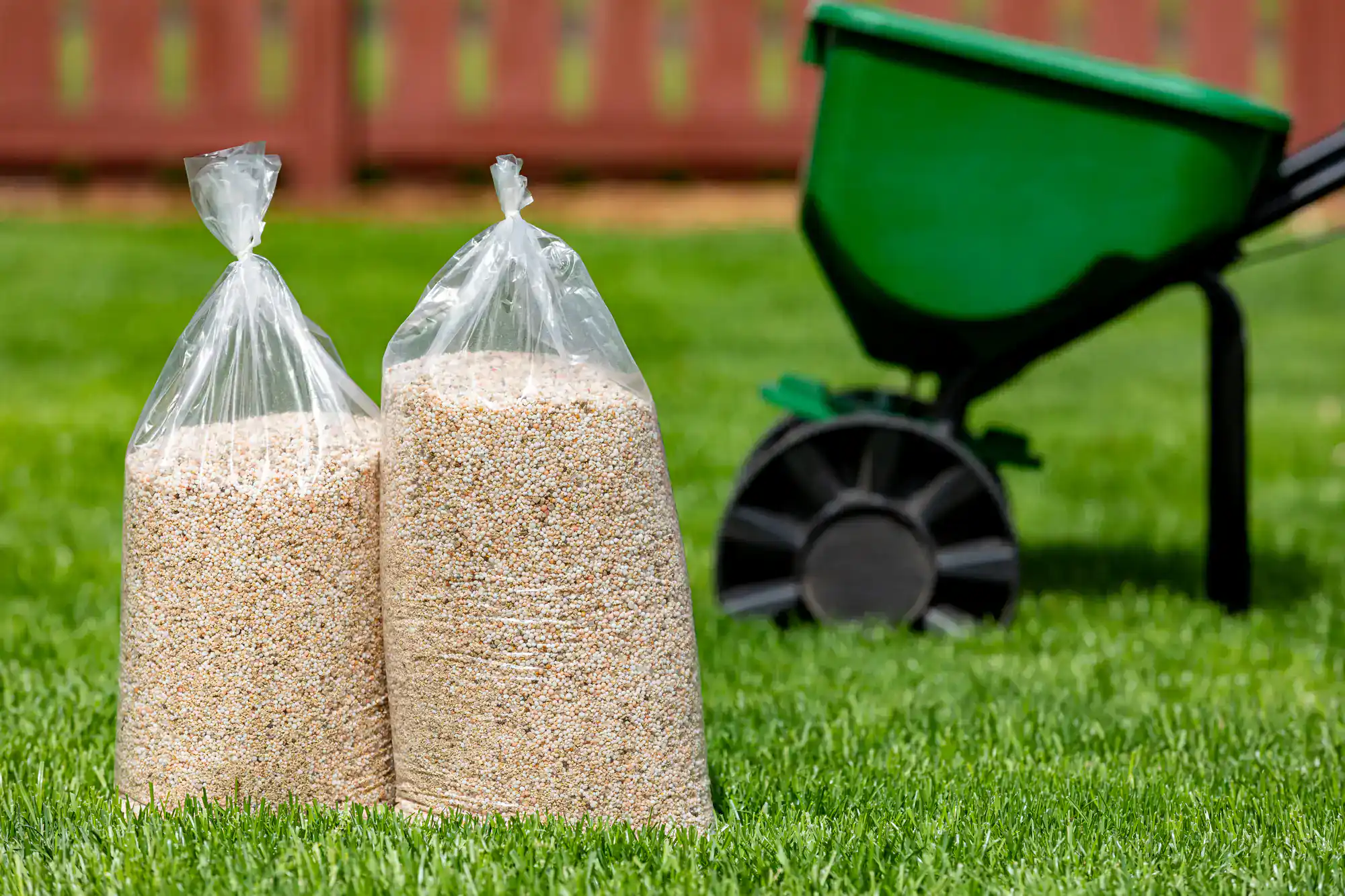
The short answer is early spring and fall but the timing within those windows matters more than most people think. In Coram, soil temperatures don’t reliably hit 55°F until around mid-April, which is when crabgrass starts germinating and when the first fertilizer application of the season makes sense. Apply too early and the product moves through the sandy Haven Loam soil before the grass roots are active enough to absorb it. Apply too late in the spring and you’ve already lost the pre-emergent window for crabgrass control.
Fall is actually the most important season for cool-season turf on Long Island. The window from late August through early October is when your lawn builds the root reserves it needs to survive winter and recover in the spring. Suffolk County’s own guidance recommends early September as the optimal timing for fall fertilization in this area. One hard rule to know: it’s illegal to apply fertilizer in Suffolk County between November 1st and April 1st violations carry a $1,000 fine. Any company that offers to fertilize your Coram lawn in February is either uninformed or not operating within the law.
Most fertilizers sold at hardware stores are formulated for a broad, national market they’re designed to work reasonably well across a wide range of soil types and climates. That’s fine if your lawn sits on average soil. But Coram’s lawns sit on Haven Loam, a sandy, fast-draining soil that leaches nutrients quickly. A standard granular fertilizer applied on a generic schedule will lose a significant portion of its nutrient load to drainage before the root zone can absorb it especially after a heavy spring rain or a summer thunderstorm.
We use a custom-blended fertilizer made specifically for us by a manufacturer it’s not sourced from a distributor’s standard catalog. The formula is calibrated to the nutrient demands and drainage characteristics of Long Island’s sandy, slightly acidic soils. That means more of what gets applied actually reaches the root zone and does what it’s supposed to do. It’s also why lawns on our program tend to hold their color and density through the summer heat in a way that lawns on generic programs often don’t. The product is built for this soil, not soil in general.
Yes and it’s worth understanding what that actually means before you hire anyone. In New York State, any company applying pesticides for hire must be registered with the NYSDEC, and must employ at least one certified commercial pesticide applicator. Getting that certification requires passing both a Core Standards exam and a category-specific exam for ornamental and turf applications. Recertification requires 24 continuing education hours every three years. It’s not a simple business license it’s a credential that tests actual knowledge of product chemistry, application safety, and environmental regulations.
This matters in Coram specifically because the sandy soils throughout central Suffolk County drain quickly into the Long Island aquifer the same groundwater that supplies drinking water to households across the area. An unlicensed applicator using the wrong product, wrong rate, or wrong timing doesn’t just risk damaging your lawn. They risk putting contaminants into a water supply that the whole community depends on. Suffolk County also maintains pesticide-free zones around public drinking water wells, and licensed applicators are required to check those locations before treating nearby properties. We send licensed professionals to every job not supervised seasonal workers, not labor-only crews.
That’s almost certainly nutsedge sometimes called nutgrass and it’s one of the most common and most frustrating lawn problems across central Suffolk County. It looks like grass but grows faster, stands taller, and has a triangular stem if you roll it between your fingers. It thrives in the sandy, occasionally moist soils that are common in Coram, and it spreads through underground tubers that can remain viable in the soil for years. Standard broadleaf weed control products don’t touch it.
Effective nutsedge control requires a licensed applicator using the appropriate selective herbicide at the right time in the plant’s growth cycle typically late spring through early summer when the plant is actively growing but hasn’t yet produced new tubers. One application usually isn’t enough; a follow-up treatment is often needed to address plants that emerge from existing tubers after the first treatment. Bentgrass is another persistent invasive grass weed that shows up regularly in Long Island lawns it colonizes cool-season turf with a fine-bladed, creeping growth pattern that’s visually distinct from the surrounding grass. Both of these require specialized knowledge and licensed products to manage effectively. Most generalist lawn care operators in the Coram area don’t have the specific program to address either one well.
The clearest signs are water pooling on the surface after rain, soil that feels hard underfoot, and grass that thins out in high-traffic areas despite regular fertilization. What’s happening in those cases is compaction the soil particles have been pressed together tightly enough that water, air, and nutrients can’t move through them efficiently. When that happens, fertilizer sits near the surface instead of reaching the root zone, and the grass starves even when you’re feeding it.
In Coram, compaction is a common issue in lawns that have been established for decades and given that the median construction year for homes here is around 1979, a lot of these lawns are 40 to 50 years old. Years of foot traffic, mowing, and freeze-thaw cycles compact the soil over time. Core aeration pulling physical plugs of soil out of the ground creates channels that allow water, air, and fertilizer to penetrate where they need to go. We use hydraulic aerators that pull deeper plugs than the tow-behind units most smaller operators use, which means the relief is real, not cosmetic. If your lawn hasn’t been aerated in the last two or three years, it’s worth doing before the next fertilization cycle otherwise you’re investing in a program that can’t fully deliver.
DIY fertilization works for some homeowners but it has a real failure rate that’s worth understanding before you commit to it. The most common outcomes are burning the lawn from over-application, missing the pre-emergent window for crabgrass because the timing was off, or applying a product that isn’t suited to Coram’s sandy soil and seeing little to no improvement after two or three treatments. Big-box fertilizers aren’t formulated for Haven Loam. The timing guidance on the bag is written for average conditions, not for the specific seasonal calendar that governs cool-season turf in central Suffolk County.
There’s also the licensing piece. Certain products including the selective herbicides needed for nutsedge and bentgrass, and the grub control products that protect against Japanese beetle larvae damage require a commercial pesticide applicator license to purchase and apply. A homeowner can’t legally use those products, which means DIY programs have a ceiling on what they can actually fix. For a home with a median value approaching $490,000, the cost of a professional program that actually works is a straightforward investment in protecting that asset. Coram homeowners who commute out of the hamlet for work each day also don’t have the time to monitor soil temperatures, track application windows, and adjust the program when conditions change. That’s what we handle so you don’t have to think about it.
Useful Links
Other Services we provide in Coram