
Hear from Our Customers
Brown patches that keep coming back every summer aren’t a watering problem or a seed problem. They’re a disease problem and until the pathogen is identified and treated correctly, no amount of reseeding fixes it. Once the right fungicide reaches the right target, the lawn stops declining and starts recovering. That’s the outcome. Not managed symptoms. Actual recovery.
For Mount Sinai homeowners, that recovery matters more than it might somewhere inland. You’re dealing with a coastal microclimate that sustains fungal pressure longer than most of Suffolk County. The marine air off Mount Sinai Harbor keeps nighttime humidity elevated through the heart of summer exactly the condition that lets brown patch spread fast on established lawns in neighborhoods like Woodhull Manor, The Orchards, and Island Estates. Treating the disease correctly means understanding that environment, not just applying a generic program.
The other thing that changes when you get real fungicide treatment: you stop wasting money. Homeowners in Mount Sinai spend hundreds every fall reseeding the same bare patches, not realizing that active fungal disease destroys new seed before it can take hold. Fix the disease first, and your lawn investment actually sticks.
We’re based out of Port Jefferson Station, roughly two to three miles from Mount Sinai via Route 25A. We hold a New York State DEC commercial pesticide applicator license which means we’ve passed state examinations, meet continuing education requirements, and are legally authorized to purchase and apply restricted-use fungicide formulations that aren’t available at any hardware store. That’s not a small distinction. It’s the difference between professional chemistry applied at calibrated rates and whatever’s on the shelf at a garden center.
We work on North Shore lawns specifically. We know how the Long Island Sound’s thermal influence extends the disease window in Mount Sinai compared to inland communities. We know what brown patch looks like in the sandy-loamy soils around Cedar Beach versus what dollar spot looks like on a dry upland lot off County Road 83. That local knowledge is built into every diagnosis we make and every treatment we apply.
The first thing we do is identify what’s actually wrong. Brown patch, dollar spot, and red thread are the three most common fungal diseases on Long Island’s coastal lawns and they look similar enough that homeowners confuse them regularly, but they respond to different fungicide chemistries. Treating dollar spot with a brown patch product doesn’t work. Treating red thread without addressing nitrogen deficiency means it comes right back. Getting the diagnosis right is the entire foundation of effective treatment.
Once we’ve identified the disease, we match the chemistry to the pathogen. As a licensed applicator, we have access to professional-grade fungicide formulations systemic products with active ingredients like azoxystrobin and propiconazole that penetrate the plant tissue and address the disease at the source rather than just coating the surface. We also rotate chemistries across applications to prevent resistance from developing, which is one of the main reasons generic spray programs stop working after a season or two.
Timing is the third piece. In Mount Sinai, the brown patch window runs June through August, driven by the Sound’s influence on overnight temperatures and humidity. Dollar spot pressure builds during dry spells when the sandy-loamy soils dry out and stress the turf. Red thread shows up in spring and fall, when temperatures are cooler and nitrogen is low. We schedule applications around those windows preventatively when possible, curatively when the disease is already active. After every visit, you receive full documentation of what was applied, at what rate, and when a legal requirement for licensed applicators in New York State.
Ready to get started?
Brown patch is the most aggressive disease on Mount Sinai lawns during summer. It spreads rapidly when nighttime temperatures stay above 70°F and humidity stays high both of which describe the coastal microclimate around Mount Sinai Harbor for weeks at a time between June and August. Properties near Cedar Beach and along Shore Road face the most sustained exposure. Our brown patch fungicide applications use systemic chemistry that stops active spread and protects the surrounding turf from infection.
Dollar spot tends to hit the upland areas of Mount Sinai harder the well-draining, sandy-loamy soils that dry out quickly during dry stretches, stressing the grass and creating ideal conditions for the disease to take hold. It shows up as small, silver-dollar-sized dead spots that expand if left untreated. Our dollar spot treatment addresses both the active disease and the underlying turf stress conditions that made the lawn vulnerable.
Red thread is a cool-season disease that peaks in spring and fall when temperatures are between 60 and 75 degrees and nitrogen levels are low. Mount Sinai’s maritime climate extends that temperature window on both ends of the season, which means red thread has more time to spread here than it does just a few miles inland. Our red thread fungicide applications are timed to those shoulder seasons and paired with agronomic recommendations that address the nitrogen deficiency driving the problem. Every service includes NYS-compliant neighbor notification and written application records because that’s what a licensed applicator is required to provide, and what you deserve to have on file.
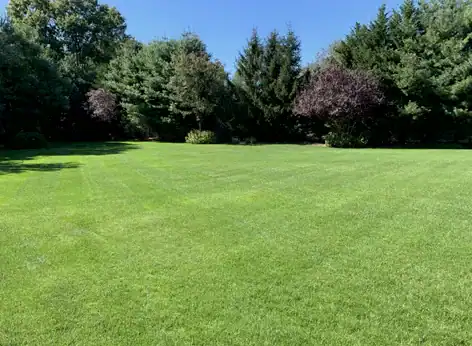
If brown patch shows up in the same areas of your lawn every July or August, you’re dealing with a recurring fungal disease not a watering issue, not a soil problem by itself, and not bad luck. Brown patch is caused by Rhizoctonia solani, a pathogen that survives in the soil and thatch layer through the winter and reactivates when conditions are right: nighttime temperatures above 70°F combined with sustained humidity. In Mount Sinai, those conditions arrive reliably every summer and last longer than they do in inland communities, because the Long Island Sound keeps overnight temperatures elevated and marine air off Mount Sinai Harbor keeps humidity high even when it hasn’t rained.
The reason it keeps coming back is usually that previous treatments were either the wrong product, applied too late, or applied without addressing the thatch layer and soil conditions that allow the pathogen to overwinter. A licensed fungicide application using the right systemic chemistry, timed to the disease window, breaks that cycle. It doesn’t just suppress what’s visible it reduces the pathogen load in the turf so the disease has less to work with the following season.
Dollar spot shows up as small, roughly circular dead patches usually two to four inches across that have a bleached or straw-colored appearance. In the early morning when there’s dew on the grass, you may see white, cottony mycelium threads across the affected areas. Individual spots can merge into larger irregular patches if the disease goes untreated, which is when homeowners often mistake it for brown patch or drought stress.
On Mount Sinai lawns, dollar spot tends to appear during dry stretches in late spring through early fall, particularly on the upland portions of the hamlet where the sandy-loamy soils drain quickly and turf dries out between rain events. Drought-stressed, nitrogen-deficient turf is highly susceptible. If your lawn has been looking thin and pale before the spots appear, that’s a sign the grass was already under stress and the disease exploited it. Correct diagnosis matters here because the treatment approach for dollar spot both the fungicide chemistry and the cultural corrections differs from what you’d use for brown patch or red thread.
Yes, and the reason is specific to Mount Sinai’s geography. The Long Island Sound acts as a thermal buffer it holds heat from the summer and releases it slowly, which keeps North Shore temperatures elevated longer into the night than you’d see just a few miles south toward the LIE corridor. Mount Sinai Harbor amplifies this effect locally. The result is that the nighttime temperature and humidity conditions required to activate and sustain brown patch above 70°F with high relative humidity are met more consistently and for longer periods in Mount Sinai than in communities like Coram or Selden just a few miles inland.
This doesn’t mean every lawn near the water will get brown patch, but it does mean the risk window is longer and the disease spreads faster when it does appear. Properties in the northern half of Mount Sinai, particularly near Cedar Beach and Shore Road, are the most exposed. If you’ve noticed that your lawn seems to struggle more than a neighbor’s a few miles south, the coastal microclimate is likely a contributing factor and it’s something we account for when designing a treatment program.
You can legally apply fungicides to your own lawn as a homeowner in New York State. What you can’t do is access restricted-use pesticide formulations those are only available to licensed commercial applicators. The products at hardware stores and garden centers are consumer-grade: lower concentrations, limited chemistry options, and no access to the systemic fungicides that professional applicators use. That’s a meaningful difference in effectiveness, not a minor one.
Beyond product access, there’s the question of diagnosis and application accuracy. Applying the wrong fungicide or the right one at the wrong rate or timing doesn’t just fail to work. It can accelerate fungicide resistance, meaning the next application of that chemistry will be even less effective. For Mount Sinai homeowners dealing with recurring disease pressure from the coastal environment, that resistance buildup can turn a manageable problem into a persistent one. A NYS DEC-licensed applicator brings the right chemistry, the right diagnosis, and the legal accountability that comes with state licensure including documented application records after every visit.
It depends on whether you’re treating an active disease or running a preventative program and those are two different conversations. For an active case of brown patch or dollar spot, a single curative application can stop the spread, but the turf that was already killed won’t recover on its own. You’ll typically see the disease stop progressing within seven to fourteen days of a correctly targeted application, and then the lawn needs time and appropriate conditions to fill back in.
For lawns with a history of recurring disease which describes a lot of established properties in Mount Sinai, particularly those on larger lots with mature turf and thatch accumulation a preventative program makes more sense. That means timed applications before the disease pressure peaks, rather than waiting until symptoms are visible. In Mount Sinai, that generally means getting ahead of brown patch in late spring before the coastal humidity builds, and addressing red thread in the shoulder seasons. Two to four applications per year, spaced and timed correctly, is typically what a preventative program looks like for a North Shore lawn with known disease history.
This is a fair question, and it’s one that comes up often for homeowners near Mount Sinai Harbor and Cedar Beach. Mount Sinai Harbor is a recognized marine sanctuary and one of the few large, relatively undeveloped embayments remaining on the North Shore residents here are rightly attentive to what goes into the environment around it.
Licensed commercial applicators in New York State are required to follow NYS DEC protocols for product selection, application rates, and buffer zones near sensitive areas. That includes using fungicide formulations and rates that are appropriate for residential turf adjacent to ecologically sensitive zones. Unlicensed operators aren’t subject to those same requirements which is one of the real risks of hiring someone without verifiable credentials in a community like Mount Sinai. When we treat a lawn near the harbor, every product used is documented, every rate is calibrated, and every application follows the legal and environmental standards that state licensure requires. You receive that documentation after every visit, so you have a record of exactly what was applied and how.
Useful Links
Other Services we provide in Mount Sinai